
Doktorskaya Kolbasa
Also known as Докторская колбаса, Doctor's Sausage, Daktariška dešra
Former Soviet Union, Russia
Overview
Doktorskaya Kolbasa is the pale, fine-textured cooked sausage known in English as Doctor's Sausage. Developed in the Soviet Union as a mild, easily eaten meat product, it became one of the most recognisable foods of Soviet and post-Soviet everyday life. The classic profile is deliberately gentle: beef and pork emulsified with egg, milk, salt, a little sugar and restrained nutmeg or cardamom, without smoke or coarse fat pieces.
Where it's from
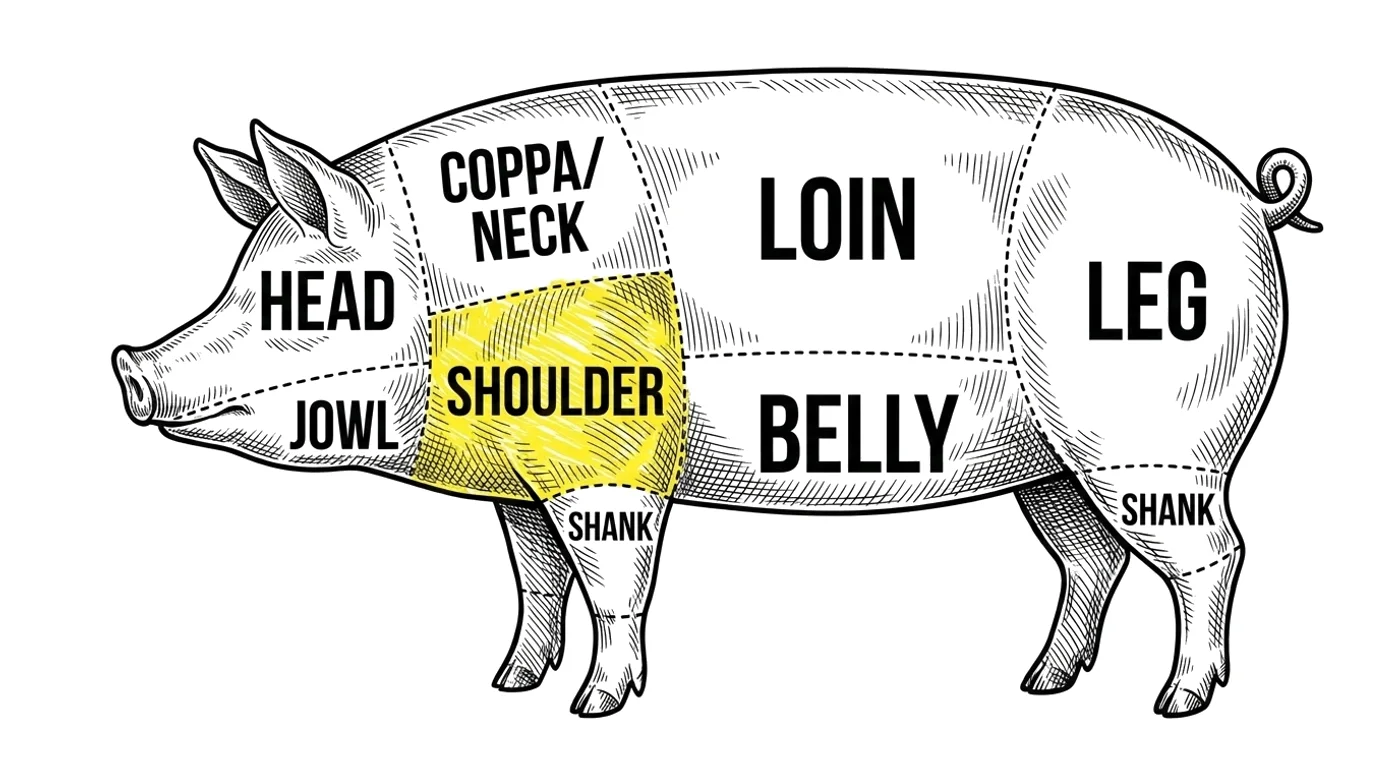
The cut
Identity and terminology
Doktorskaya is the feminine form of doctor in Russian and modifies kolbasa, sausage. The name refers to the product's original dietary positioning rather than a modern medical claim. Daktariška is a Lithuanian adaptation found in Baltic use, while Doktorskaya is the correct Russian canonical form. Current Eurasian rules restrict imitation of standardised meat-product names, so a commercial home-style product cannot assume entitlement to the name merely because its seasoning is similar.
Composition and characteristics
Classic formulations use high-quality beef and semi-fat pork, with egg and milk contributing protein, tenderness and the characteristic soft bite. The batter is very finely comminuted, uniformly pale pink and free from visible fat cubes. Sugar is slight and the spice level is low. Later state standards and industrial practice changed permitted ingredients and performance criteria, which is why historical, Soviet GOST and modern retail versions should not be presented as one immutable recipe.
Production and process
Cold beef and pork are finely ground, mixed with salt and nitrite cure, then emulsified with ice, pasteurised egg and milk. Temperature control prevents fat separation and a grainy slice. The batter is stuffed into a broad casing and gently cooked until the centre reaches 71°C, followed by rapid chilling. Traditional Doktorskaya is unsmoked; smoking after cooking belongs to a different product logic and increases the need for surface-hygiene control.
History and regional forms
Professional literature shows that the name was in use by the early 1930s, while the standardised Soviet form became closely associated with the industrial expansion of Moscow meat processing in the 1930s. It later served as both an everyday food and a symbol of state quality, scarcity and nostalgia. Anthropological research on Soviet-branded sausages shows how these foods continued to carry political and emotional meanings after the Soviet system ended.
Use, storage and related products
Doktorskaya is sliced for bread, breakfast, salads and cold platters, and it may be fried or added to simple cooked dishes. It resembles bologna or fine polony in structure but is distinguished by its mild dairy-and-egg formulation and Soviet identity. Egg and milk are allergens. The product is refrigerated and ready to eat after cooking, but sliced surfaces require strict hygiene and short chilled storage.
Recipe and cure
This is not a finished recipe. It is a window into how this meat is traditionally cured. Before you follow any process, run it through one of our curing calculators so the salt, cure and timings are right and safe for your own batch.
Make this — the measured Curesmith version →“Make this” opens the same cure as a measured recipe, scaled to your batch.
- Meat
- Lean pork shoulder
- Cut
- Lean pork shoulder
- Salt (%)
- 2.1
- Curing salt
- Cure #1 as specified in the recipe
- Fermented
- No
- Starter or mould
- None; this product is not fermented
- Smoked
- No
- Maturation
- Refrigerate at 0–4°C; use within 4 days after opening or freeze promptly
- Basis
- per 1,000 g lean pork shoulder
- Style
- fine cured and cooked Soviet-style sausage
Ingredients
- Lean beef topside50% · 500 g
- Lean pork shoulder100% · 1000 g
- Skinless pork belly40% · 400 g
- Pasteurised whole egg3.2% · 60 g
- Whole milk2.1% · 40 g
- Ice water10.5% · 200 g
- Fine salt2.1% · 40 g
- Cure #1, 6.25% sodium nitrite0.24% · 4.5 g
- Sugar0.11% · 2 g
- Ground nutmeg0.03% · 0.6 g
- Ground cardamom0% · 0.4 g
Method
- Trim, weigh and chill all meat, fat and equipment to 0–2°C.
- Grind all meat twice through 3 mm, then fine-process with ice water, egg, milk and seasonings.
- Mix lean meat with salt, Cure #1 and liquid until tacky, then incorporate the remaining meat, fat and seasonings.
- Stuff into 60–80 mm cellulose or fibrous casing, remove air pockets and refrigerate 8–12 hours.
- Fine-process to a smooth pale batter while holding the emulsion below 10°C.
- Traditional Doktorskaya is unsmoked; dry the casing without applying smoke.
Safety. Use pasteurised egg and milk, control emulsion temperature, cook the cold point, cool rapidly and declare egg and milk. Do not make medical claims.