
Duck Sausage
Also known as Smoked duck sausage, Duck and pork sausage
Generic
Overview
Duck sausage is an ingredient-defined poultry-sausage family rather than one fixed regional recipe. It may be fresh, smoked and cooked, emulsified, or fermented and dried. Duck brings dark colour and a rich flavour but varies markedly by species, cut and whether skin is included. Many formulas combine it with pork for fat and bind, while others use duck skin and fat to retain a more complete duck identity.
Where it's from
The cut
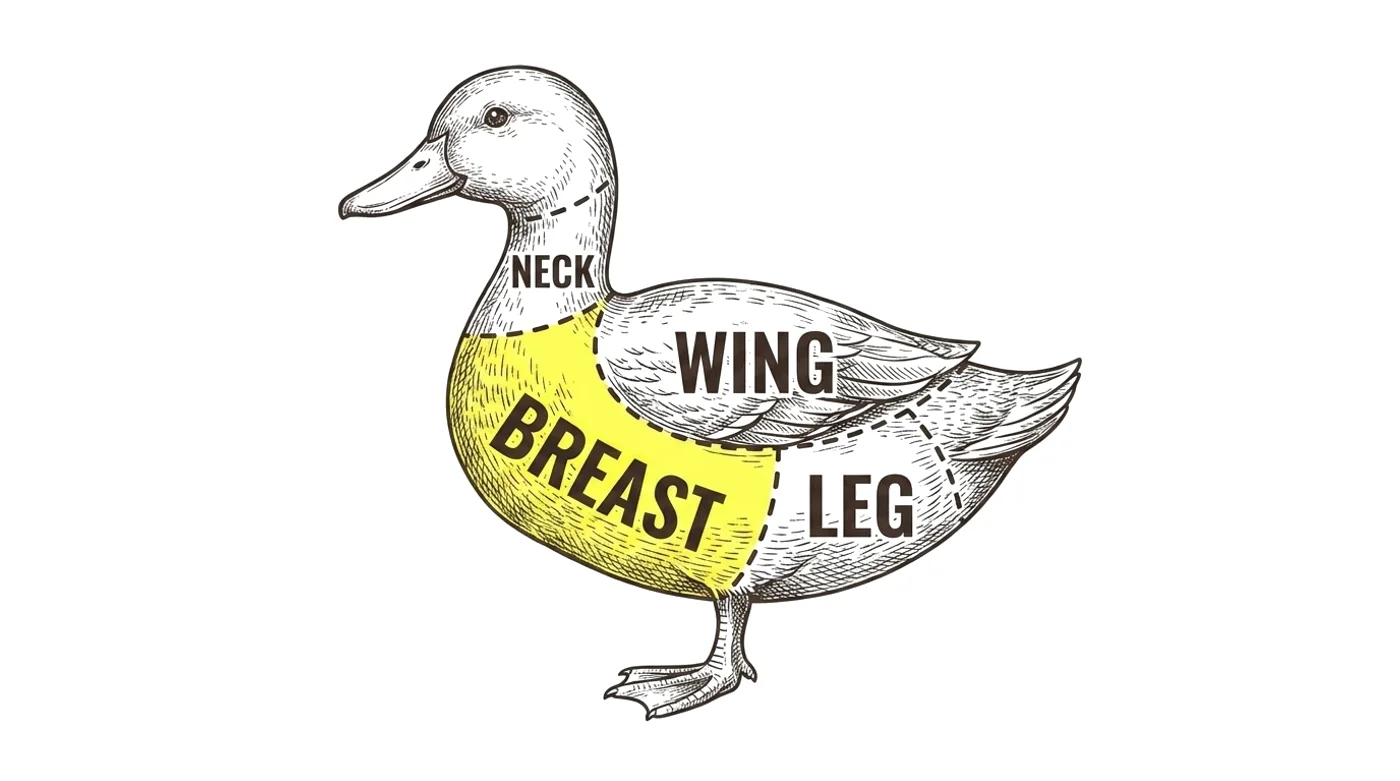
Identity and terminology
The name should describe both species and process. A cooked smoked duck sausage is not interchangeable with a raw fermented duck salami, a Chinese preserved sausage containing duck, or a pork sausage flavoured with duck liver. Substituting chicken or turkey changes flavour, fat composition and labelling. Where duck forms a substantial part of a mixed sausage, the Curesmith process applies the poultry cooking endpoint to the whole product.
Composition and characteristics
Boneless thigh provides flavour and myoglobin, breast gives lean structure, and clean skin with attached fat supplies richness. Duck fat is soft and prone to smearing, so it must be frozen-firm before grinding. Pork shoulder and a smaller beef fraction can strengthen texture. Pepper, allspice, coriander and marjoram suit a Central European-style cooked branch, while garlic, citrus, fruit or Asian aromatics produce entirely different regional expressions.
Production and process
Duck is handled as raw poultry: equipment and ready-to-eat surfaces are separated, the meat remains cold, and the grinder is cleaned thoroughly after use. For a smoked cooked link, the meat and skin are ground separately, mixed to a bind, cured under refrigeration, smoked and poached to 74°C at the cold point. A fermented duck sausage requires a starter culture, measured pH and water activity, not merely a longer hanging time.
History and regional forms
Processed duck products have long histories in several Asian and European food cultures, but duck sausage itself has no single point of origin. Modern meat-science work investigates duck in cooked-smoked sausages because its lean meat can be combined with pork fat, protein ingredients or other binders to improve yield and texture. This technical literature supports a family article rather than a false claim that one mixed-meat formula is universally traditional.
Use, storage and related products
Cooked duck sausage may be served hot with lentils, beans, cabbage or fruit-based condiments, or chilled and sliced. It is related to goose sausage and chicken sausage but has a darker colour and more distinctive fat. The cooked product is not shelf stable and must be chilled. Any dry or fermented branch requires its own validated process and should not inherit the storage claims of a cooked link.
Recipe and cure
This is not a finished recipe. It is a window into how this meat is traditionally cured. Before you follow any process, run it through one of our curing calculators so the salt, cure and timings are right and safe for your own batch.
Make this — the measured Curesmith version →“Make this” opens the same cure as a measured recipe, scaled to your batch.
- Meat
- Boneless duck thigh and breast
- Cut
- Boneless duck thigh and breast
- Salt (%)
- 1.8
- Curing salt
- Cure #1 as specified in the recipe
- Fermented
- No
- Starter or mould
- None; this product is not fermented
- Smoked
- Yes
- Maturation
- Refrigerate at 0–4°C; use within 4 days after opening or freeze promptly
- Basis
- per 1,000 g boneless duck thigh and breast
- Style
- cured, smoked and cooked duck sausage
Ingredients
- Boneless duck thigh and breast100% · 1000 g
- Duck skin and attached fat25% · 250 g
- Pork shoulder90% · 900 g
- Lean beef chuck40% · 400 g
- Ice water9.8% · 250 g
- Fine salt1.8% · 45 g
- Cure #1, 6.25% sodium nitrite0.25% · 6.5 g
- Black pepper0.2% · 5 g
- Ground allspice0.2% · 5 g
- Ground coriander seed0.2% · 5 g
- Dried marjoram0.1% · 2.5 g
Method
- Trim, weigh and chill all meat, fat and equipment to 0–2°C.
- Grind duck and red meats through 5 mm; twice-grind frozen-firm duck skin and fat through 3 mm.
- Mix lean meat with salt, Cure #1 and liquid until tacky, then incorporate the remaining meat, fat and seasonings.
- Stuff into 32–36 mm hog casing, remove air pockets and refrigerate 8–12 hours.
- Dry, then apply hot smoke at 55–65°C before poaching.
- Cook until the cold point reaches 74°C.
Safety. Treat duck as poultry, prevent cross-contamination and use a 74°C cold-point endpoint for the cooked branch. Fermented forms need separate validated hurdles.