
English Ham Sausage
Also known as Ham Sausage-English, English-style ham sausage, English Ham Sausage with Rusk
England, United Kingdom
Overview
English Ham Sausage with Rusk is a source-attributed cooked pork formulation built from finely ground lean leg, fattier pork, hydrated rusk and mild warm spices. It is not a sausage containing slices of finished ham. Instead, the lean leg fraction, cured pink colour and firm cold-slicing texture explain the ham reference. The available evidence does not establish a protected regional recipe or one national standard under this exact title, so it is a technical style rather than a definitive account of all English ham sausage.
Where it's from
The cut
Identity and terminology
Ham sausage has been used internationally for different fine-textured cooked sausages, sometimes with beef, sometimes without cereal and sometimes as a large slicing product. The qualifier English in the source narrows this branch to pork and rusk but does not create legal protection. Current English rules define meat-content requirements for products sold as sausage and related names; they do not turn this formula into a reserved geographical product. It is a separate thing from German Schinkenwurst, from Polish kiełbasa szynkowa and from the American ham-sausage recipes.
Composition and characteristics
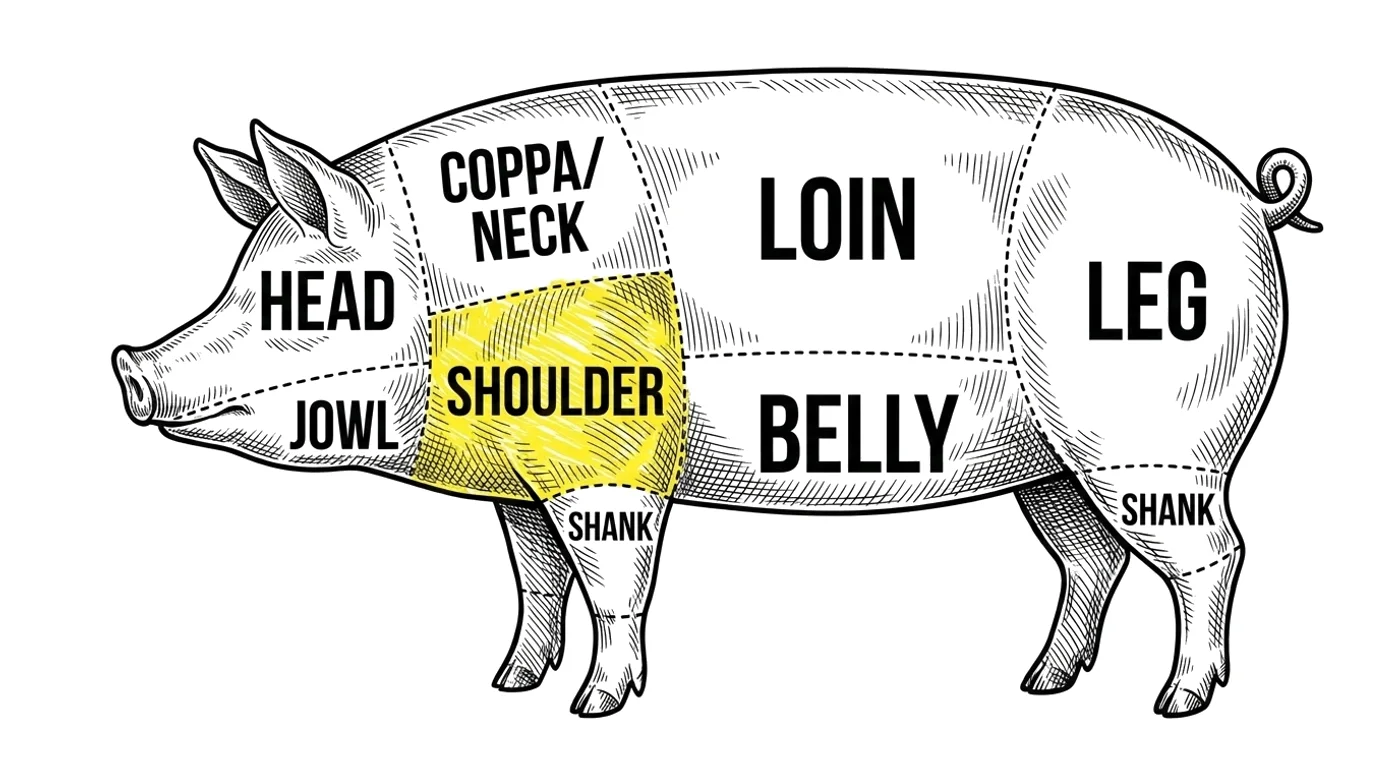
Lean pork leg supplies the prominent cured meat character. Fatty shoulder or jowl provides enough fat for a supple slice, while fine butcher's rusk and water make the product lighter and softer than an all-meat ham sausage. White pepper, mace, ginger and a trace of cayenne create restrained warmth without masking pork. A broad beef middle or fibrous casing gives a luncheon-sausage format. The final cross-section is fine and pink, with no obvious bread particles when the rusk has been hydrated and mixed evenly.
Production and process
Rusk is soaked under refrigeration before chilled meats are ground separately. Salt and precisely calculated Cure #1 are mixed into the lean fraction until tacky, after which hydrated rusk and fatty pork are incorporated. The source dose of 2.5 g Cure #1 is corrected to 1.625 g because the actual meat and fat block is only 650 g. Refrigerated curing replaces a warm colour-development hang. The large casing is surface-dried, smoked gently, poached to 71°C at the cold point and rapidly chilled.
History and regional forms
The style belongs to a wider history of cooked slicing sausages designed to extend expensive lean meat and create a stable, even slice for cold service. Historical English and American-language manuals used ham sausage for materially different formulas, which demonstrates that the term was a category rather than one immutable recipe. Rusk is consistent with British sausage manufacture, but the batch does not claim a town, inventor or protected tradition without evidence. Its historical value lies in showing how cured leg meat, cereal binder and smoke were combined.
Use, storage and related products
Slice the chilled sausage for bread, mustard, pickles and cold platters, or warm thick slices gently with eggs or potatoes. It is not shelf stable and the cut face should be wrapped promptly. Wheat must be declared because rusk is structural, not incidental. The main comparison is Schinkenwurst, which usually follows German guideline conventions and may have a different meat block and casing. Polish ham sausage commonly emphasises larger lean pieces; this English-style branch is finer and deliberately extended with hydrated rusk.
Recipe and cure
This is not a finished recipe. It is a window into how this meat is traditionally cured. Before you follow any process, run it through one of our curing calculators so the salt, cure and timings are right and safe for your own batch.
Make this — the measured Curesmith version →“Make this” opens the same cure as a measured recipe, scaled to your batch.
- Meat
- Lean pork leg
- Cut
- Lean pork leg
- Salt (%)
- 1.8
- Curing salt
- Cure #1 as specified in the recipe
- Fermented
- No
- Starter or mould
- None; this product is not fermented
- Smoked
- Yes
- Maturation
- Refrigerate at 0–4°C; use within 4 days or freeze promptly
- Basis
- per 1,000 g lean pork leg
- Style
- cured smoked and cooked English-style pork sausage with rusk
Ingredients
- Lean pork leg100% · 1000 g
- Fatty pork shoulder or jowl65% · 650 g
- Fine butcher's rusk22.7% · 375 g
- Ice water30.3% · 500 g
- Fine salt1.8% · 30 g
- Cure #1, 6.25% sodium nitrite0.25% · 4 g
- White pepper0.3% · 5 g
- Ground mace0.15% · 2.5 g
- Ground ginger0.08% · 1.5 g
- Cayenne pepper0.05% · 0.8 g
Method
- Combine rusk with the measured ice water and refrigerate until evenly hydrated.
- Grind chilled lean leg through 3 mm and fatty pork through 6 mm.
- Mix lean pork with salt, Cure #1 and spices until tacky, then fold in hydrated rusk and fatty pork.
- Fill the casing firmly, remove air and refrigerate for 8–12 hours.
- Dry the surface, then smoke at 55–60°C for up to two hours.
- Poach in 78–80°C water until the cold point reaches 71°C.
Safety. Calculate Cure #1 against the 650 g animal block, cure cold, declare wheat, probe the centre to 71°C and chill rapidly.