
Overview
English pork pie is a baked savoury pie built around seasoned pork enclosed in a firm pastry case and normally served cold. The family includes hand-raised and moulded forms, cured or uncured fillings and different jelly practices. It is a charcuterie product as much as a pastry, because filling structure, cooking and chilling determine its identity.
Where it's from
The cut
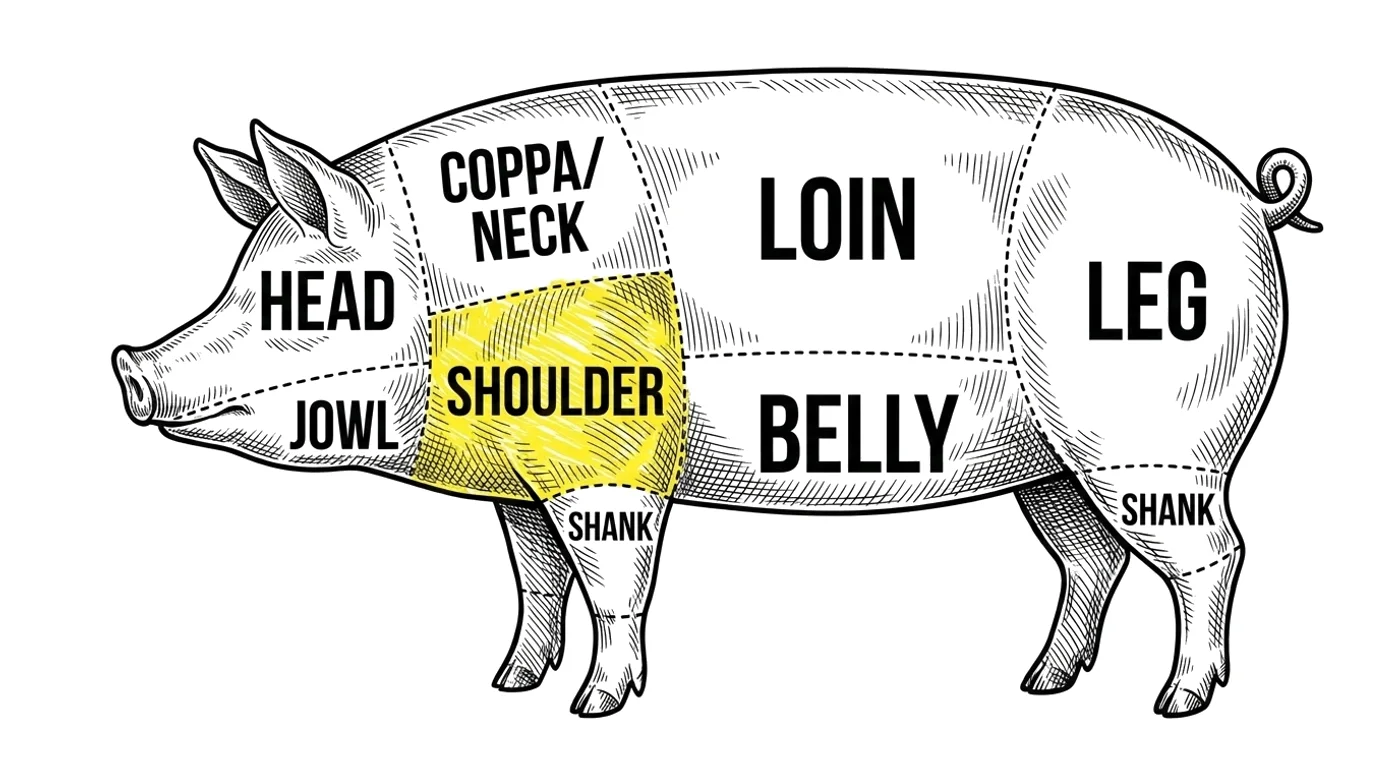
Identity and protected boundary
The generic family must not inherit every feature of Melton Mowbray Pork Pie PGI. The protected child has its own geographical, ingredient, shape and production requirements, including its characteristic bow-walled form and uncured grey pork filling. Other English pork pies may be straight-sided, differently seasoned, cured or manufactured outside the protected area.
Composition and characteristics
The core components are pork filling, hot-water or other sturdy pastry and, in many versions, a savoury jelly added after baking. Meat may be chopped or minced and can include shoulder, belly and other suitable cuts. The finished pie should slice cleanly, with a baked shell, cohesive filling and controlled space for jelly rather than uncontrolled voids.
Production method
Production involves preparing the pastry and filling under chilled control, forming the case, packing the meat without damaging the walls, closing and venting the lid, then baking until the centre reaches 71°C. The pie is cooled promptly. Where jelly is used, it is introduced hygienically after baking and the finished pie remains refrigerated.
History and cultural context
Raised meat pies have long served as portable English food for markets, travel, farming and festive tables. Pork pie became particularly associated with the Midlands, although many regional and commercial styles developed. Protection of the Melton Mowbray name formalised one historic branch without turning it into the definition of every English pork pie.
Culinary use and relationships
Pork pie is usually eaten cold in wedges with mustard, pickles, chutney, cheese or salad, and is common at picnics and buffets. It is related to pâté en croûte and other meat pies but differs in English pastry tradition and filling style. Melton Mowbray is a protected form of it, not another name for it.
Recipe and cure
This is not a finished recipe. It is a window into how this meat is traditionally cured. Before you follow any process, run it through one of our curing calculators so the salt, cure and timings are right and safe for your own batch.
Make this — the measured Curesmith version →“Make this” opens the same cure as a measured recipe, scaled to your batch.
- Meat
- Pork shoulder, diced 8 mm
- Cut
- Pork shoulder, diced 8 mm
- Curing salt
- None
- Fermented
- No
- Smoked
- No
- Basis
- per 1,000 g pork shoulder, diced 8 mm
- Style
- Generic raised hot-water-crust pork pie; not Melton Mowbray Pork Pie PGI.
Ingredients
- Pork shoulder, diced 8 mm100% · 1000 g
- Pork belly, diced 8 mm45% · 450 g
- Fine salt1.5% · 25.5 g
- White pepper0.17% · 3 g
- Ground mace0.06% · 1 g
- Dried sage0.1% · 1.5 g
- Plain flour40.8% · 714.5 g
- Lard30% · 300 g
- Water17.9% · 314.5 g
- Fine salt0.65% · 11.5 g
- Strong pork stock25.7% · 450 g
- Gelatine1.2% · 21.5 g
Safety. The thick filling and pastry create a cold-point challenge. Validate baking at the centre, avoid long warm holding, add jelly under hygienic conditions, cool rapidly and maintain refrigeration. A sealed pastry shell or jelly layer does not make the pie shelf-stable.