
Extrawurst
Also known as Feine Extrawurst, Extrawurst im Kranz, Extrawurst in Stangen
Austria, especially Vienna, Austria
Overview
Extrawurst is one of Austria's best-known Brühwürste, a fine pink sausage made from beef and/or pork, bacon, water, salt, seasoning and usually potato starch. It appears as a broad straight chub for thin slicing and as a curved ring. The texture is smooth and cohesive, with a mild cured-meat flavour suited to sandwiches, cold plates and everyday snacks. Despite the name, which can mean a special favour in Austrian German, the product itself is ordinary in the best sense: familiar, economical and embedded in daily food culture.
Where it's from
The cut
Identity and terminology
Austrian Codex B14 distinguishes Feine Extrawurst, Extrawurst in Stangen and Extrawurst im Kranz by form and quality class. The straight fine product and the ring are therefore related but not compositionally interchangeable labels. The traditional-food register describes older smoked forms and modern products that may be cooked in impermeable synthetic casing without prior smoke. German-speaking markets outside Austria use overlapping terms for Fleischwurst and Lyoner, but those names should not erase the Austrian Codex identity. Extrawurst is not an EU geographical indication.
Composition and characteristics
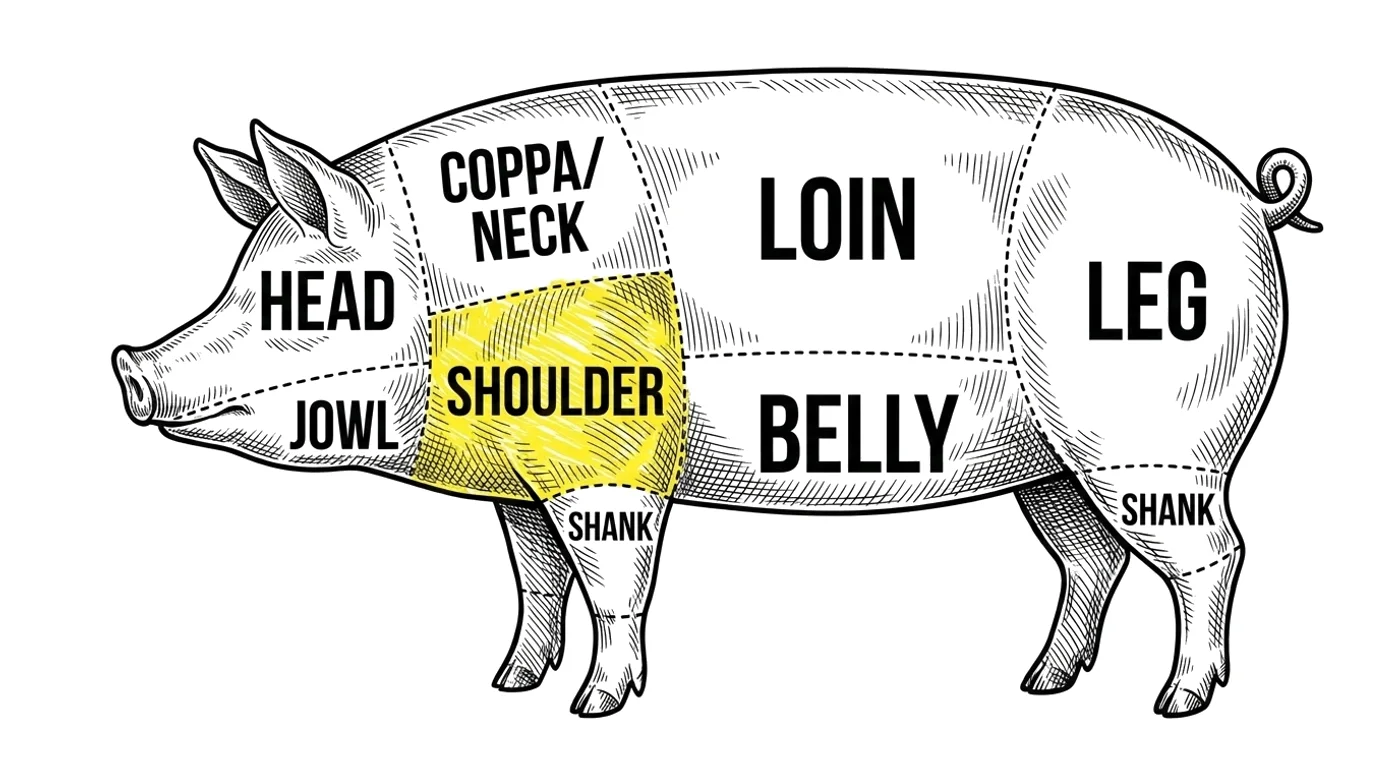
The base is a finely comminuted mixture of lean beef and/or pork with pork bacon or belly and a substantial water phase. Potato starch supports water binding and sliceability. White pepper, nutmeg, mace, paprika, garlic and mustard appear in restrained combinations. A straight chub produces a large uniform slice, while the ring has a smaller curved cross-section. The cooked interior ranges from pale to medium pink, and the casing may show a light smoke colour where smoke-permeable material and a traditional smoke step are used.
Production and process
Cold meat and fat are ground, cured and emulsified with ice water while the batter remains below the temperature at which fat separation becomes likely. Starch and seasoning are added without overworking the emulsion. The batter is stuffed as a ring or straight chub, dried, optionally smoked, then scalded to a measured centre temperature. Rapid chilling sets the emulsion and limits bacterial growth. The Curesmith formula calculates Cure #1 against the actual meat-and-fat block rather than treating the added water as meat.
History and regional forms
The Austrian traditional-food register traces Extrawurst to the early nineteenth century and records it among the sausages known in Vienna by the 1820s and 1830s. Later butcher manuals and the national Codex stabilised distinct product classes while allowing technical changes in casing and smoking. Extrawurst also entered Austrian speech through the idiom eine Extrawurst gebraten bekommen, meaning to receive special treatment. Its culinary identity and linguistic life therefore reinforce one another without turning the name into a protected geographical designation.
Use, storage and related products
Extrawurst is commonly sliced thinly for rolls, open sandwiches and cold platters, paired with mustard, pickles, horseradish or cheese. Thicker slices may be fried, breaded or used in simple salads. It is related to Austrian Knackwurst, Pariser, Lyoner and Fleischwurst, but casing form, composition class and cut face separate the names in the Codex. Once cooked it is ready to eat, yet it remains perishable. Opened chubs and sliced surfaces require clean handling, rapid return to refrigeration and short chilled storage.
Recipe and cure
This is not a finished recipe. It is a window into how this meat is traditionally cured. Before you follow any process, run it through one of our curing calculators so the salt, cure and timings are right and safe for your own batch.
Make this — the measured Curesmith version →“Make this” opens the same cure as a measured recipe, scaled to your batch.
- Meat
- Lean beef chuck or lean pork shoulder
- Cut
- Lean beef chuck or lean pork shoulder
- Salt (%)
- 2.4
- Curing salt
- Cure #1 as specified in the recipe
- Fermented
- No
- Starter or mould
- None; this product is not fermented
- Smoked
- Yes
- Maturation
- Refrigerate at 0–4°C; use within 4 days after opening or freeze promptly
- Basis
- per 1,000 g lean beef chuck or lean pork shoulder
- Style
- fine cured, lightly smoked and scalded Austrian sausage
Ingredients
- Lean beef chuck or lean pork shoulder100% · 1000 g
- Skinless pork belly and firm back fat50% · 500 g
- Ice water47.4% · 711 g
- Fine salt2.4% · 35.5 g
- Cure #1, 6.25% sodium nitrite0.23% · 3.5 g
- Potato starch1.5% · 22 g
- White pepper0.15% · 2 g
- Ground nutmeg0.07% · 1 g
- Ground mace0.07% · 1 g
- Sweet paprika0.15% · 2 g
- Ground mustard seed0.07% · 1 g
- Fresh garlic, crushed0.45% · 6.5 g
Method
- Trim, weigh and chill all meat, fat and equipment to 0–2°C.
- Grind meat and fat through 5 mm, then fine-process with ice water.
- Mix lean meat with salt and liquid to a tacky bind, then add fat, binder and seasonings in the stated order.
- Fine-process in stages, keeping the batter below 10°C, then fold in the potato starch.
- Stuff into 55–60 mm smoke-permeable fibrous casing, remove air pockets and close securely.
- Dry the casing, then apply light smoke at 55–60°C for 45–60 minutes.
Safety. Control batter temperature, cure dose, centre temperature and rapid cooling. Sliced ready-to-eat product is vulnerable to post-cook contamination and must remain refrigerated.