
Falukorv
Also known as Falu sausage, Fahlu Korf
Dalarna and national Sweden, Sweden
Overview
Falukorv is a large Swedish smoked and heat-treated sausage with a firm brownish-pink slice and a mild to pronounced taste of smoke, seasoning and salt. It is sold in broad curved lengths that are cut into thick rounds for frying, baking or everyday family dishes. The official Traditional Speciality Guaranteed specification defines it as a meat product rather than as a location-bound speciality. Production now occurs throughout Sweden, but the name and historical narrative remain anchored to Falun and the copper-mining region of Dalarna.
Where it's from
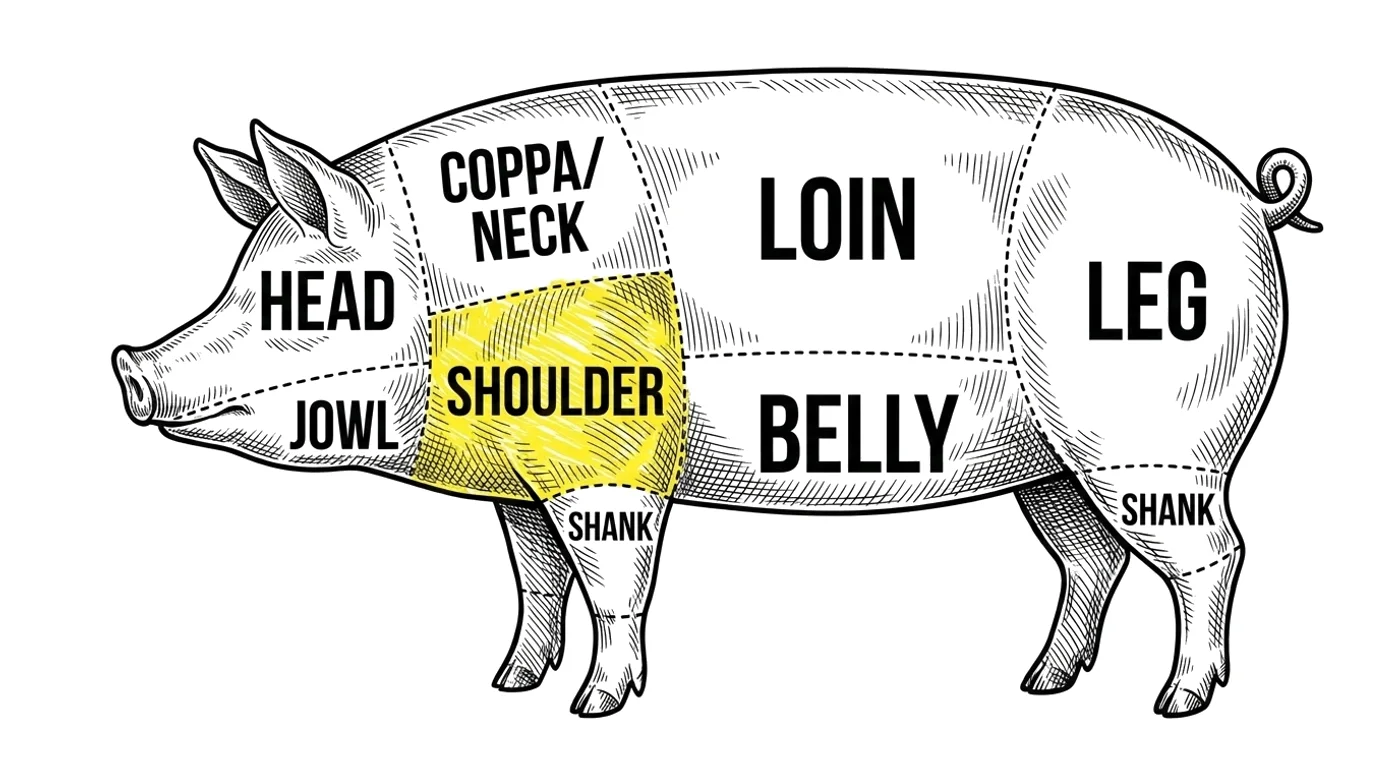
The cut
Identity and terminology
The name joins Falu, the adjectival form of Falun, with korv, sausage. The European registration reserves Falukorv as a TSG and describes the product's traditional composition and method. This differs from a PDO or PGI because the protected character lies in the traditional recipe and process, not in a requirement that all production take place in Falun. Swedish control guidance treats Falukorv as a protected food name, so phrases such as vegetarian Falukorv can be misleading where the product does not satisfy the specification.
Composition and characteristics
The obligatory raw materials are raw or salted beef, horsemeat or pork with rind removed, pork fat, potato flour, water, salt and seasoning. Sugar, dextrose and onion are permitted, while preservative E250 is obligatory. The finished sausage must contain at least 45 g meat per 100 g, no more than 65 g water per 100 g and no more than 23 g fat per 100 g on the specified basis. Potato-flour dry matter is limited. These controls preserve a firm slice rather than a loose, heavily extended batter.
Production and process
The raw materials and additives are emulsified or chopped, packed into smoke-permeable casings at least 45 mm in diameter, smoked and heat-treated to a core temperature of at least 72°C. The sausage is then chilled below 8°C. A Curesmith home adaptation can follow those compositional and process principles, but it cannot self-certify legal compliance. The ring's large diameter makes cold-point probing and rapid cooling essential. Potato flour is the characteristic binder; replacing it with unrelated cereal or protein systems moves the formula away from the registered identity.
History and regional forms
The specification traces Falukorv to seventeenth-century Sweden. Ox hides were used to make hauling ropes for the Falun copper mine, leaving meat that could be preserved as sausage. A newspaper reference from 1834 records smoked sausage from the area being sold in Stockholm as Fahlu Korf. National production rules arrived in 1973, and the protected European registration followed in 2001, with amendments approved in 2012. The history links mining, seasonal meat preservation, urban trade and later national standardisation.
Use, storage and related products
Falukorv is fried in centimetre-thick slices, baked whole with slits filled with onion, mustard, tomato or cheese, or used in stews such as korv stroganoff. Some regions also use thin slices as sandwich filling. Outside Scandinavia it is sometimes compared with ring bologna, but that shortcut does not convey the TSG composition and Swedish use. The product is ready to eat after manufacture but commonly cooked again for service. Keep it refrigerated, protect opened surfaces and do not treat smoke as a substitute for the required heat treatment.
Recipe and cure
This is not a finished recipe. It is a window into how this meat is traditionally cured. Before you follow any process, run it through one of our curing calculators so the salt, cure and timings are right and safe for your own batch.
Make this — the measured Curesmith version →“Make this” opens the same cure as a measured recipe, scaled to your batch.
- Meat
- Lean pork shoulder
- Cut
- Lean pork shoulder
- Salt (%)
- 2
- Curing salt
- Cure #1 as specified in the recipe
- Fermented
- No
- Starter or mould
- None; this product is not fermented
- Smoked
- Yes
- Maturation
- Refrigerate at 0–4°C; use within 4 days after opening or freeze promptly
- Basis
- per 1,000 g lean pork shoulder
- Style
- fine cured, smoked and heat-treated Swedish ring sausage
Ingredients
- Lean pork shoulder100% · 1000 g
- Lean beef chuck85% · 850 g
- Pork shoulder with connective tissue30% · 300 g
- Pork back fat40% · 400 g
- Potato flour5.6% · 143 g
- Fresh onion, minced5.6% · 143 g
- Ice water22.4% · 571.5 g
- Fine salt2% · 51.5 g
- Cure #1, 6.25% sodium nitrite0.24% · 6 g
- Black pepper0.22% · 5.5 g
- Ground coriander seed0.22% · 5.5 g
- Ground nutmeg0.11% · 3 g
Method
- Trim, weigh and chill all meat, fat and equipment to 0–2°C.
- Grind pork and fat through 8–10 mm and beef through 3 mm; fine-process the beef base with ice water.
- Mix lean meat with salt and liquid to a tacky bind, then add fat, binder and seasonings in the stated order.
- Emulsify the beef base first, then incorporate pork, fat, onion and potato flour without warming the batter.
- Stuff into 55 mm smoke-permeable fibrous or natural casing formed as a ring, remove air pockets and close securely.
- Dry the ring and smoke at 55–60°C until evenly coloured and aromatic.
Safety. The TSG requires smoking, a core temperature of at least 72°C and chilling below 8°C. Home production cannot claim certified protected-name conformity without the relevant controls.