
Farinheira
Also known as Portuguese flour sausage, Enchido de farinha
Portugal, with distinct regional forms, Portugal
Overview
Farinheira is a Portuguese enchido built around wheat flour or bread, pork fat, garlic, paprika or pepper paste and smoke. It is usually curved into a horseshoe and has a yellow to orange exterior with a soft, paste-like interior. Unlike chouriço, it may contain little lean meat, and the cereal is not merely a minor binder. Flour is the defining bulk ingredient. The sausage is cooked before eating and often enriches boiled dishes, stews, eggs and rice with smoke, garlic and rendered fat.
Where it's from
The cut
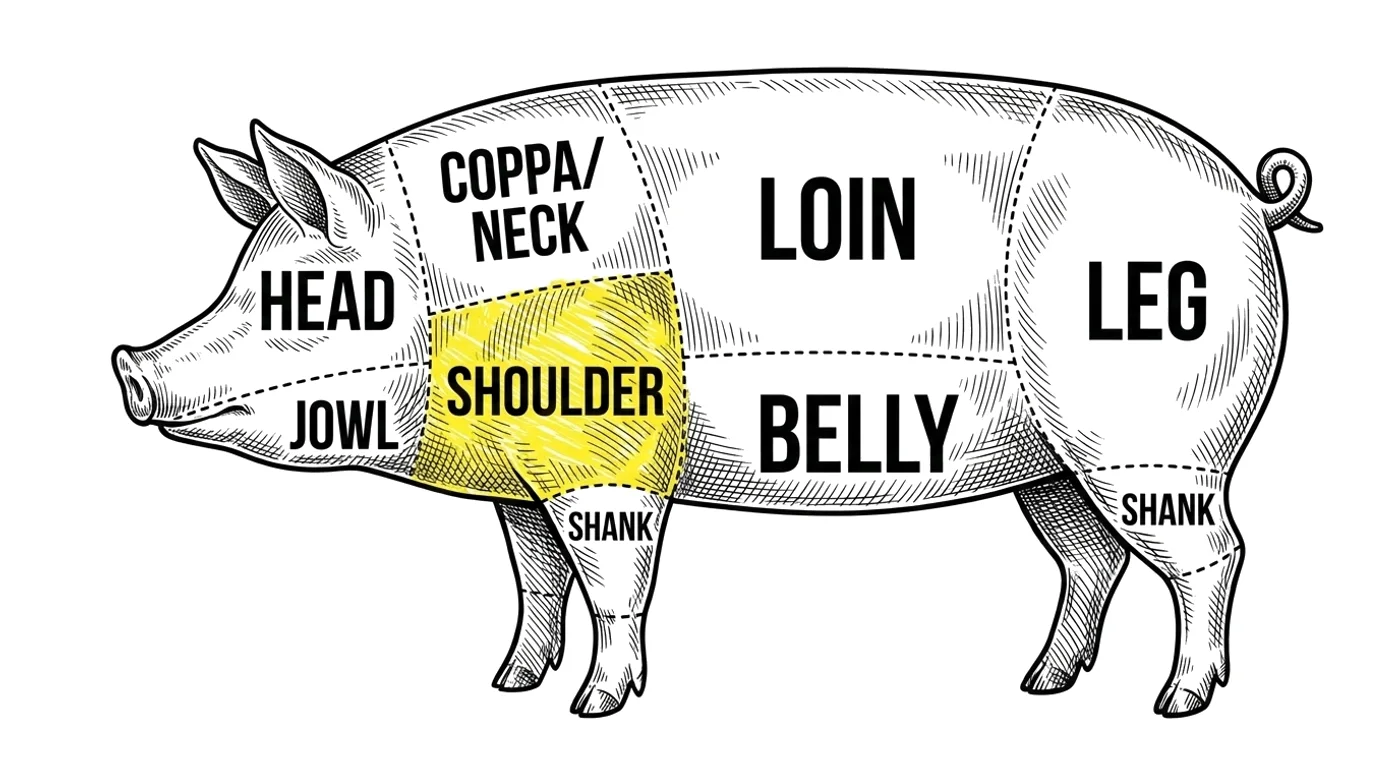
Identity and terminology
The word comes from farinha, flour. It names a broad Portuguese family rather than one immutable formula. Some versions use wheat flour, others bread, maize flour or cooking liquor, and regional products vary in fat, meat, olive oil, pepper paste and casing. Protected Farinheira de Estremoz e Borba PGI is a narrower identity made with Alentejana pork fat, wheat flour, local seasoning and a defined slow-smoking process in specified municipalities. Generic Farinheira must not be presented as that PGI unless its origin and specification are satisfied.
Composition and characteristics
A common form combines soft pork fat with wheat flour, water or stock, garlic, salt and paprika. Wine, bay, nutmeg or pepper may appear. The high starch content absorbs liquid and melted fat, giving a soft but sliceable paste after cooking. Protected Estremoz and Borba examples use roughly forty percent fat to sixty percent flour and have a balanced garlic and smoke character. Other regional records, such as Farinheira Raiana, include bread, bone liquor, meat scraps, olive oil, onion and cinnamon, showing how wide the family can be.
Production and process
Fat is cut or minced, mixed with flour and seasoned liquid, then filled into natural casing as a short horseshoe. Traditional production matures and smokes the raw sausage before it is cooked by the consumer. That sequence needs disciplined temperature, hygiene and process control because the moist uncured filling cannot safely spend several days in a warm improvised smokehouse. The Curesmith home branch dries and smokes under refrigeration, then poaches immediately to a measured centre temperature. It remains a cooked refrigerated adaptation, not a validated room-temperature cured product.
History and regional forms
Farinheira is often linked in popular accounts to Jewish communities in early modern Portugal, where flour-based sausages could resemble pork enchidos during periods of persecution. The historical relationship is plausible as part of a wider story of concealed food practice, but individual regional formulas also reflect practical rural preservation, cereal availability and whole-animal use. Modern Portuguese registers document many local forms. Their differences caution against reducing the entire family to a single origin story or assuming every yellow flour sausage carries geographical protection.
Use, storage and related products
Farinheira is normally poached gently to prevent the casing from bursting, then sliced or crumbled. It appears in cozido, feijoada, scrambled eggs, rice dishes and croquettes, and it can be served with greens or bread. The sausage is related to alheira through cereal and smoke, but alheira usually contains shredded meat and bread in a different structure. Wheat is a major allergen. White wine may introduce sulphites. Keep cooked Farinheira refrigerated, reheat thoroughly and never eat an uncooked home filling.
Recipe and cure
This is not a finished recipe. It is a window into how this meat is traditionally cured. Before you follow any process, run it through one of our curing calculators so the salt, cure and timings are right and safe for your own batch.
Make this — the measured Curesmith version →“Make this” opens the same cure as a measured recipe, scaled to your batch.
- Meat
- Wheat flour
- Cut
- Wheat flour
- Salt (%)
- 4
- Curing salt
- None
- Fermented
- No
- Starter or mould
- None; this product is not fermented
- Smoked
- Yes
- Maturation
- Refrigerate at 0–4°C; use within 4 days after opening or freeze promptly
- Basis
- per 1,000 g wheat flour
- Style
- uncured Portuguese flour-and-pork-fat sausage, smoked cold and fully cooked
Ingredients
- Soft pork back fat, 8 mm dice80% · 800 g
- Wheat flour125% · 1000 g
- White wine13.6% · 109 g
- Chilled water27.3% · 218 g
- Fine salt4.1% · 32.5 g
- Sweet paprika0.91% · 7.5 g
- Fresh garlic, crushed1.6% · 12.5 g
- Black pepper0.23% · 2 g
- Bay leaf, finely ground0.06% · 0.5 g
- Ground nutmeg0.11% · 0.9 g
Method
- Chill and dice the fat; mix the flour and dry seasonings separately.
- Combine fat, flour, wine and enough chilled water to form a cohesive but stuffable paste.
- Stuff 34–36 mm hog casings loosely enough to avoid splitting and form short horseshoes.
- Set the links on racks at 3–5°C for 12 hours so the casing dries.
- Apply two light oak-smoke sessions in a chamber held at 7°C or below, refrigerating at 3–5°C between sessions.
- Poach gently in 78–80°C water until the cold point reaches 71°C.
Safety. The moist cereal-and-fat filling is not safely cold-smoked for days at warm temperatures. Keep smoke exposure refrigerated, cook to a measured endpoint, cool rapidly and declare wheat.