
Finocchiona
fee-no-KYOH-nah
Tuscany (regional), Tuscany, Italy
Aromatic and gently sweet, the fennel unmistakable through soft, well-marbled pork.
Overview
Finocchiona is the fennel-scented salami of Tuscany. Pork and firm fat are seasoned with fennel seed or flower, pepper, garlic and optional red wine, producing a soft, aromatic slice that is unmistakably different from pepper-led Italian salami.
Where it's from
Climate. Tuscany's hills, historically short of pepper and long on wild fennel.
Altitude. Tuscan hills
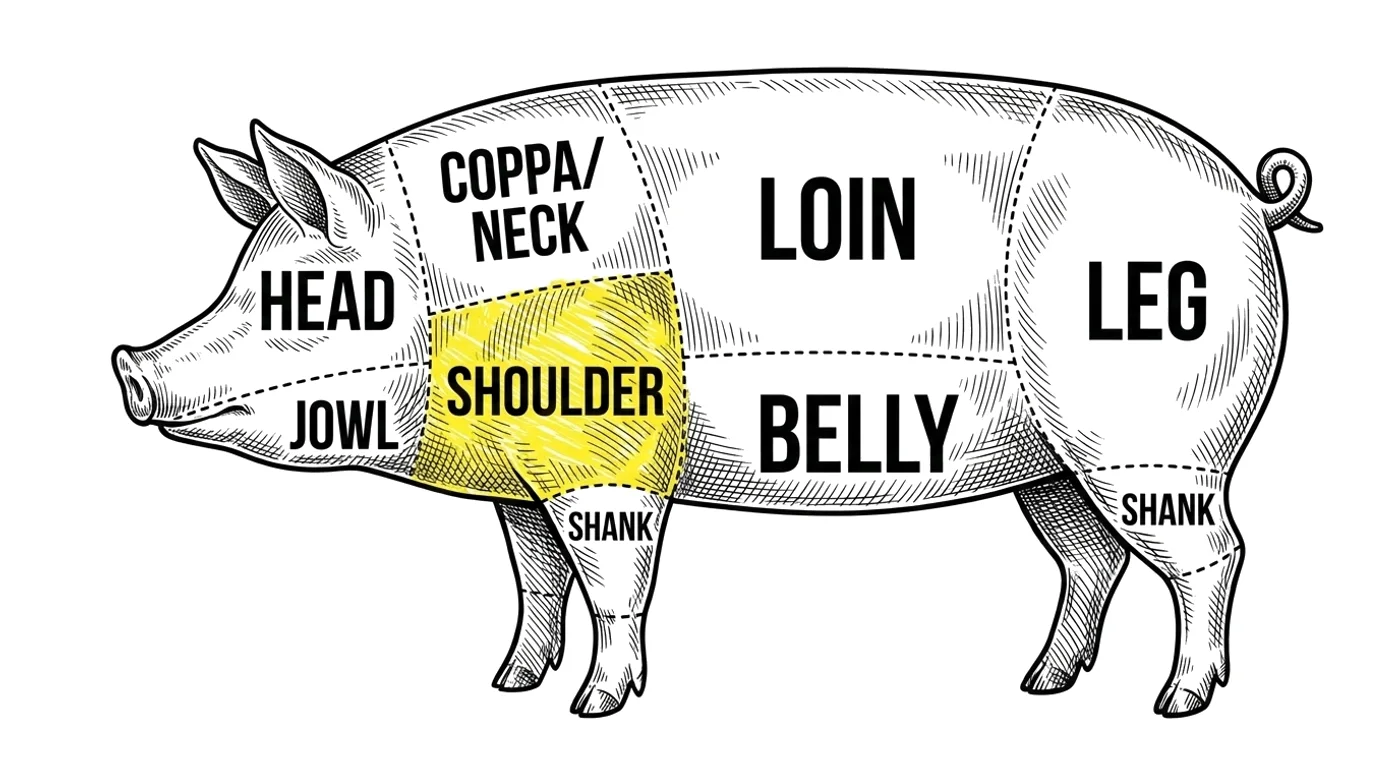
The cut
How to recognise it
Finocchiona is cylindrical and often broad, with a natural casing and pale white surface bloom. The slice is soft but cohesive, pink-red with distinct white fat. Fennel should rise immediately from the cut surface, supported by pepper and garlic. An overly acidic taste, smeared fat, a hard dry rim, hollow centre or aggressive ammonia is a process defect.
- Shape and size
- Large cylindrical salame, coarse cut
- Lean colour
- Rosy red with visible fat
- Fat and marbling
- White cubes through the lean
- Casing
- Beef middle or protein-lined fibrous casing, 46 to 60 mm
- Surface bloom
- Natural white mould
Origins and history
Tuscan pork curing reaches back to Etruscan and Roman husbandry, when oak and chestnut woodland supported large pig populations. Finocchiona's particular identity developed from wild fennel, an abundant local aromatic that could replace or stretch expensive imported pepper. One popular story claims that a thief hid stolen salami among fennel plants and discovered that the aroma had entered the meat. Another links the verb infinocchiare, to deceive, with innkeepers using fennel to disguise poor wine. These stories are part of Tuscan folklore rather than proven invention accounts, but both show how strongly the sausage is associated with fennel. Farm production became a recognised regional speciality, and European PGI registration in 2015 formalised the Tuscan area and ingredient ranges.
Name. From finocchio, Italian for fennel.
- Production today
- Tuscan producers under the IGP, plus many artisan makers.
- Protection
- IGP; linked to Tuscan tradition and production.
- Tradition vs modern
- Fennel remains the defining seasoning; the sbriciolona style is a softer, crumblier version.
- Seasonality
- Made year-round.
Compare with. Salchichón
Serving and cultural significance
Serve Finocchiona in generous thin slices with unsalted Tuscan bread, schiacciata or ciaccino. Semi-aged pecorino is a natural partner, as are fresh figs and simple red wine. The sausage should be the dominant aromatic element, so avoid heavily spiced accompaniments.
Recipe and cure
This is not a finished recipe. It is a window into how this meat is traditionally cured. Before you follow any process, please run it through one of our curing calculators, so the salt, cure and timings are right and safe for your own batch.
Curesmith home adaptation — not designation-compliant
Make this — the measured Curesmith version →The cure below is the traditional reference. “Make this” opens the measured Curesmith home recipe, scaled to your batch.
Traditional or protected production
PGI production uses traced Italian pork, firm fat, salt, pepper, garlic and defined quantities of fennel seed or flower, with red wine permitted. The mixture is stuffed and matured for a minimum period that increases with size. The protected product is made in Tuscany and retains a relatively soft, fragrant texture rather than being dried into a hard salami.
- Meat
- pork
- Cut
- minced pork and fat
- Salt (%)
- 2.8
- Curing salt
- Not included in the base recipe below
- Other agents
- fennel seeds and flowers, garlic, pepper, sometimes wine
- Fermented
- Yes
- Target pH
- 5.0 to 6.0 under the IGP specification
- Starter or mould
- Natural white surface mould
- Smoked
- No
- Target aW or weight loss
- aw not above 0.945 under the current IGP specification
- Temperature (°C)
- ferment 22 to 24, then dry 13 to 15
- Humidity (%)
- ferment ~90, then 75 to 80
- Maturation
- 4 to 8 weeks and up
- Basis
- per 1000 g green meat
- Style
- Traditional fermented and dried salame
Ingredients
- lean pork (base)100% · 1000 g/kg
- back fat25% · 250 g/kg
- black peppercorns, whole0.4% · 4 g/kg
- white pepper0.2% · 2 g/kg
- fennel seeds0.3% · 3 g/kg
- garlic0.2% · 2 g/kg
- red wine2.5% · 25 g/kg
- dextrose0.2% · 2 g/kg
Method
- Mince pork and fat and mix with all ingredients to green meat weight.
- Stuff into casing.
- Ferment warm until the target pH is reached.
- Dry slowly to the target weight loss.
Notes
- The official protected specification controls the named product. Any Curesmith EQ, starter-culture, curing-salt or home-scale adaptation is a separate method and must not be presented as designation-compliant.
- This traditional recipe uses no nitrite. For safety we recommend adding Cure #2: in a low-oxygen, slow-dried product nitrite is the specific guard against Clostridium botulinum, while salt, acidity and drying control Salmonella, E. coli, Listeria and Staphylococcus.
Safety. Fermented and dry-cured. Hold the ferment to the target pH before drying, and judge readiness by weight loss and water activity.
In the Codex
What this product teaches, and where to read more.
Temple. Roof, Water Activity