
Fleischwurst
Also known as Meat sausage, Ring Fleischwurst, Fleischwurst im Ring
Germany
Overview
Fleischwurst is a German fine scalded sausage sold most recognisably as a broad ring, although straight chubs also occur. Its cured pink interior is smooth, springy and sliceable, with a lightly smoked casing and restrained seasoning. The product belongs to the Brühwurst tradition, in which finely comminuted meat, fat and ice water form a stable brät before stuffing, smoking and cooking. It is eaten cold in slices, warmed in water or cut into salads and simple cooked dishes.
Where it's from
The cut
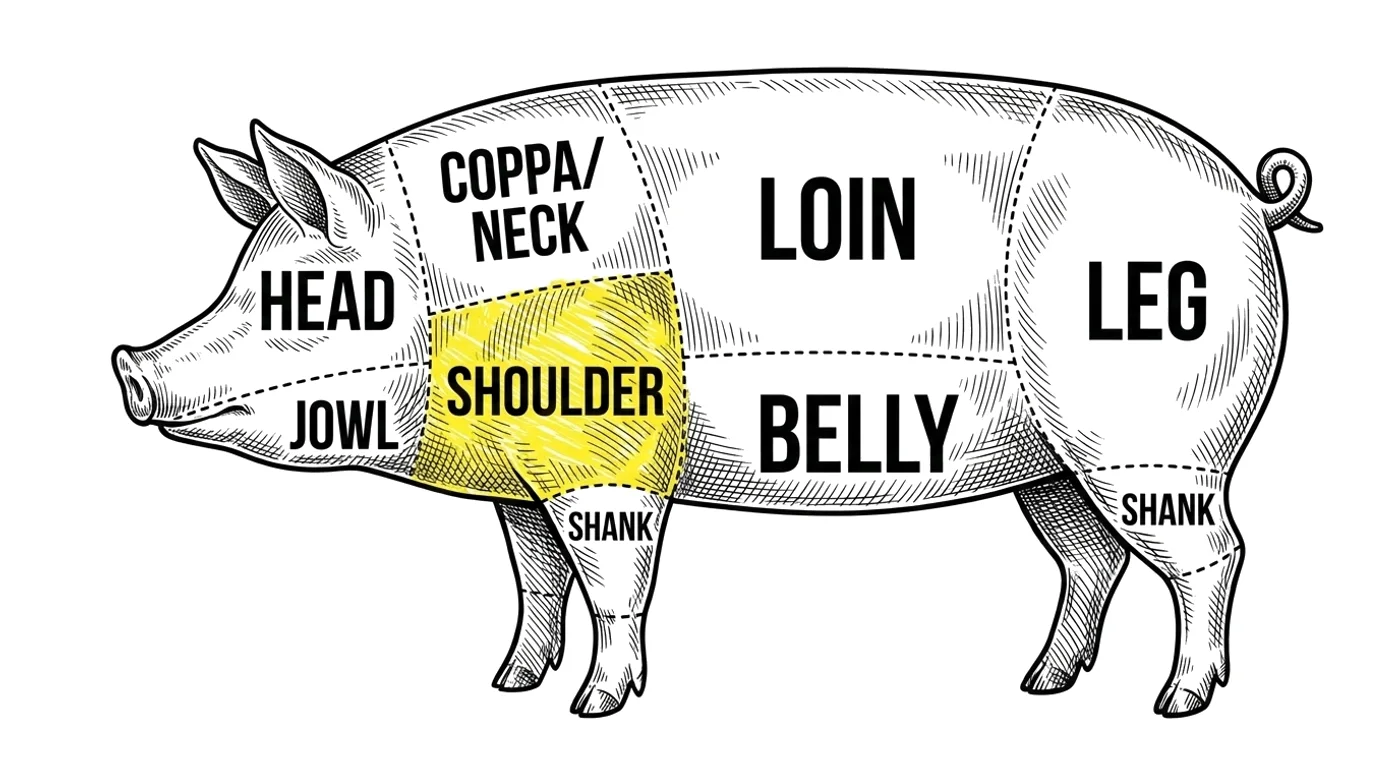
Identity and terminology
The German name means meat sausage, but it is not a catch-all term for every sausage containing meat. Current German guidelines place Fleischwurst in a defined group with Lyoner, Gekochte Salami and several related names. Regional usage overlaps, especially between Fleischwurst and Lyoner, yet the ring form remains a strong retail cue. It should not be confused with coarse Polish kielbasa, raw Mettwurst or Austrian Extrawurst, whose national framework divides straight and ring forms into its own quality classes.
Composition and characteristics
A typical Fleischwurst combines lean pork with beef for bind and colour, firm pork fat for succulence and ice water for the emulsion. White or black pepper, nutmeg, coriander and ginger give a mild warm-spice profile. Garlic may appear in some local or commercial recipes but is not the organising flavour. The cut face should be homogeneous without pockets of liquid or smeared fat. A medium natural or smoke-permeable casing is bent into a ring and develops a light brown surface during smoking.
Production and process
Production begins with very cold lean meat that is chopped with salt, nitrite cure and ice until myofibrillar protein creates a sticky brät. Chilled fat and spices are incorporated without allowing the batter to warm or split. The emulsion is stuffed firmly, dried, lightly smoked and scalded. Home production needs a probe-confirmed cold-point endpoint rather than a time-only water bath. Rapid cooling follows immediately because a cooked ring is still a moist, perishable ready-to-eat product vulnerable to post-cook contamination.
History and regional forms
Fine scalded sausages expanded with urban butcher shops and mechanical bowl cutters during the nineteenth and early twentieth centuries. The name Fleischwurst became especially familiar in western and central Germany, while Lyoner connects the same broad technical family to the older prestige of Lyon sausage. Modern supermarket rings preserve the portable, ready-to-slice form, but recipes differ in beef content, garlic, smoke and calibre. The German guidelines describe customary composition and quality; they do not create a protected geographical indication.
Use, storage and related products
Fleischwurst is sliced for bread rolls, cold platters and Wurstsalat, where strips are mixed with onion, vinegar and oil. Thicker pieces can be warmed gently with mustard, added to stews or pan-fried. Once cooked it is ready to eat, but it is not shelf stable. Keep it at 0–4°C, protect the cut face and use an opened ring promptly. Its fine, mild brät separates it from coarse Jagdwurst, while its larger ring separates it visually from slender Wiener sausages.
Variations
Named formulas within this product rather than separate ones. Quantities are per 1000 g of the meat block.
Lyoner - Fine Pork Scalded Branch
- Lean pork shoulder555.5 g
- Skinless pork jowl or connective shoulder222 g
- Firm pork back fat222 g
- Crushed ice111 g
- Fine salt16 g
- Cure #1, 6.25% sodium nitrite2.5 g
- Ground white pepper2 g
- Ground nutmeg1 g
- Ground ginger0.5 g
- Ground cardamom0.5 g
German Mortadella with Bell Peppers - Fine Scalded Branch
- Lean pork shoulder333.5 g
- Medium-fat pork shoulder333.5 g
- Skinless pork jowl or connective shoulder222 g
- Firm pork back fat111 g
- Crushed ice111 g
- Fine salt18 g
- Cure #1, 6.25% sodium nitrite2.5 g
- Ground white pepper2 g
- Sweet paprika0.6 g
- Ground coriander0.6 g
- Ground mace0.6 g
- Ground cardamom0.3 g
- Ground ginger0.3 g
- Red bell pepper, 8–10 mm dice15.5 g
- Green bell pepper, 8–10 mm dice15.5 g
Mortadella Lyoner - Pork, Beef and Fat Emulsion Branch
- Lean pork shoulder300 g
- Lean beef chuck300 g
- Firm pork back fat and skinless jowl400 g
- Crushed ice150 g
- Fine salt18 g
- Cure #1, 6.25% sodium nitrite2.5 g
- Ground white pepper2 g
- Ground mace0.5 g
- Ground coriander0.5 g
- Ground ginger0.5 g
- Ground cardamom0.5 g
- Sweet paprika1 g
- Onion powder2 g
Norddeutsche Mortadella - Pepper and Pistachio Branch
- Lean pork shoulder333.5 g
- Medium-fat pork shoulder or belly trim333.5 g
- Skinless pork jowl222 g
- Firm pork back fat111 g
- Crushed ice111 g
- Fine salt18 g
- Cure #1, 6.25% sodium nitrite2.5 g
- Ground white pepper2 g
- Sweet paprika0.6 g
- Ground coriander0.6 g
- Ground mace0.6 g
- Ground cardamom0.3 g
- Ground ginger0.3 g
- Red bell pepper, roasted, peeled, dried and diced16.5 g
- Shelled pistachios16.5 g
Pariser Fleischwurst - German Fine Pork Branch
- Lean pork shoulder555.5 g
- Skinless pork jowl222 g
- Firm pork back fat222 g
- Crushed ice111 g
- Fine salt18 g
- Cure #1, 6.25% sodium nitrite2.5 g
- Ground white pepper2 g
- Ground nutmeg1 g
- Ground cinnamon0.3 g
- Ground ginger0.6 g
- Ground cardamom0.6 g
Recipe and cure
This is not a finished recipe. It is a window into how this meat is traditionally cured. Before you follow any process, run it through one of our curing calculators so the salt, cure and timings are right and safe for your own batch.
Make this — the measured Curesmith version →“Make this” opens the same cure as a measured recipe, scaled to your batch.
- Meat
- Lean pork shoulder
- Cut
- Lean pork shoulder
- Salt (%)
- 1.8
- Curing salt
- Cure #1 as specified in the recipe
- Fermented
- No
- Starter or mould
- None; this product is not fermented
- Smoked
- Yes
- Maturation
- Refrigerate at 0–4°C; use within 4 days after opening or freeze promptly
- Basis
- per 1,000 g lean pork shoulder
- Style
- fine cured, smoked and scalded German ring sausage
Ingredients
- Lean pork shoulder100% · 1000 g
- Pork back fat60% · 600 g
- Lean beef chuck with connective tissue20% · 200 g
- Ice water11.1% · 200 g
- Fine salt1.8% · 32 g
- Cure #1, 6.25% sodium nitrite0.25% · 4.5 g
- Black pepper0.22% · 4 g
- Ground nutmeg0.06% · 1 g
- Ground coriander seed0.06% · 1 g
- Ground ginger0.03% · 0.6 g
Method
- Trim, weigh and chill meat, fat, water and equipment to 0–2°C.
- Grind lean meat through 5 mm and fat through 3 mm; partially freeze before fine comminution.
- Fine-process lean meat with salt, cure and ice water to a tacky brät, then incorporate chilled fat and spices.
- Stuff firmly into 40–45 mm smoke-permeable casing formed as a ring, remove air pockets and close securely.
- Dry the ring, then apply light beech smoke at 55–60°C until evenly golden-brown.
- Poach or steam gently until the cold point reaches 71°C.
Safety. Keep the emulsion below 10°C, cook the cold point to 71°C, cool rapidly and prevent post-cook contamination.