
Overview
Frankfurter and Wiener sausages are fine-textured, narrow cooked sausages, usually cured, lightly smoked and scalded or otherwise cooked. They are characterised by a uniform emulsion, a clean snap when natural casing is used and a mild seasoned flavour. The family includes several legally and culturally distinct naming traditions.
Where it's from
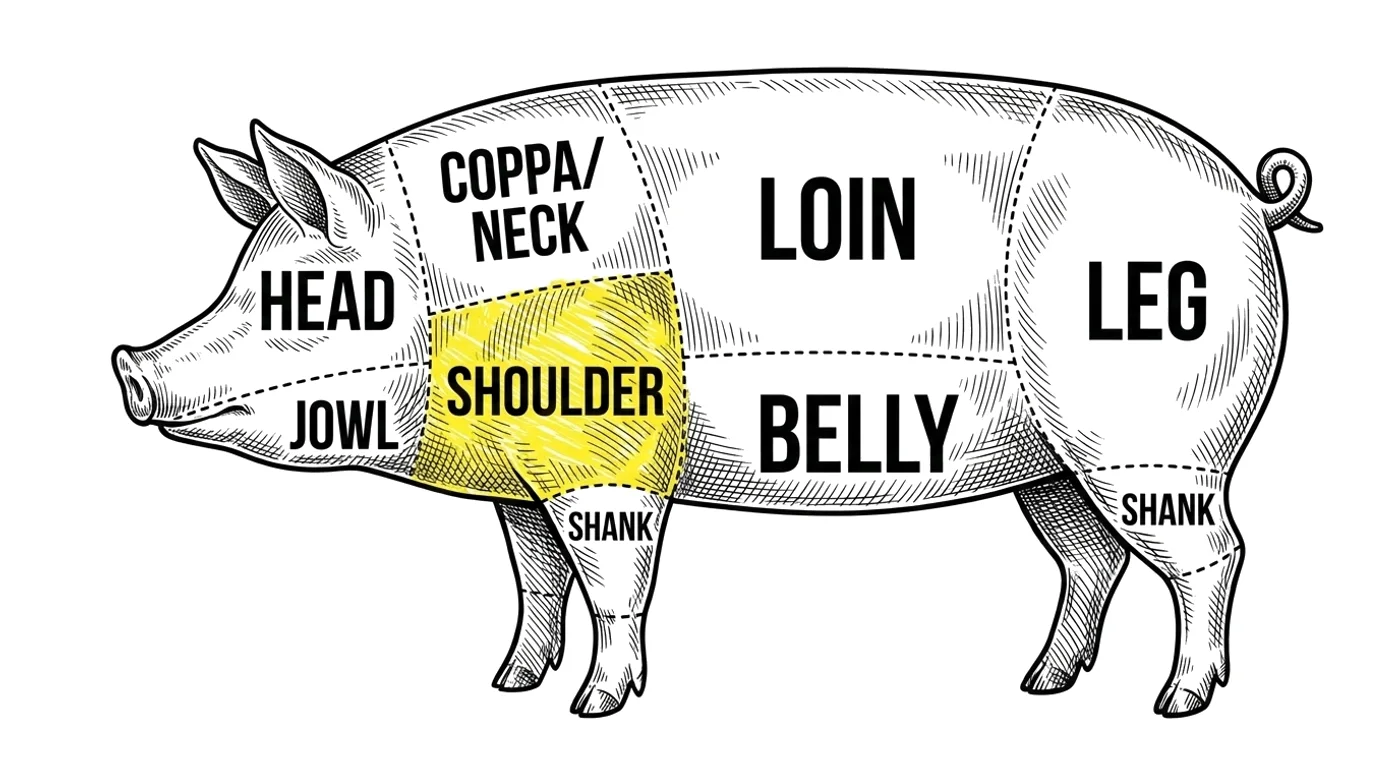
The cut
Identity and terminology
German guidance distinguishes Würstchen nach Frankfurter Art from Wiener or Wiener Würstchen. In the cited German category, Frankfurter-style sausage is pork-based, while Wiener uses beef, pork and bacon. Austrian usage and the history of the Vienna sausage add another naming layer. In the United States, frankfurter, frank, hot dog, wiener and similar names operate within federal cooked-sausage standards. The terms should therefore be explained by jurisdiction rather than presented as perfect synonyms.
Composition and characteristics
The product is made from a finely comminuted meat-and-fat batter with salt, curing salt where used, water or ice and seasonings. The batter should be stable and uniform, without visible fat separation. Traditional small-calibre natural casings provide the characteristic bite; skinless commercial products are peeled after cooking. Species and byproduct declarations depend on the applicable standard.
Production and process
Lean meat and fat are chilled, comminuted and emulsified while the batter temperature is controlled. Salt and cure extract functional proteins; ice or chilled water controls temperature and consistency. The batter is stuffed into narrow casings, linked, smoked where required and cooked until the centre reaches 71°C. Rapid cooling limits microbial growth and preserves texture.
History and regional forms
Frankfurt and Vienna both became associated with fine cooked sausages during the development of professional Central European sausage making. Migration and industrial production carried the form worldwide. North American hot dogs, canned Vienna sausages and regional Würstchen are related but not identical in size, composition, casing or legal identity.
Use, storage and related products
Frankfurters and Wieners are normally reheated rather than aggressively boiled, which can split casings. They are served with mustard, bread, potato dishes or in buns. Products remain refrigerated unless a specific shelf-stable package and process has been validated. Related entries include Hot Dog, Vienna Sausage, Bockwurst and other fine cooked Würstchen.
Recipe and cure
This is not a finished recipe. It is a window into how this meat is traditionally cured. Before you follow any process, run it through one of our curing calculators so the salt, cure and timings are right and safe for your own batch.
Make this — the measured Curesmith version →“Make this” opens the same cure as a measured recipe, scaled to your batch.
- Meat
- Pork shoulder
- Cut
- Pork shoulder
- Salt (%)
- 1.75
- Curing salt
- Cure #1/#2 as specified
- Fermented
- No
- Smoked
- Yes
- Basis
- per 1,000 g pork shoulder
- Style
- Representative emulsified cooked-sausage branch; not a claim of compliance with every Frankfurter or Wiener jurisdiction.
Ingredients
- Pork shoulder100% · 1000 g
- Lean beef45% · 450 g
- Pork back fat35% · 350 g
- Fine salt1.8% · 32 g
- Cure #1 containing 6.25% sodium nitrite0.25% · 4.5 g
- Dextrose0.2% · 3.5 g
- White pepper0.2% · 3.5 g
- Sweet paprika0.15% · 2.5 g
- Ground coriander0.1% · 2 g
- Ground mace0.05% · 0.9 g
- Garlic powder0.1% · 2 g
- Crushed ice15.2% · 272.5 g
Safety. These are cooked sausages, not fresh sausages. The meat batter must remain cold during emulsification, cure and species declarations must be calculated correctly, and the finished sausage requires validated cooking, rapid cooling and refrigerated storage. Smoke is not a substitute for lethality.