
Frankfurter Würstchen
Also known as Frankfurter sausage, Frankfurter, Frankfurter Wurst
Hesse, Germany
Overview
Frankfurter Würstchen is the slender pork sausage associated with Frankfurt am Main. It is finely comminuted, cured, lightly smoked and normally sold in pairs. The link has a taut sheep casing, a delicate snap and a mild savoury interior rather than a coarse meat grain. It is reheated gently in hot water rather than boiled hard, which protects the casing and keeps the brät juicy. Outside Germany, frankfurter often names a much wider class of hot-dog sausages, so place and composition must be stated.
Where it's from
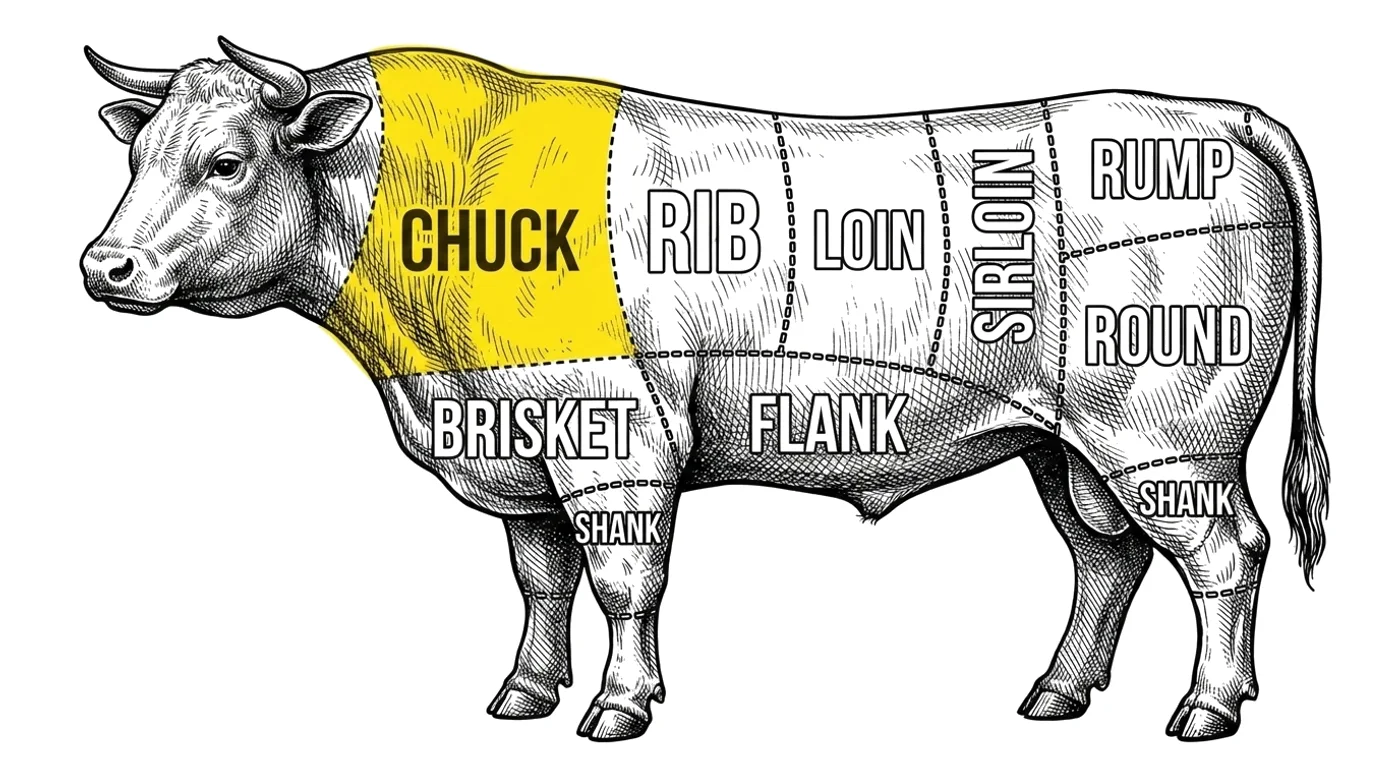
The cut
Identity and terminology
In German usage, Frankfurter Würstchen denotes the Frankfurt product, while Würstchen nach Frankfurter Art means sausage made in the Frankfurt style outside the protected origin. The Hessian government explains that a German Frankfurter comes from Frankfurt and contains pork without beef. Wiener Würstchen is the mixed pork-and-beef relative developed in Vienna. English-language frankfurter and American frank or hot dog broadened the word further, often treating it as a technical product class rather than a claim of Frankfurt origin.
Composition and characteristics
The defining German sausage uses finely comminuted pork and pork fat, nitrite curing salt, restrained pepper and warm spice, and a narrow sheep casing. It is smaller and more delicate than Fleischwurst, with no visible meat pieces. Light smoking colours the casing without giving the heavy smoke of many country sausages. Beef is the decisive boundary: a mixed or all-beef link can be a frankfurter in international or United States usage, but it is not the protected German Frankfurt identity.
Production and process
Cold pork is chopped with salt, cure and ice to form a stable brät, then stuffed into sheep casings as paired links. After controlled casing drying, the sausages receive light smoke and are scalded to a safe centre temperature. The traditional product reaches the consumer fully cooked and is reheated below a rolling boil. A Curesmith mixed beef-and-pork source branch is labelled Frankfurter-style because its composition does not satisfy the German origin identity. Smoking alone never supplies the required lethality.
History and regional forms
Frankfurt sausage traditions are documented over centuries, although early fried, coarser sausages were not identical to the modern product. The Hessian account connects the present fine pork sausage with the nineteenth-century transition from frying to scalding. Johann Georg Lahner, a butcher trained in Frankfurt, moved to Vienna and in 1805 produced a mixed pork-and-beef sausage there. That Viennese link became known internationally as frankfurter, creating the durable naming reversal between Germany and Austria.
Use, storage and related products
Frankfurter Würstchen is warmed in water and served as a pair with bread, mustard, horseradish or potato salad. It should be heated gently because vigorous boiling can burst the sheep casing. The sausage is related to Wiener Würstel, hot dogs and Cocktailwürstchen, but protected German origin and pork-only composition are central distinctions. Refrigerate the cooked links at 0–4°C, handle them as ready-to-eat food and use opened packaging promptly.
Recipe and cure
This is not a finished recipe. It is a window into how this meat is traditionally cured. Before you follow any process, run it through one of our curing calculators so the salt, cure and timings are right and safe for your own batch.
Make this — the measured Curesmith version →“Make this” opens the same cure as a measured recipe, scaled to your batch.
- Meat
- Lean beef chuck
- Cut
- Lean beef chuck
- Salt (%)
- 1.8
- Curing salt
- Cure #1 as specified in the recipe
- Fermented
- No
- Starter or mould
- None; this product is not fermented
- Smoked
- Yes
- Maturation
- Refrigerate at 0–4°C; use within 4 days after opening or freeze promptly
- Basis
- per 1,000 g lean beef chuck
- Style
- fine cured, smoked and cooked international frankfurter-style sausage
Ingredients
- Lean beef chuck100% · 1000 g
- Lean pork shoulder35% · 350 g
- Pork back fat35% · 350 g
- Ice water14.7% · 250 g
- Fine salt1.8% · 30 g
- Cure #1, 6.25% sodium nitrite0.25% · 4 g
- Sweet paprika0.19% · 3.5 g
- White pepper0.19% · 3.5 g
- Ground coriander seed0.19% · 3.5 g
- Ground nutmeg0.1% · 1.5 g
Method
- Trim, weigh and chill meat, fat, water and equipment to 0–2°C.
- Grind chilled meat through 5 mm and then 3 mm; grind fat separately through 3 mm.
- Build the beef brät first with salt, cure and ice water, add pork, then incorporate the chilled fat and spices.
- Stuff firmly into 24–26 mm sheep casings formed as 10–12 cm links, remove air pockets and close securely.
- Dry at controlled warm-smoke conditions, then apply smoke at 55–60°C until light brown.
- Poach or steam gently until the cold point reaches 71°C.
Safety. Use the Frankfurt name only where origin and composition permit; cook to 71°C in home production and refrigerate after rapid cooling.