
Gebrühte Knoblauchwurst
Also known as Knoblauchwurst, Cooked German garlic sausage, Garlic sausage
Thuringia and historic Silesia, Germany
Overview
Gebrühte Knoblauchwurst is a cooked German garlic sausage with a cured beef-forward farce, pork fat and an unmistakable but balanced garlic aroma. The source associates the style with Thuringia and the former German city of Breslau, now Wrocław in Poland. Its broad casing, fine grain and scalded finish separate it from narrow garlic links and from raw sausages that share the descriptive name.
Where it's from
The cut
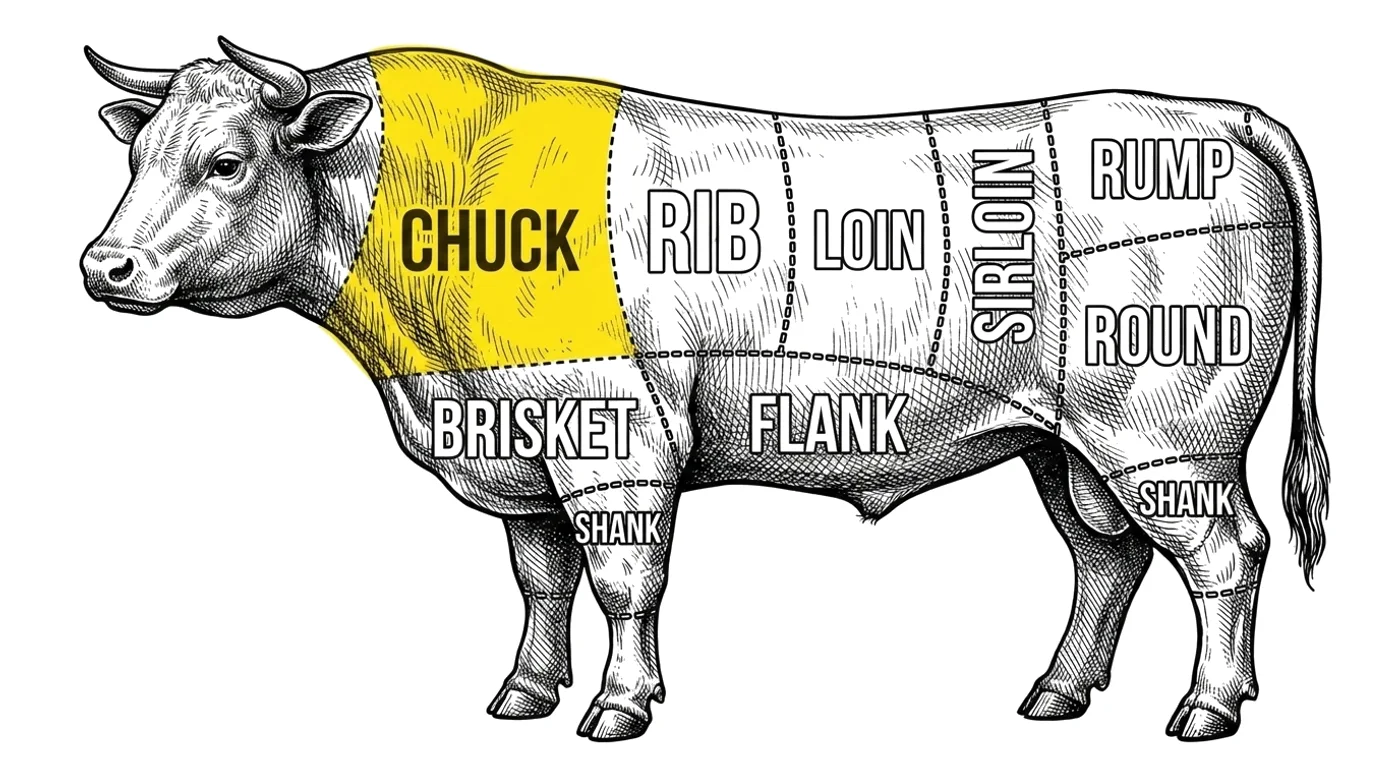
Identity and terminology
Knoblauchwurst literally means garlic sausage and can refer to more than one process class. German meat guidelines distinguish cooked and raw garlic-bearing sausage groups, so the method must be stated. This article covers the gebrühte, or scalded, branch. It is also separate from Polish Kiełbasa czosnkowa, whose Polish naming, meat pattern and national technical tradition should not be displaced by a German translation.
Composition and characteristics
Lean beef forms most of the animal block, giving a dark cured colour and firm protein bind. Pork shoulder supplies additional meat character, while back fat softens the texture and carries the volatile garlic compounds. Black pepper is more prominent than in many fine scalded sausages. Coriander, caraway and nutmeg add warm background notes, but fresh diced garlic remains the defining flavour and visible aromatic ingredient.
Production and process
The chilled beef, pork and fat are ground finely. Salt, accurately weighed nitrite cure and ice water are mixed into the lean meat first to extract binding proteins. The fat, garlic and spices then enter without overheating the mixture. A coarse-fine style can remain visibly ground, while a smoother branch may be bowl-cut. After stuffing and chilled curing, the chub is warm-smoked, poached until the centre reaches 71°C, then cooled rapidly.
History and regional forms
Garlic sausages occur across central and eastern Europe, but the shared aromatic does not erase their product identities. This German branch reflects a cooked Brühwurst technique and a beef-heavy composition. Raw Knoblauchwurst is matured rather than poached, while Polish garlic sausage is usually a more recognisably particulate pork product. Historical reference to Breslau describes cultural geography and does not create a modern protected designation.
Use, storage and related products
Slice Gebrühte Knoblauchwurst cold for bread, warm thicker pieces gently, or brown them briefly. The garlic character becomes stronger with storage, but keeping time is limited by the moist cooked matrix. Refrigeration is mandatory, and a cut chub should be wrapped against drying and cross-contamination. A correct slice is cured red, fine and cohesive, with pale fat integrated cleanly and no pockets of separated water.
Recipe and cure
This is not a finished recipe. It is a window into how this meat is traditionally cured. Before you follow any process, run it through one of our curing calculators so the salt, cure and timings are right and safe for your own batch.
Make this — the measured Curesmith version →“Make this” opens the same cure as a measured recipe, scaled to your batch.
- Meat
- Beef chuck
- Cut
- Beef chuck
- Salt (%)
- 1.8
- Curing salt
- Cure #1 as specified in the recipe
- Fermented
- No
- Starter or mould
- None; this product is not fermented
- Smoked
- Yes
- Maturation
- Refrigerate at 0–4°C; use within 4 days or freeze promptly
- Basis
- per 1,000 g beef chuck
- Style
- cured smoked and cooked German garlic sausage
Ingredients
- Beef chuck100% · 1000 g
- Pork back fat40% · 400 g
- Pork shoulder with moderate connective tissue15% · 150 g
- Ice water9.9% · 154 g
- Fine salt1.8% · 27.5 g
- Cure #1, 6.25% sodium nitrite0.25% · 4 g
- Black pepper0.3% · 4.5 g
- Ground nutmeg0.05% · 0.8 g
- Ground coriander0.1% · 1.5 g
- Ground caraway0.1% · 1.5 g
- Fresh garlic, finely diced0.5% · 7.5 g
Method
- Trim, weigh and chill meat, fat, water and equipment to 0–2°C.
- Grind beef, pork and fat separately through 3 mm.
- Dissolve Cure #1 in part of the water; mix meat with salt, cure and water until tacky, then add fat, garlic and spices.
- Fill the broad casing firmly, remove air and refrigerate for 8–12 hours.
- Dry the casing and warm-smoke at 60–65°C until evenly coloured and aromatic.
- Poach at 78–80°C until the cold point reaches 71°C.
Safety. Prevent emulsion warming, distribute cure and garlic evenly, cook the centre to 71°C and cool the broad casing rapidly.