
Gelderse Rookworst
Also known as Rookworst, Gelderland smoked sausage
Gelderland, Netherlands
Overview
Gelderse Rookworst is a Dutch smoked sausage associated with the province of Gelderland and commonly formed as a horseshoe or ring. Traditional butcher-made versions contain pork or pork with beef, use a natural casing and receive genuine wood smoke before cooking. The Curesmith branch combines beef, pork jowl and belly, preserving the fine-and-coarse structure described by the source. Although Gelderse is geographical language, the name is not treated here as a registered PDO, PGI or TSG.
Where it's from
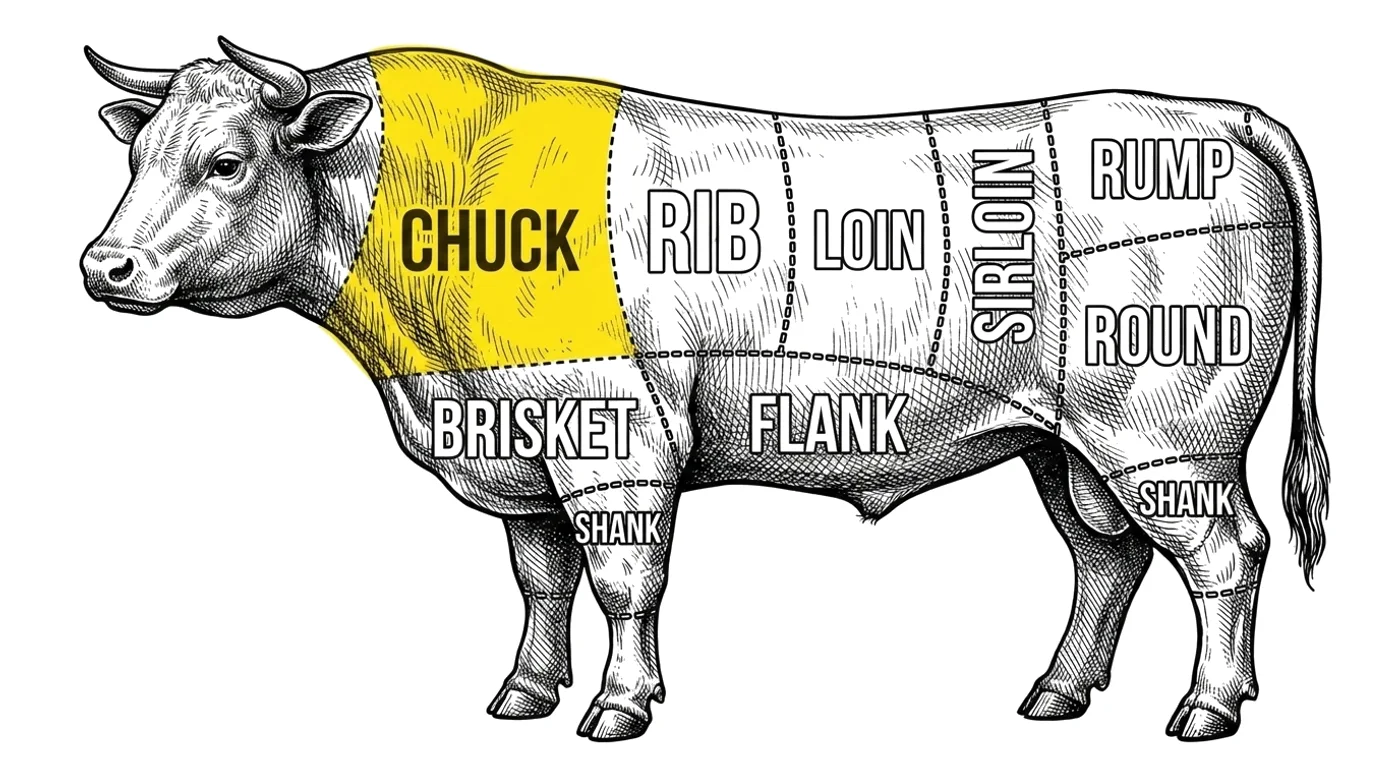
The cut
Identity and terminology
Rook means smoke and worst means sausage, so rookworst is literally smoked sausage. Gelderse identifies Gelderland, but Dutch usage often treats Gelderse rookworst and rookworst as overlapping market terms. That overlap does not erase provenance rules: an origin impression on a label must not mislead consumers about where substantial production occurred. Traditional smoked rings should also be distinguished from modern vacuum-packed sausages flavoured with smoke condensate and from verse rookworst, the raw form that still requires cooking.
Composition and characteristics
The classic ring has a brown-gold casing, a firm snap and a pink, finely bound interior. Beef supplies a lean binding fraction, jowl brings collagen and fat, and belly provides coarser succulent particles. White pepper, nutmeg, clove, ginger and coriander create a warm but restrained Dutch profile. The product is less heavily spiced than many German smoked sausages. A natural hog casing and beech or oak smoke give the most recognisable butcher-shop result, while industrial versions may use collagen casing and smoke flavour.
Production and process
Lean beef and jowl are ground fine and mixed with salt, curing salt and water until adhesive. Coarser belly and spices are then incorporated, preserving some particle contrast. The mixture is stuffed as a ring, cured cold, surface-dried and smoked with hardwood. Poaching completes the lethality step. The sausage must then be cooled rapidly and refrigerated. A smoky aroma does not prove that the product was traditionally smoked, and neither natural smoke nor vacuum packaging makes a home-produced ring shelf stable.
History and regional forms
Rookworst became closely tied to Dutch winter eating because it pairs naturally with stamppot, especially mashed potato with kale or sauerkraut. Gelderland's name became prominent in this sausage trade, but the precise origin story is less secure than the product's modern cultural association. Eighteenth-century Gelderland cookery literature is often cited in accounts of wood smoking, yet a regional culinary history is not the same as protected-name law. Today both butcher-made rings and nationally distributed industrial versions coexist.
Use, storage and related products
Gelderse Rookworst is heated and served whole or sliced over boerenkoolstamppot, zuurkoolstamppot, pea soup and bean dishes. Mustard is the usual sharp accompaniment. Raw butcher's rookworst must be cooked; fully cooked packaged versions need only reheating according to the label. The Atlas recipe is fully cooked but remains refrigerated. It is distinct from dry metworst, which is preserved by drying, and from unsmoked fresh sausage. Store at 0–4°C and use opened sausage promptly.
Recipe and cure
This is not a finished recipe. It is a window into how this meat is traditionally cured. Before you follow any process, run it through one of our curing calculators so the salt, cure and timings are right and safe for your own batch.
Make this — the measured Curesmith version →“Make this” opens the same cure as a measured recipe, scaled to your batch.
- Meat
- Lean beef chuck
- Cut
- Lean beef chuck
- Salt (%)
- 1.9
- Curing salt
- Cure #1 as specified in the recipe
- Fermented
- No
- Starter or mould
- None; this product is not fermented
- Smoked
- Yes
- Maturation
- Refrigerate at 0–4°C; use within 4 days or freeze promptly
- Basis
- per 1,000 g lean beef chuck
- Style
- cured, smoked and cooked Dutch ring sausage
Ingredients
- Lean beef chuck100% · 1000 g
- Pork jowl85% · 850 g
- Skinless pork belly85% · 850 g
- Ice water5.3% · 143 g
- Fine salt1.9% · 51.5 g
- Cure #1, 6.25% sodium nitrite0.24% · 6.5 g
- White pepper0.21% · 5.5 g
- Nutmeg0.21% · 5.5 g
- Ground cloves0.03% · 0.9 g
- Ground ginger0.05% · 1.5 g
- Ground coriander0.11% · 3 g
Method
- Chill materials to 0–2°C and grind each component separately.
- Mix beef and jowl with salt, dissolved Cure #1 and ice water until tacky.
- Fold in the coarser belly and spices without smearing the fat.
- Stuff, form rings and refrigerate for 8–12 hours.
- Dry the casing under controlled conditions, then smoke with beech or oak at 30–35°C for up to 90 minutes.
- Poach at 78–80°C until the cold point reaches 71°C.
Safety. Cure under refrigeration, control genuine smoke separately from cooking, reach a measured cold-point endpoint and cool rapidly.