
German Knacker and Klöpfer
Also known as Knacker, Klöpfer, Kloepfer, Dicke, Rote, Servela
Germany
Overview
German Knacker and Klöpfer belong to a family of cured scalded sausages valued for a juicy filling and a casing that gives a clear snap. The current German meat guidelines group the names with Dicke, Rote, Servela, Rindswurst and Schüblinge. That official grouping supports one controlling article, while the two source pages remain separate recipes because their meat selections are not identical.
Where it's from
The cut
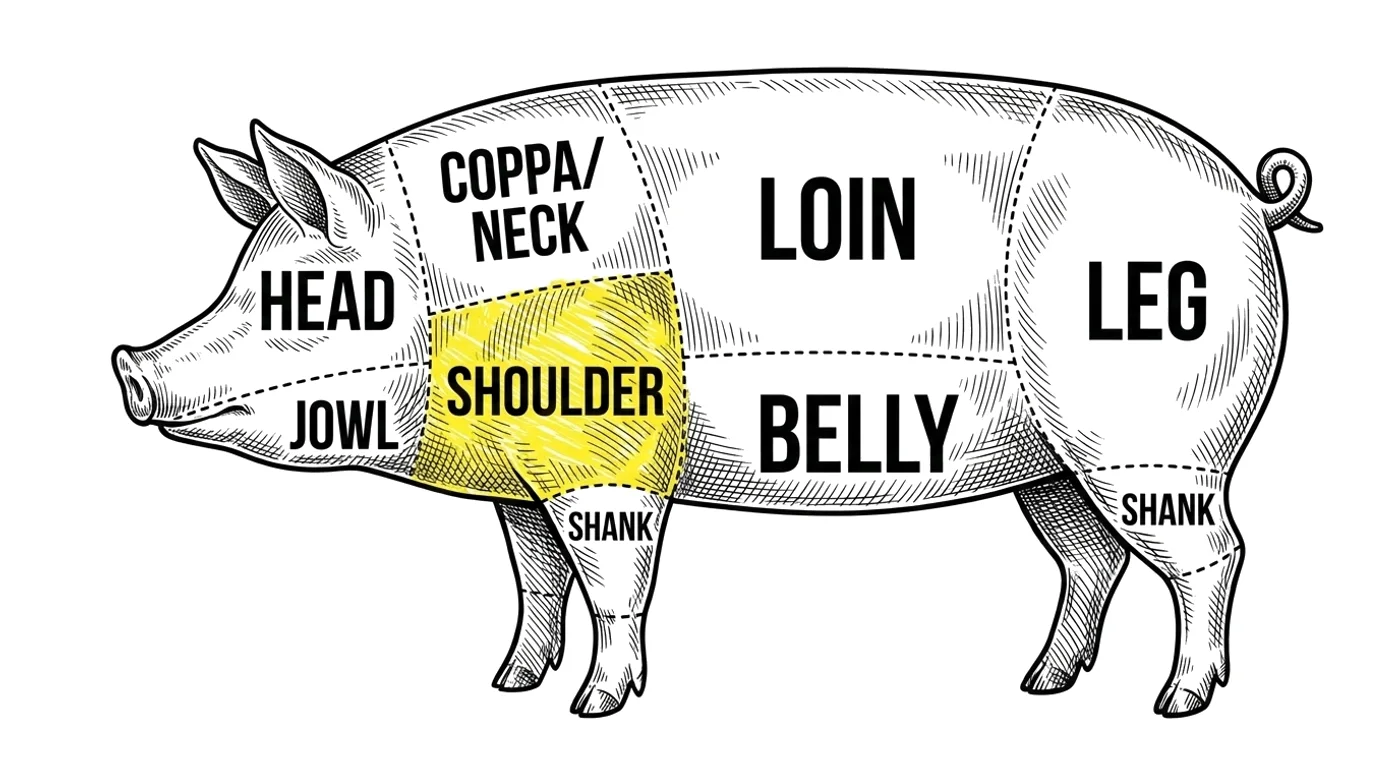
Identity and terminology
Knack refers to the audible break produced when a well-filled natural casing is bitten. In German usage, however, Knacker can also label raw regional sausages, so process class must accompany the name. This article covers the cooked guideline family represented by Klöpfer and the pork-jowl Knacker source formula. Austrian Knacker is handled separately under Austrian Knackwurst because its Codex composition and service form differ.
Composition and characteristics
The Klöpfer branch combines lean pork, a smaller beef fraction, pork skin and firm fat. The Knacker branch replaces beef with pork jowl while retaining cooked skin and back fat. Both are finely ground, cured pink and seasoned with pepper, caraway, marjoram, garlic and a small amount of mace or nutmeg. Skin contributes gelatin and bite, while a narrow hog casing supplies the expected crack.
Production and process
Pork skin is cooked until tender, ground warm and chilled promptly. Raw meat and fat are ground cold, mixed with salt and accurately weighed nitrite cure, then combined with skin and spices. After stuffing and a refrigerated curing hold, the links are dried, warm-smoked and poached until the centre reaches 71°C. Rapid chilling preserves both safety and the plump casing rather than leaving the sausages to cool slowly in air.
History and regional forms
These names sit within the dense regional vocabulary of German Brühwurst. Similar formulations may be marketed as Rote, Servela or Schübling according to locality, calibre and quality grade. They should not automatically be merged with Bockwurst, which has its own familiar form, or with Berliner Knacker and other raw sausages that are smoked and matured without a scalding cook. Method is the decisive boundary.
Use, storage and related products
Serve cooked Knacker or Klöpfer gently heated in water, grilled briefly or eaten cold after proper chilling. Reboiling can split the casing and dry the filling. Both recipe branches remain refrigerated and are not shelf stable. On the cut face, look for a fine pink matrix with small fat and skin particles, a warm garlic and marjoram aroma and enough resilience to complement the crisp natural casing.
Recipe and cure
This is not a finished recipe. It is a window into how this meat is traditionally cured. Before you follow any process, run it through one of our curing calculators so the salt, cure and timings are right and safe for your own batch.
Make this — the measured Curesmith version →“Make this” opens the same cure as a measured recipe, scaled to your batch.
- Meat
- Pork shoulder
- Cut
- Pork shoulder
- Salt (%)
- 1.8
- Curing salt
- Cure #1 as specified in the recipe
- Fermented
- No
- Starter or mould
- None; this product is not fermented
- Smoked
- Yes
- Maturation
- Refrigerate at 0–4°C; use within 4 days or freeze promptly
- Basis
- per 1,000 g pork shoulder
- Style
- cured smoked German scalded sausage with pork skin
Ingredients
- Pork shoulder100% · 1000 g
- Beef chuck20% · 200 g
- Cooked pork skin10% · 100 g
- Pork back fat50% · 500 g
- Ice water11% · 198 g
- Fine salt1.8% · 32.5 g
- Cure #1, 6.25% sodium nitrite0.25% · 4.5 g
- Black pepper0.2% · 3.5 g
- Ground caraway0.2% · 3.5 g
- Dried marjoram0.1% · 2 g
- Ground mace0.05% · 0.9 g
- Fresh garlic0.3% · 5.5 g
Method
- Cook the cleaned pork skin at about 90°C until tender, drain it and grind while warm.
- Chill meat and fat to 0–2°C, then grind each fraction as specified.
- Dissolve Cure #1 in measured ice water and mix it with pork, beef and salt until tacky.
- Add cold ground skin, fat, pepper, caraway, marjoram, mace and garlic; mix only until even.
- Fill the casing firmly, remove air and refrigerate for 8–12 hours.
- Dry the casing, apply warm smoke at about 60°C, then poach at 78–80°C until the cold point reaches 71°C.
Safety. Cook pork skin separately, chill all components, weigh Cure #1 against the animal block, reach 71°C and cool rapidly.