
Goose Sausage
Also known as Cooked goose sausage, Goose emulsion sausage
Generic
Overview
Goose sausage is a functional family name rather than one traditional recipe. The branch developed here is a pale, finely comminuted cooked sausage made entirely from goose meat, goose skin and goose fat. It uses the bird's own fat system instead of pork back fat, which gives a recognisably goose-derived richness and keeps the identity distinct from mixed poultry-and-pork sausages. No geographical or historical qualifier accompanies the name, so it stands as a generic technical family rather than being assigned to a country the evidence does not support.
Where it's from
The cut
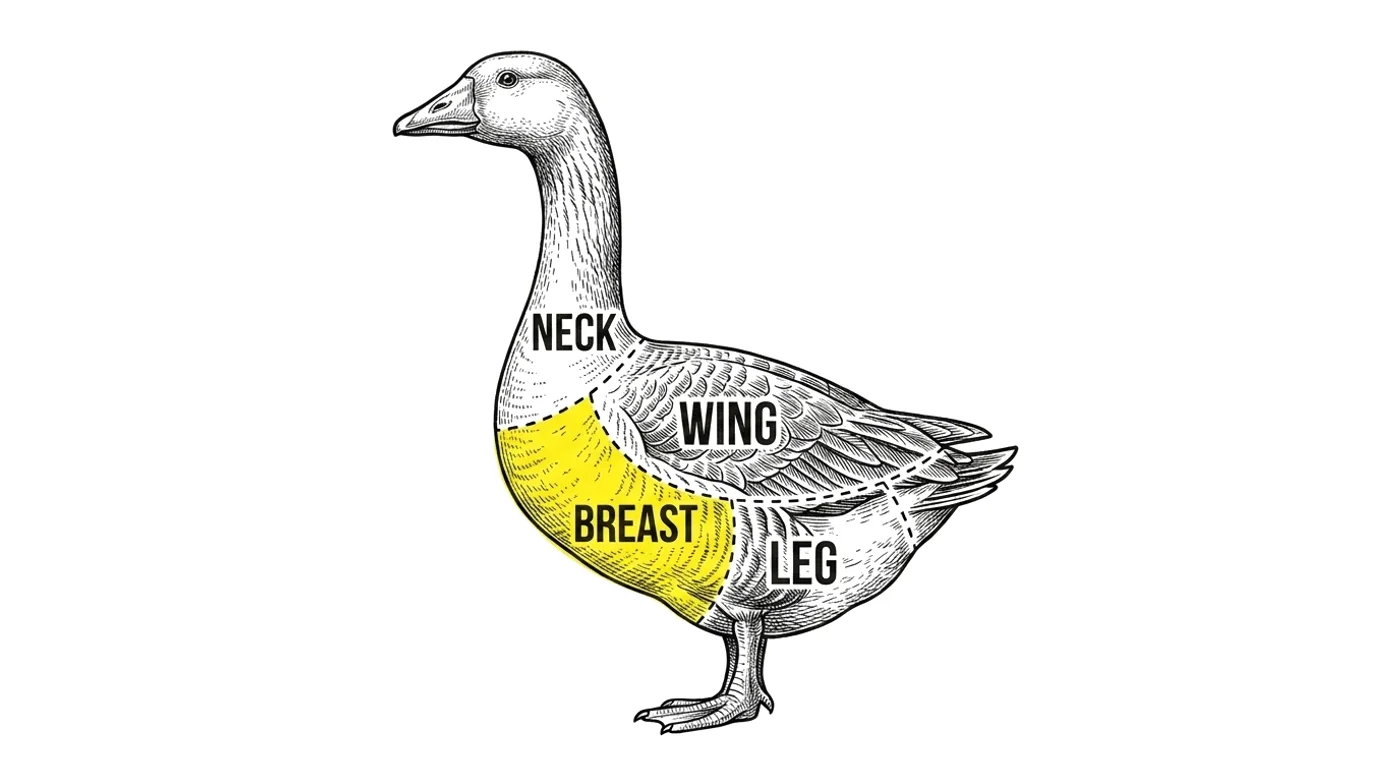
Identity and terminology
The name describes the principal species, not a protected style. Goose sausages can be fresh, smoked, fermented, liver-based or emulsified; those processes are not interchangeable. This entry covers the uncured cooked-emulsion form. It also differs from Salame d'oca di Mortara and other named regional goose products, whose composition and legal rules deserve their own identities. A product made mainly from pork with a small goose addition should be described as a mixed-meat sausage rather than folded into this all-goose branch.
Composition and characteristics
Lean meat from the breast and legs supplies myofibrillar protein, cleaned skin contributes collagen and fat, and separate goose fat provides succulence. Progressive grinding is important because coarse skin remains rubbery. Non-fat dry milk binds water and supports the emulsion, while white pepper and a small amount of cayenne keep the seasoning restrained. The absence of curing salt produces a light grey or cream interior rather than cured pink. A delicate sheep casing gives the link a crisp outline and suits the smooth batter.
Production and process
All goose components must remain very cold. Meat is ground twice, skin is reduced through successively finer plates and semi-frozen fat is added only after the salt-soluble bind has begun to form. Ice water is introduced in stages so the batter stays below 10°C. Links are filled without excessive pressure and poached gently to a 74°C cold-point endpoint, the poultry control used for this branch. A brief shower is only the start of cooling; the sausage must then complete controlled chilling before packaging.
History and regional forms
Geese have supplied meat, rendered fat and preserved products across many European and Jewish food traditions, but that broad history does not prove a single lineage for this formula. The source's emphasis on goose skin reflects modern meat-science practice: skin increases water binding when it is finely comminuted, while goose fat carries the species-specific flavour. What can be told is a technical history of how the bird was used, not a regional origin story. Named religious or regional variants require separate composition, slaughter and labelling controls.
Use, storage and related products
Serve the links warmed gently, browned in a pan or sliced into bean, lentil and cabbage dishes. Mild fruit accompaniments such as apple or quince suit the rich poultry fat, while mustard and pickles provide contrast. Milk must be declared because of the dry-milk binder. Store at 0–4°C and freeze promptly if the batch will not be eaten within four days. The sausage is cooked but not shelf stable, and optional curing salt would create a visibly and technically different branch.
Recipe and cure
This is not a finished recipe. It is a window into how this meat is traditionally cured. Before you follow any process, run it through one of our curing calculators so the salt, cure and timings are right and safe for your own batch.
Make this — the measured Curesmith version →“Make this” opens the same cure as a measured recipe, scaled to your batch.
- Meat
- Skinless goose leg and breast meat
- Cut
- Skinless goose leg and breast meat
- Salt (%)
- 1.8
- Curing salt
- None
- Fermented
- No
- Starter or mould
- None; this product is not fermented
- Smoked
- No
- Maturation
- Refrigerate at 0–4°C; use within 4 days or freeze promptly
- Basis
- per 1,000 g skinless goose leg and breast meat
- Style
- uncured fine cooked goose sausage
Ingredients
- Skinless goose leg and breast meat100% · 1000 g
- Cleaned goose skin30% · 300 g
- Rendered or finely diced goose fat15% · 150 g
- Ice water9.9% · 143 g
- Fine salt1.8% · 25.5 g
- White pepper0.2% · 3 g
- Cayenne pepper0.05% · 0.7 g
- Non-fat dry milk3.9% · 57 g
Method
- Remove shot, feathers, glands and damaged tissue, then chill meat, skin, fat and equipment to 0–2°C.
- Grind meat twice and skin progressively finer; keep fat semi-frozen.
- Process meat and skin with salt, milk powder and half the ice water, then add fat, pepper, cayenne and remaining water.
- Fill sheep casings without overpacking and link at 10 cm.
- Poach in 78–80°C water until the cold point reaches 74°C.
- Shower briefly and complete controlled chilling.
Safety. Keep skin and fat cold, control batter temperature, declare milk, cook the poultry batter to 74°C and complete rapid chilling.