
Halberstädter Würstchen
Also known as Halberstadt sausages, Halberstädter sausages
Saxony-Anhalt, Germany
Overview
Halberstädter Würstchen is a protected German sausage from Halberstadt and the defined surrounding production area in Saxony-Anhalt. The EU specification describes a long, thin cooked sausage in tender natural casing, sold as a preserved product. Its identity comes from the interaction of fine seasoned sausage meat, casing, local processing knowledge and a distinctive chimney-smoking method. Registration as a Protected Geographical Indication means the name is legally reserved for qualifying product; a similar home recipe made elsewhere can explain the style but cannot acquire the PGI by copying ingredients.
Where it's from
The cut
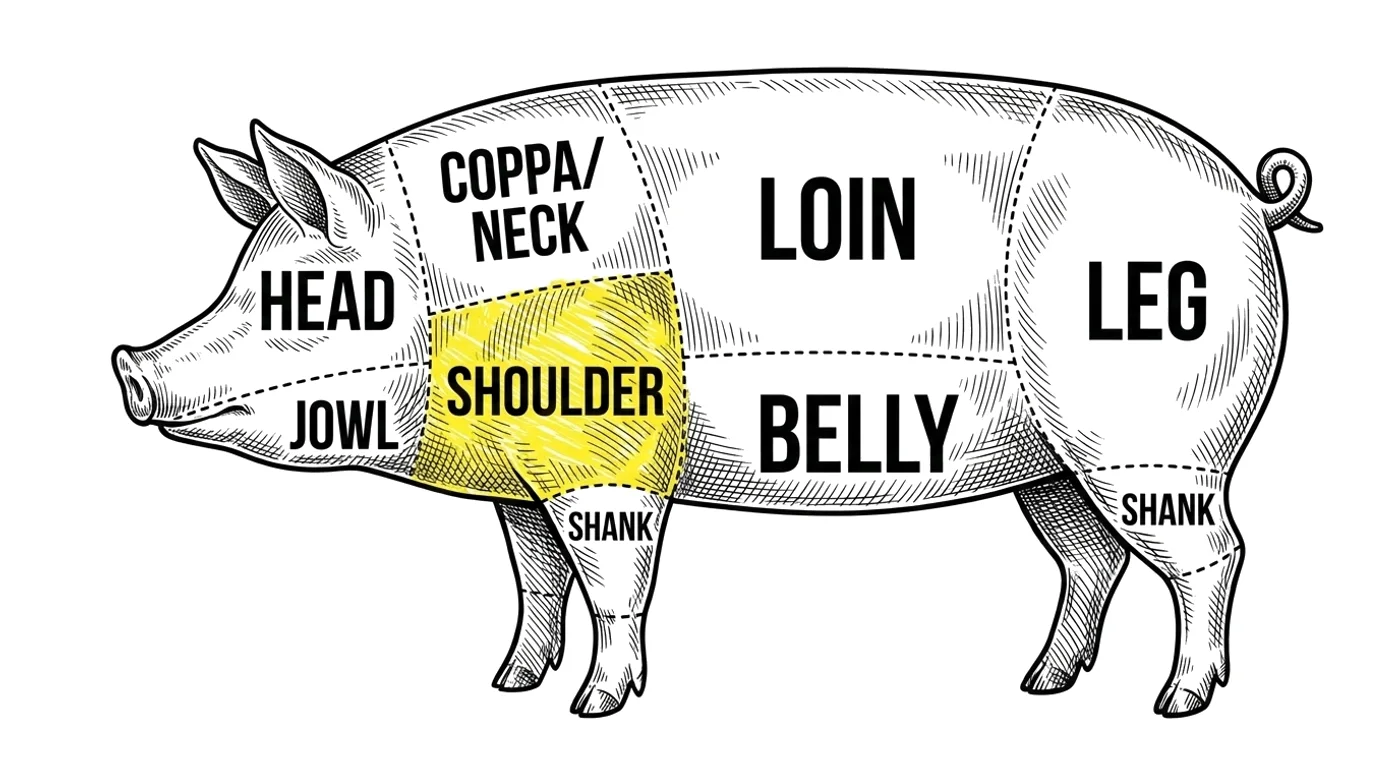
Identity and terminology
Würstchen is the German diminutive for small sausage, while Halberstädter means from Halberstadt. The place adjective is therefore the legally important part of the name. It is not a generic Wiener, Frankfurter or Bockwurst, though all four are slender cooked links. Halberstädter Würstchen has its own protected geography, preservation history and smoking signature. The plural protected name covers the product as marketed, while an individual link may be described grammatically as a Halberstädter Würstchen.
Composition and characteristics
The source branch uses pork, beef and firm pork fat in a fine cohesive matrix, seasoned with pepper, mace, nutmeg, caraway and ginger. Tender sheep casing produces the narrow classic form; later amendments accommodate defined product variations without erasing the natural-casing identity. The exterior develops a characteristic brown-red smoke colour and the bite remains delicate. Water supports extraction and juiciness, while Cure #1 produces stable cured colour and flavour. Exact commercial composition and preserved presentation must follow the current specification and approved production controls.
Production and process
Meats are chilled, ground separately and mixed with salt, curing salt and water before fat and spices are incorporated. Filled links undergo carefully controlled beech smoking. The specification links the characteristic aroma and colour to a traditional masonry chimney system in which moist and dry-hot smoke phases behave differently. Domestic hot smoking at 60–75°C can produce a useful educational adaptation, but it does not reproduce the protected installation. The home branch is subsequently poached to 71°C, cooled rapidly and refrigerated, with no claim of ambient stability.
History and regional forms
The EU application records 23 November 1883 as the first production date, crediting Halberstadt master butcher Friedrich Heine. He opened a factory the following year, gained exhibition recognition in 1896 and helped pioneer canned presentation. By the early twentieth century the sausages were served in railway-station restaurants and Mitropa dining cars, spreading the town's reputation. This history explains why preservation is more than packaging detail: it allowed a fragile natural-casing sausage and its local smoke character to travel far beyond Halberstadt.
Use, storage and related products
Commercial Halberstädter Würstchen are warmed gently and served with bread, mustard, potato salad or simple vegetables. Their fine texture also suits soup service, provided vigorous boiling does not split the casing. For Atlas use, the protected article and the home adaptation must remain visibly separate. Only certified product meeting the geographical and process rules may use the PGI in trade. The adaptation stays at 0–4°C, is used within four days or frozen, and should never be represented as the preserved protected product.
Recipe and cure
This is not a finished recipe. It is a window into how this meat is traditionally cured. Before you follow any process, run it through one of our curing calculators so the salt, cure and timings are right and safe for your own batch.
Make this — the measured Curesmith version →“Make this” opens the same cure as a measured recipe, scaled to your batch.
- Meat
- Lean pork shoulder
- Cut
- Lean pork shoulder
- Salt (%)
- 1.8
- Curing salt
- Cure #1 as specified in the recipe
- Fermented
- No
- Starter or mould
- None; this product is not fermented
- Smoked
- Yes
- Maturation
- Refrigerate at 0–4°C; use within 4 days or freeze promptly
- Basis
- per 1,000 g lean pork shoulder
- Style
- cured smoked and cooked fine German sausage
Ingredients
- Lean pork shoulder100% · 1000 g
- Lean beef chuck50% · 500 g
- Pork back fat50% · 500 g
- Ice water12% · 240 g
- Fine salt1.8% · 36 g
- Cure #1, 6.25% sodium nitrite0.25% · 5 g
- White pepper0.2% · 4 g
- Ground mace0.05% · 1 g
- Ground nutmeg0.05% · 1 g
- Ground caraway0.05% · 1 g
- Ground ginger0.03% · 0.6 g
Method
- Trim and chill pork, beef, fat, water and equipment to 0–2°C.
- Grind pork and fat through 6 mm and beef through 3 mm.
- Mix beef and pork with salt, Cure #1 and ice water until tacky, then incorporate spices and back fat.
- Fill tender sheep casings, link at 20 cm and refrigerate for 8–12 hours.
- Dry the casing surface, then hot-smoke with beech while controlling the chamber within 60–75°C.
- Poach at 75–78°C until the cold point reaches 71°C.
Safety. Protected production must follow the PGI area and preservation rules; home adaptations require accurate cure dosing, a 71°C endpoint and refrigeration.