
Harbin Red Sausage
Also known as Harbin hongchang, 哈尔滨红肠, Lidaosi, Li Dao Si sausage
Heilongjiang, China
Overview
Harbin Red Sausage is one of the food emblems of Harbin in north-eastern China. Its wrinkled red-brown casing, garlic aroma and hardwood smoke distinguish it from the sweet dried sausages of southern China. Heilongjiang's cultural authorities describe the craft as an edible example of Chinese and European exchange. The official heritage account names lean pork and beef hindquarter among the principal meats and records curing, filling, baking, boiling and smoking as characteristic stages.
Where it's from
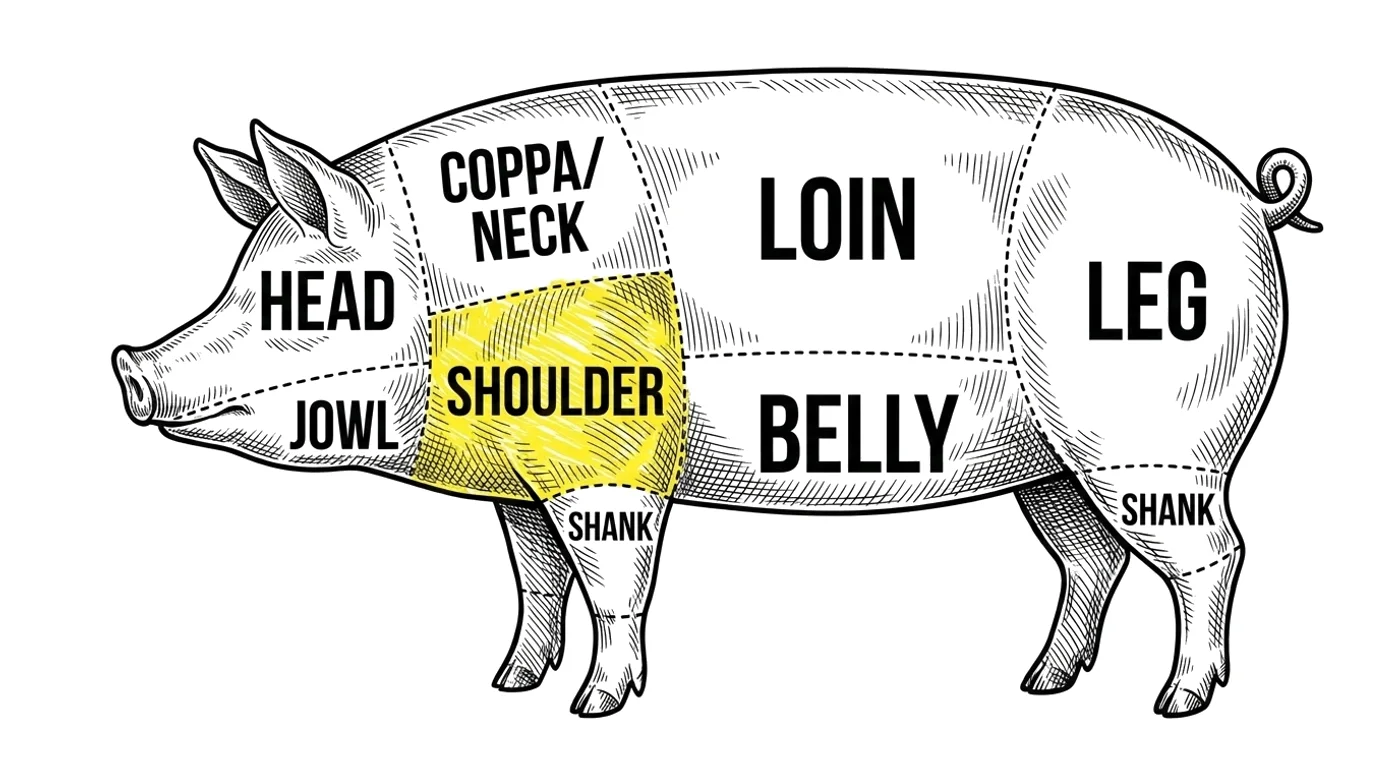
The cut
Identity and terminology
The Chinese name 红肠 means red sausage. Lidaosi is a Chinese phonetic rendering associated with Lithuanian sausage, reflecting the technicians and recipes that reached Harbin through Russian commercial networks. It is not Lap Cheong and should not be grouped with Cantonese dried sausage. The red in the modern name refers to the smoked casing colour, not chilli heat. Harbin geography and the product's local adoption are essential to the identity even though the batch makes no geographical-indication claim.
Composition and characteristics
Traditional and commercial formulas vary, but pork, beef, firm fat, garlic and smoke are recurrent. The Curesmith branch uses sixty per cent lean pork, twenty per cent beef and twenty per cent back fat. Potato starch supports the bind while black pepper, nutmeg, cumin and cardamom create the source's warm spice structure. A 36 mm hog casing forms short plump links. The finished cut face is tight and pink with small fat pieces, while the exterior is darker, wrinkled and strongly aromatic.
Production and process
Meat and fat cure separately under refrigeration before grinding. The lean fractions are mixed with Cure #1, spices, starch and ice water until tacky, then chilled fat is folded through. Stuffed links dry briefly in controlled air, receive warm hardwood smoke and are poached to a measured 71°C. A short hot finishing smoke may deepen colour, but it must follow hygienic handling and be followed by immediate cooling. The home branch does not claim to reproduce every repeated boil-and-smoke stage of the registered craft technique.
History and regional forms
Harbin grew rapidly around the Chinese Eastern Railway at the end of the nineteenth century and drew migrants and businesses from the Russian Empire. Heilongjiang heritage material links red-sausage manufacture to the Qiulin enterprise and Lithuanian sausage knowledge introduced around 1900. Local makers adapted the European model to northern Chinese preferences and raw materials. The result became part of Harbin's old-brand economy, sold as everyday food, travel provision and a gift that signifies the city.
Use, storage and related products
Harbin Red Sausage is eaten cold in slices, warmed, grilled or added to bread and simple dishes. Garlic and smoke make it assertive enough to serve without heavy sauce. Keep the home branch refrigerated and use it within four days after opening, or freeze. Its closest boundary is with Eastern European smoked cooked sausage, from which it descends; its Harbin history, Chinese name and local craft evolution prevent it from being treated as merely imported kielbasa.
Recipe and cure
This is not a finished recipe. It is a window into how this meat is traditionally cured. Before you follow any process, run it through one of our curing calculators so the salt, cure and timings are right and safe for your own batch.
Make this — the measured Curesmith version →“Make this” opens the same cure as a measured recipe, scaled to your batch.
- Meat
- Lean pork shoulder
- Cut
- Lean pork shoulder
- Salt (%)
- 1.8
- Curing salt
- Cure #1 as specified in the recipe
- Fermented
- No
- Starter or mould
- None; this product is not fermented
- Smoked
- Yes
- Maturation
- Refrigerate at 0–4°C; use within 4 days or freeze promptly
- Basis
- per 1,000 g lean pork shoulder
- Style
- cured, smoked and cooked Harbin pork-and-beef sausage
Ingredients
- Lean pork shoulder100% · 1000 g
- Lean beef rump or silverside25.9% · 350 g
- Pork back fat35% · 350 g
- Ice water11.1% · 150 g
- Fine salt2.2% · 30 g
- Cure #1, 6.25% sodium nitrite0.22% · 3 g
- Potato starch1.2% · 16.5 g
- Black pepper0.24% · 3.5 g
- Fresh garlic, crushed0.37% · 5 g
- Ground nutmeg0.06% · 0.8 g
- Ground cumin0.06% · 0.8 g
- Ground cardamom0.1% · 0.5 g
Method
- Trim pork and beef, dice back fat and chill every component to 0–2°C.
- Dissolve Cure #1 with salt in a little water and mix through the pork and beef; salt the fat separately.
- Grind the cured meats, mix with spices, starch and water until tacky, then fold in the fat dice.
- Fill hog casings firmly, link and refrigerate for a further two hours.
- Dry the surface, then smoke over clean hardwood at 50–60°C for 90–120 minutes.
- Poach at 78–80°C until the cold point reaches 71°C.
Safety. Cure cold, keep the mixed batter below 10°C, probe the final hot stage to 71°C and chill immediately after any finishing smoke.