
Overview
Hauswürstel is an Austrian raw sausage whose name means house sausage. The current Austrian Food Book places Hauswürstel roh among sliceable raw sausages without surface coating. It is moderately dried and smoked at low temperature, producing a firm but not extremely hard everyday sausage.
Where it's from
The cut
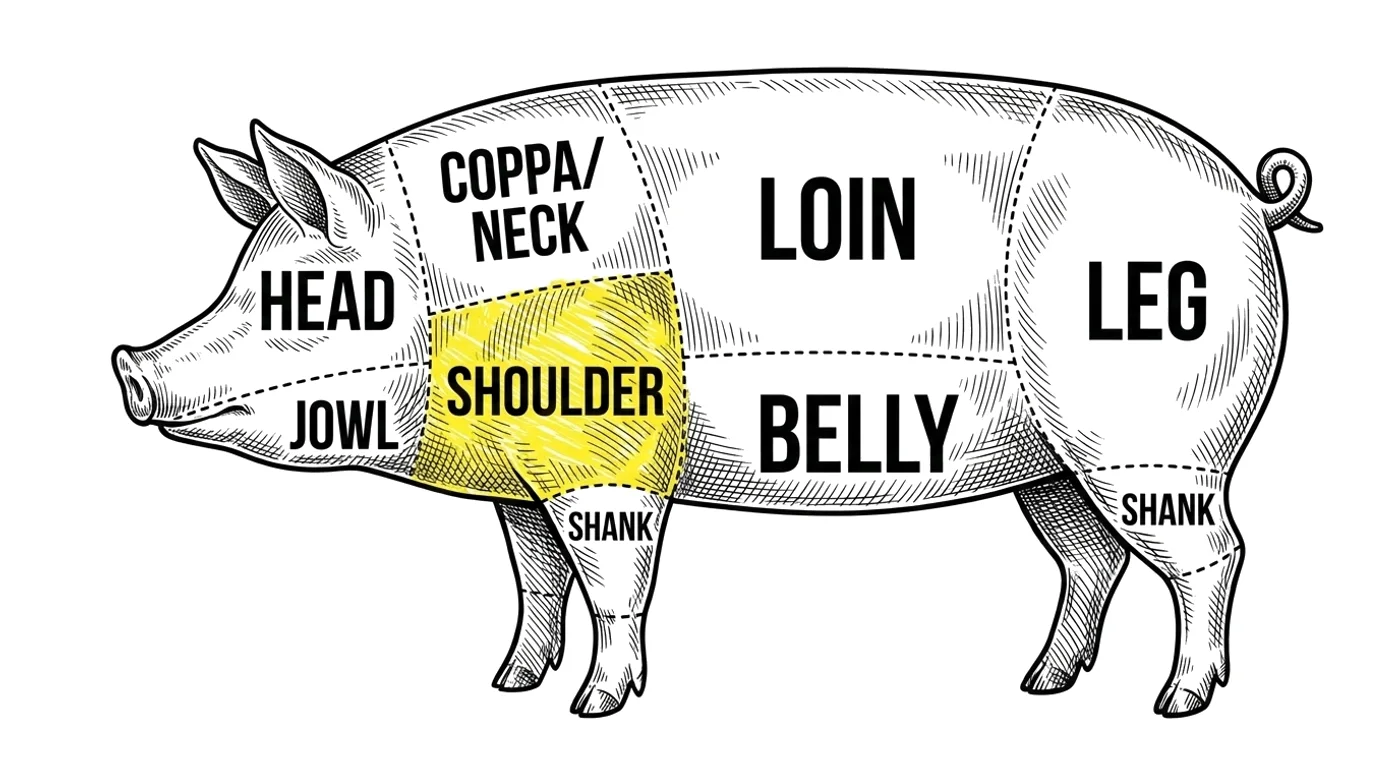
Identity and boundaries
The raw identity must be stated because Austria also has cooked products called Hauswürstel, including regional Burgenland forms. Bauernkrainer is recorded as a regional name for raw Hauswürstel, but should not be applied automatically to every farmer-style sausage or to unrelated Krainer products. Its identity is consequently narrower than the everyday phrase house sausage, which can describe many unrelated fresh, cooked or smoked products in other regions.
Composition and characteristics
The Austrian formulation class uses lean beef and/or pork with firm bacon. Compared with long-dried salami, Hauswürstel has a lower expected drying loss and a more supple bite. The cut surface is compact and visibly cured, with smoke, pepper and garlic commonly shaping the flavour.
Production and maturation
Chilled meat and bacon are ground, cured, seasoned and mixed with culture where the process requires fermentation. The sausage is stuffed, matured and smoked at no more than the national low-temperature limit, then dried to the defined branch endpoint. The modest drying loss demands careful refrigeration and storage assessment. The relatively modest drying loss helps explain its softer texture and shorter keeping character compared with long-matured Austrian Rohwurst.
History and context
The product reflects Austrian household and rural sausage traditions in which practical, lightly dried links were made for family use rather than prolonged export storage. Codification preserved the familiar name while distinguishing the raw form from cooked sausages sold under similar local names.
Culinary use and relationships
Hauswürstel is eaten cold in slices, packed for excursions or served with bread, mustard and pickles. It sits between softer raw sausages and fully dried salami. It remains distinct from Kaminwurzen, Landjäger, cooked Hauswürstel and generic home sausage made outside the Austrian identity. The raw qualifier matters, because cooked Hauswürstel and generic household sausages are different products handled differently.
Recipe and cure
This is not a finished recipe. It is a window into how this meat is traditionally cured. Before you follow any process, run it through one of our curing calculators so the salt, cure and timings are right and safe for your own batch.
Make this — the measured Curesmith version →“Make this” opens the same cure as a measured recipe, scaled to your batch.
- Meat
- Pork shoulder
- Cut
- Pork shoulder
- Salt (%)
- 2.5
- Curing salt
- Cure #1/#2 as specified
- Fermented
- Yes
- Target pH
- 5.3 or lower
- Smoked
- Yes
- Basis
- per 1,000 g pork shoulder
- Style
- Austrian-style fermented, smoked and dried raw sausage.
Ingredients
- Pork shoulder100% · 1000 g
- Lean beef20% · 200 g
- Pork back fat20% · 200 g
- Fine salt2.5% · 35 g
- Cure #2 containing 6.25% sodium nitrite0.25% · 3.5 g
- Dextrose0.41% · 5.5 g
- Black pepper0.31% · 4.5 g
- Garlic0.31% · 4.5 g
- Caraway0.15% · 2 g
- Flora Italia LC or equivalent starter culture0.03% · 0.4 g
Safety. Hauswürstel is a raw sausage despite its homely name. It requires validated curing, fermentation or maturation, smoking below the applicable limit, controlled drying and a verified release endpoint. Cooked Hauswürstel branches require separate thermal controls.