
Hot Dog
Also known as Hotdog, Frank, Frankfurter, Wiener, Vienna sausage
United States
Overview
The hot dog is a finely comminuted cooked sausage and an American way of serving it in a split bun. United States law groups hot-dog, frankfurter, frank, wiener and Vienna with similar cured cooked sausages and permits them to be smoked or unsmoked. The food's cultural identity extends beyond that standard: carts, amusement parks, baseball grounds and regional toppings turned the sausage in a bun into a recognisable national street food.
Where it's from
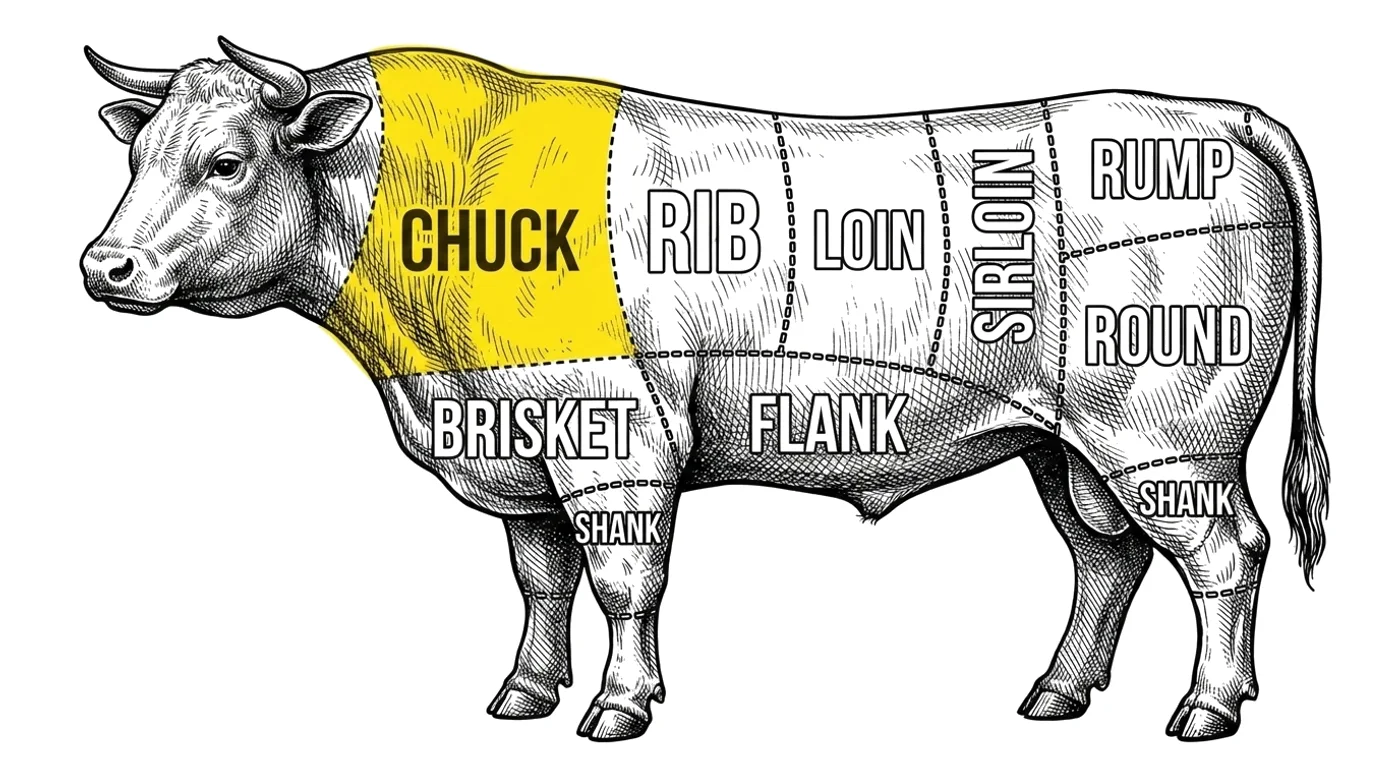
The cut
Identity and terminology
Hot dog can mean the sausage alone or the complete bun-and-sausage dish. Frankfurter and wiener point to German and Austrian ancestry, but American regulation treats the generic names as interchangeable within one cooked-sausage standard. Species qualifiers remain meaningful: beef hot dog must identify its beef composition, while mixed-meat products follow their ingredient declaration. The hot dog is a cultural form. The protected German Frankfurter Würstchen and the Austrian Wiener Würstel are separate products with their own specifications.
Composition and characteristics
The Curesmith branch uses forty per cent beef, thirty-five per cent pork and twenty-five per cent pork back fat, with fifteen per cent added ice. Those figures fit the current United States limits of no more than thirty per cent fat and no more than forty per cent combined fat and added water. White pepper, paprika, mace and garlic season the fine cured batter. Sheep casing produces a natural-casing snap; cellulose casing is peeled after cooling for the smooth skinless form.
Production and process
Lean meat is extracted with salt and Cure #1 before fat and ice are incorporated in stages. Temperature control is essential because a warm batter loses emulsion stability and releases fat during cooking. Links cure cold, dry at the surface, receive optional smoke and are poached to 71°C. Rapid cooling follows. A skinless product is peeled only when completely cold. Commercial post-lethality exposure carries Listeria controls; at home, clean handling and short refrigerated storage are essential.
History and regional forms
The first American hot dogs descended from German sausage traditions brought by migrants. Library of Congress material places the term and ballpark association in the early 1890s, while Smithsonian collections document Coney Island equipment and Nathan's 1916 stand. The all-beef form also became important in Jewish American food culture. These overlapping histories caution against a single-inventor story, but they clearly show how a European cooked sausage became a distinct American public food.
Use, storage and related products
Serve the hot dog warmed in a bun with mustard, onions, relish, sauerkraut, chilli or the toppings of a named regional style. Refrigerate unopened and opened products according to safe handling guidance, and never treat vacuum packaging as shelf stability. The sausage may be ready to eat, but reheating is recommended for vulnerable consumers under current safety advice. A Coney Island frank with meat sauce is a related dish identity; a German Frankfurter Würstchen is a place-defined sausage with a different naming boundary.
Recipe and cure
This is not a finished recipe. It is a window into how this meat is traditionally cured. Before you follow any process, run it through one of our curing calculators so the salt, cure and timings are right and safe for your own batch.
Make this — the measured Curesmith version →“Make this” opens the same cure as a measured recipe, scaled to your batch.
- Meat
- Lean beef chuck
- Cut
- Lean beef chuck
- Salt (%)
- 1.8
- Curing salt
- Cure #1 as specified in the recipe
- Fermented
- No
- Starter or mould
- None; this product is not fermented
- Smoked
- Yes
- Maturation
- Refrigerate at 0–4°C; use within 4 days or freeze promptly
- Basis
- per 1,000 g lean beef chuck
- Style
- cured, smoked and cooked emulsified American sausage
Ingredients
- Lean beef chuck100% · 1000 g
- Lean pork shoulder90% · 900 g
- Pork back fat65% · 650 g
- Crushed ice14.7% · 375 g
- Fine salt1.8% · 45 g
- Cure #1, 6.25% sodium nitrite0.25% · 6.5 g
- White pepper0.2% · 5 g
- Sweet paprika0.1% · 2.5 g
- Ground mace0.05% · 1.5 g
- Fresh garlic, crushed0.35% · 9 g
Method
- Trim and chill meats, fat, ice and equipment to 0–2°C.
- Grind beef and pork through 6 mm and back fat through 3 mm.
- Dissolve Cure #1 in part of the ice, extract the lean meats with salt, then add fat, spices and remaining ice in stages.
- Fill the selected casing, link at 12–15 cm and refrigerate for 4–8 hours.
- Dry the casing surface, then smoke at 55–65°C for about one hour.
- Poach at 75–78°C until the cold point reaches 71°C.
Safety. Maintain a cold emulsion, comply with fat and added-water limits, cook to 71°C, prevent post-cook contamination and refrigerate promptly.