
Overview
Hungarian Winter Salami is a large cylindrical salami with a dense white-grey mould coat, brownish-red pork, small white fat particles and gentle smoke. it is mild and mature rather than sharply sour. A large cylindrical salami with a dense white-grey mould coat, brownish-red pork, small white fat particles and gentle smoke. It is mild and mature rather than sharply sour. The Codex treats it as a complete production system, not merely a familiar name. Raw material, cut or particle size, casing, smoke, fermentation, cooking and maturation all contribute to the identity. The current status is Generic Hungarian winter-salami family; Szegedi Téliszalámi PDO and Budapesti Téliszalámi PGI are separate protected products. The protected or traditional reference and the Curesmith home method remain separate.
Where it's from
The cut
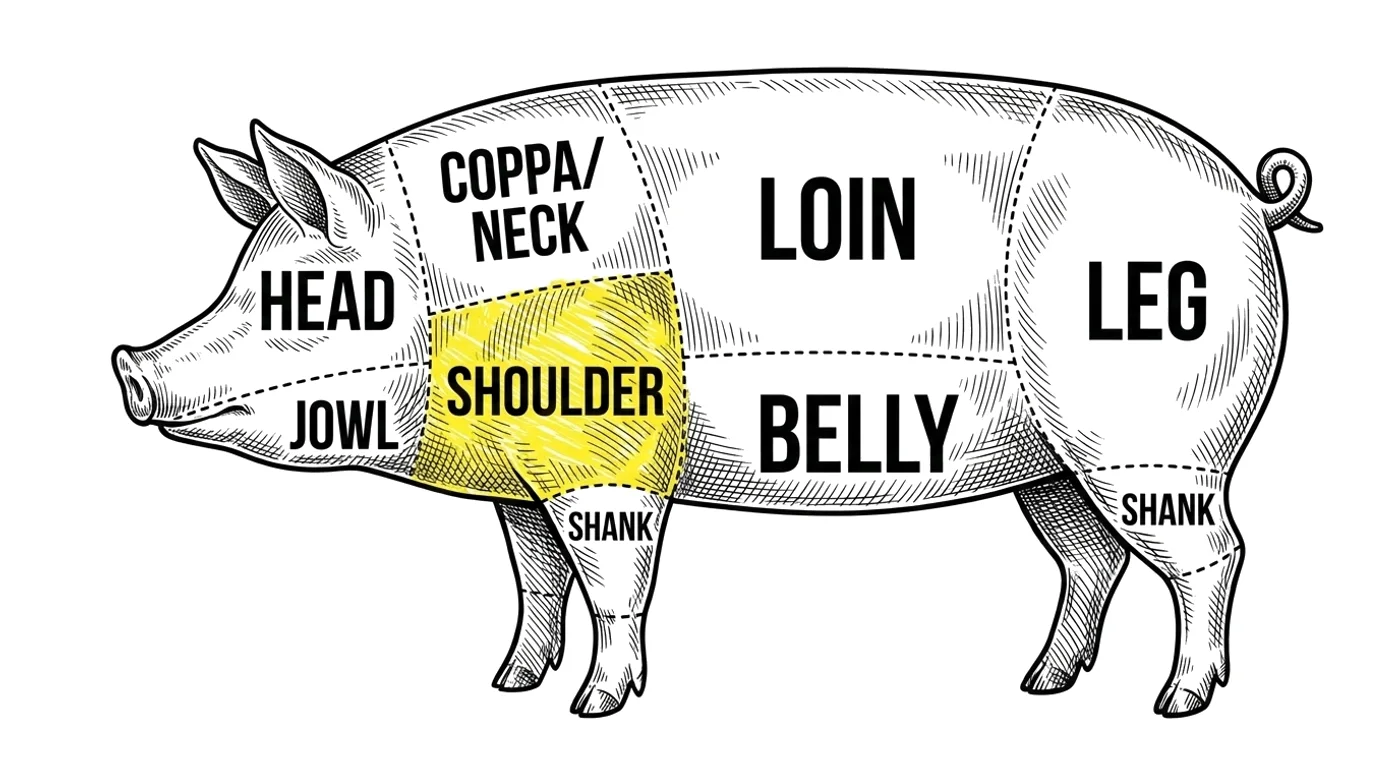
How to recognise it
A large cylindrical salami with a dense white-grey mould coat, brownish-red pork, small white fat particles and gentle smoke. It is mild and mature rather than sharply sour. Grease smear, hollow pockets, case hardening, a wet centre, rancidity or uncontrolled dark mould is a production fault.
Origins and history
Hungarian winter salami developed as an industrial speciality in the nineteenth century, especially through the Pick enterprise in Szeged and the Herz business in Budapest. Large sausages were prepared during cold weather, lightly smoked and matured slowly until a grey-white noble mould covered the casing. The winter climate originally made the long process predictable, and the name remained even after controlled chambers allowed year-round production. The technique became internationally recognisable through dense pork, hard fat, allspice and restrained smoke. Today Szegedi szalámi or Szegedi téliszalámi is a PDO and Budapesti téliszalámi is a PGI. This generic entry describes the broader winter-salami family and must not borrow either protected identity.
Serving and cultural significance
Slice it thinly and serve with bread, pickled peppers, cheese and Hungarian wine. The noble mould is removed with the casing before eating. Avoid strong smoke or heavy sauces that conceal the long winter-salami aroma.
Recipe and cure
This is not a finished recipe. It is a window into how this meat is traditionally cured. Before you follow any process, run it through one of our curing calculators so the salt, cure and timings are right and safe for your own batch.
Make this — the measured Curesmith version →The cure below is the traditional reference. “Make this” opens the measured Curesmith home recipe, scaled to your batch.
Traditional or protected production
Generic Hungarian Winter Salami is a long-matured mould-ripened style rather than one protected name. Pork and hard fat are cured, seasoned, stuffed into broad casing, lightly cold smoked and matured slowly at low temperature until a white-grey noble mould develops. The process produces a mild, dense slice rather than a sharply acidic ferment. Szegedi szalámi or téliszalámi PDO and Budapesti szalámi or téliszalámi PGI remain separate protected products.
- Meat
- pork (traditionally Mangalitza and Italian heavy-pig crossbreds)
- Cut
- minced
- Salt (%)
- 2.2 to 2.5%
- Curing salt
- Cure #1
- Other agents
- dextrose; white pepper, mild spice
- Fermented
- No
- Starter or mould
- house/noble surface mould (Penicillium); the traditional Szeged method uses no mould starter
- Smoked
- beech cold-smoke, around 12 C, for 12 to 14 days
- Target aW or weight loss
- slow, long drying to heavy weight loss
- Temperature (°C)
- cold smoke ~12; ripen and dry cool
- Humidity (%)
- 72 to 75
- Maturation
- weeks
- Basis
- percentage of meat weight
- Style
- minced, stuffed, lightly cold-smoked, mould-ripened and slowly dried
Ingredients
- pork
- salt
- dextrose
- white pepper
- mild spice
- Cure #1
Notes
- Nitrite at 156 ppm ingoing.
- Not an acid ferment: it ripens at a high pH (Szegedi sits above pH 5.6), relying on salt, a noble mould cover and slow drying.
- Beech cold-smoke at about 12 C for 12 to 14 days, then long cool drying.
- Convert any volume spice measures to weight as a percentage of the meat.
- The Szeged (PDO, 2007) and Budapest (PGI, 2009) winter salamis are the protected members of this family.
Safety. A mould-ripened, slowly dried salami rather than a tangy ferment; safety rests on salt, the noble mould cover and thorough drying. The high pH means drying must be slow and even.
In the Codex
What this product teaches, and where to read more.
Temple. Pillar, Mould Control