
Overview
Jagdwurst is a German coarse Brühwurst recognised by a cured fine base holding larger pieces of lean meat and fat. Its name translates as hunting sausage, but modern identity is defined by composition and cut face rather than by game meat. Current German guidelines describe both northern and southern styles, using beef, pork and bacon. Jadgwurst is a common transposition of the name and is kept only as an alias.
Where it's from
The cut
Identity and terminology
Jagd means hunt and Wurst means sausage. The shared hunting language does not make Jagdwurst equivalent to Polish Kiełbasa Myśliwska, Italian Cacciatora or a generic wild-game link. German guidelines place the southern form with coarse scalded sausages whose pieces may reach cherry size. The northern form has a finely comminuted base with pea-sized and sometimes cherry-sized inclusions. Both are cured products and neither requires venison.
Composition and characteristics
The North German executable branch uses coarse lean pork suspended in a fine beef-and-fat base, with additional small back-fat pieces. Mustard, coriander, mace, ginger and white pepper give the restrained warm seasoning documented by the source. A 50–60 mm casing creates a broad pink slice where pale coarse pork and fat remain visible against the finer cured matrix. A uniform 10 mm grind would lose this defining contrast.
Production and process
Beef and part of the back fat are fine-cut with ice water, salt, Cure #1 and seasonings to form the binding base. Coarse pork and remaining fat are folded through cold. After stuffing and refrigerated curing, the sausage is dried, lightly smoked and cooked to 71°C. Rapid chilling sets the fat and protects the large diameter. The product remains refrigerated unless a separate validated drying process establishes another release status.
History and regional forms
Jagdwurst belongs to Germany's long-developed system of scalded sausages, where names distinguish particle size, casing and meat quality. Northern and southern styles show how one national name can hold controlled regional differences without becoming two unrelated products. Its durable association with hunting probably reflects portable service and naming fashion, but the present-day product is a butcher's cooked sausage rather than a preserved ration made from hunted animals.
Use, storage and related products
Serve Jagdwurst in cold slices with bread, mustard and pickles, cube it for salads, or use thicker slices in the eastern German dish Jägerschnitzel, where sausage is breaded and fried. Store the cooked sausage at 0–4°C. Keep it separate from fine Lyoner, from Bierschinken with its characteristic lean inclusions, and from actual wild-game sausage.
Recipe and cure
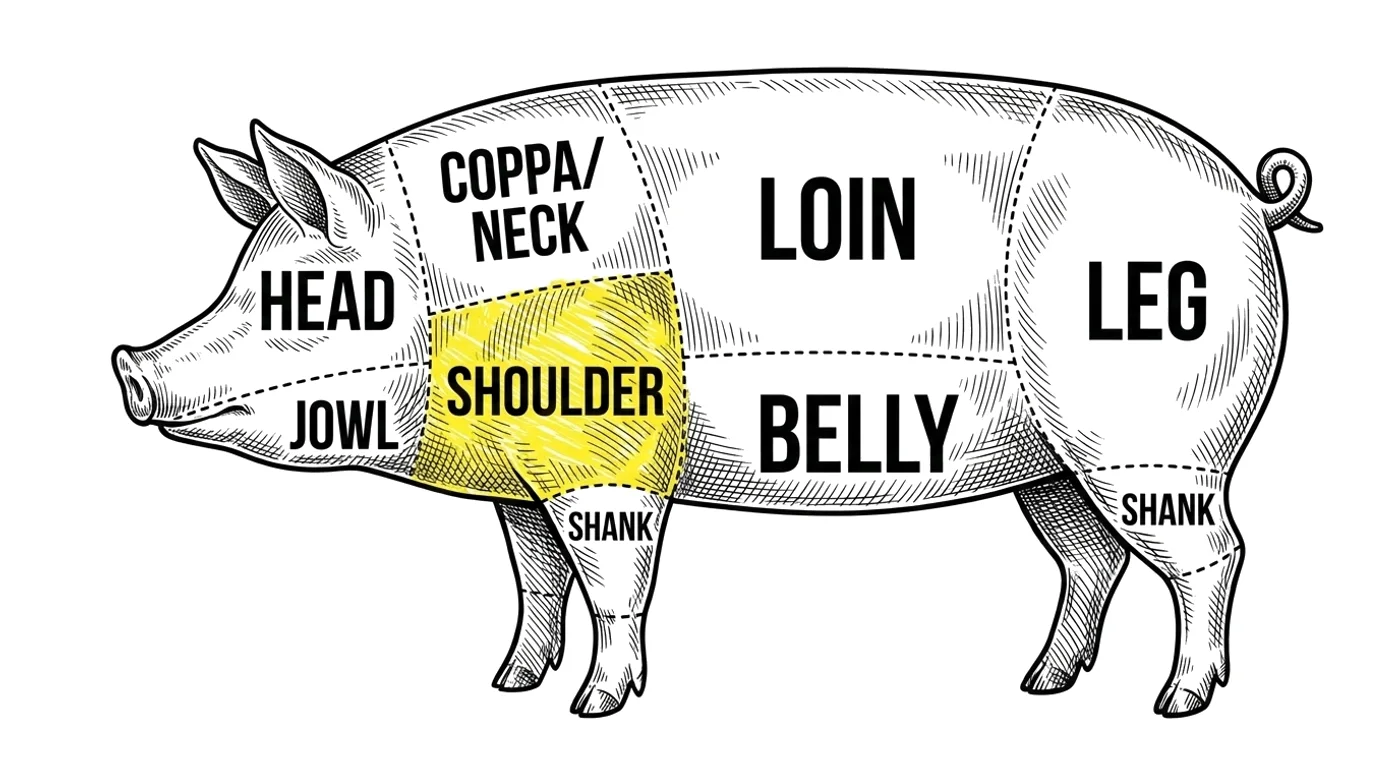
This is not a finished recipe. It is a window into how this meat is traditionally cured. Before you follow any process, run it through one of our curing calculators so the salt, cure and timings are right and safe for your own batch.
Make this — the measured Curesmith version →“Make this” opens the same cure as a measured recipe, scaled to your batch.
- Meat
- Pork shoulder for fine matrix
- Cut
- Pork shoulder for fine matrix
- Salt (%)
- 1.75
- Curing salt
- Cure #1/#2 as specified
- Fermented
- No
- Smoked
- Yes
- Basis
- per 1,000 g pork shoulder for fine matrix
- Style
- Representative German coarse-inclusion cooked sausage.
Ingredients
- Pork shoulder for fine matrix100% · 1000 g
- Lean beef55% · 550 g
- Pork back fat45% · 450 g
- Lean pork, diced 8–10 mm20% · 200 g
- Fine salt1.8% · 39 g
- Cure #1 containing 6.25% sodium nitrite0.25% · 5.5 g
- White pepper0.2% · 4.5 g
- Mustard seed0.2% · 4.5 g
- Ground coriander0.1% · 2 g
- Garlic powder0.1% · 2 g
- Sweet paprika0.1% · 2 g
- Crushed ice12.1% · 266.5 g
Safety. Jagdwurst is a cooked ready-to-eat sausage and requires a validated cold-point lethality, rapid cooling and refrigerated storage. Coarse inclusions can heat differently from the fine matrix, so chamber or water temperature alone is not an adequate endpoint.