
Jambon de Savoie
Savoie, Auvergne-Rhone-Alpes, France
Firm and savoury, a juniper-scented Alpine ham of Savoie.
Overview
Jambon de Savoie is firm and savoury, a juniper-scented alpine ham of savoie. A firm Alpine ham with red lean, a clean white fat edge and restrained pepper, juniper and dried-meat aromas. Smoke may occur in some commercial styles but is not treated as universal. The Codex treats the product as a complete curing or cooking system, not simply a famous name. Raw material, cut or particle size, casing, smoke, fermentation, heat treatment and maturation all contribute to the result. The current legal or quality status is French IGP application specification exists, but the name is not currently registered as an EU GI. The source tradition and the Curesmith home method are kept separate.
Where it's from
Climate. The French Alps of Savoie, cool and dry.
Altitude. Alpine valleys
The cut
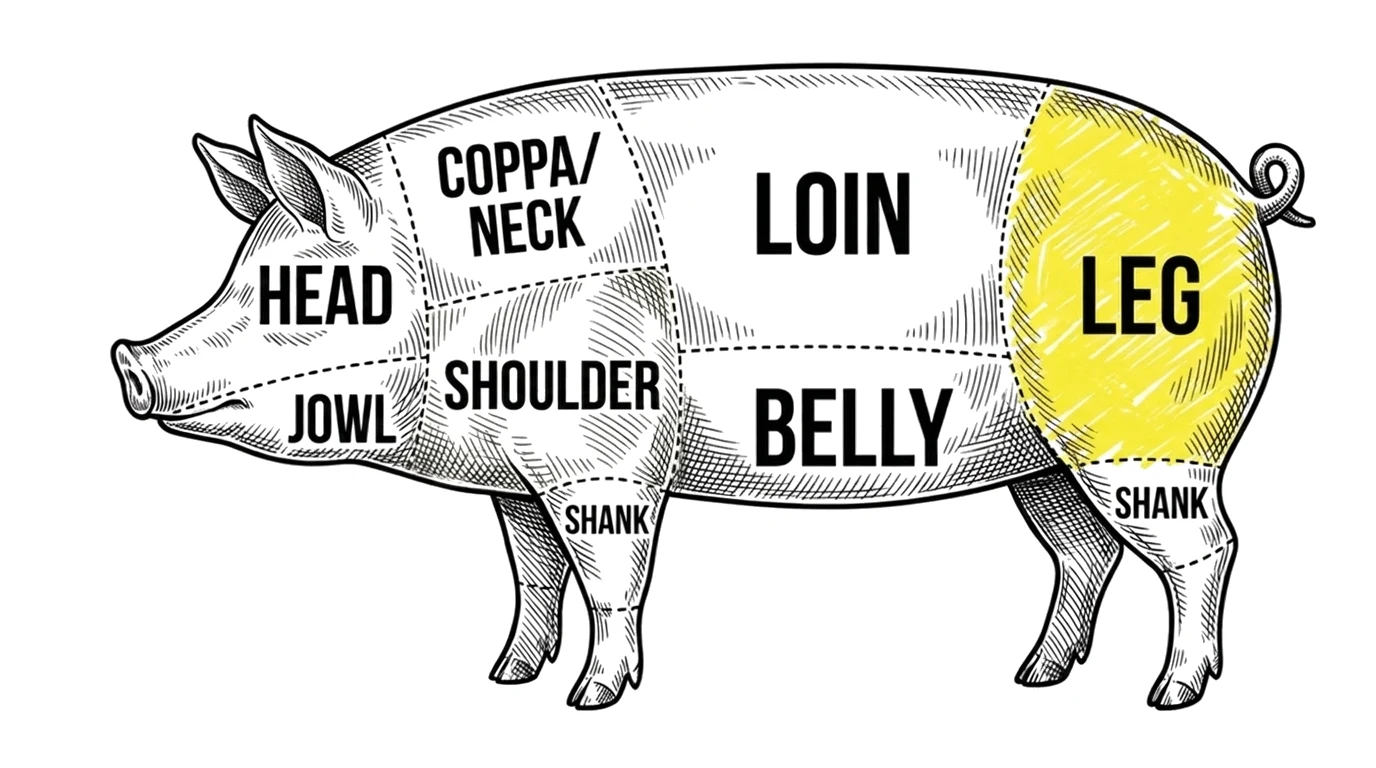
How to recognise it
A firm Alpine ham with red lean, a clean white fat edge and restrained pepper, juniper and dried-meat aromas. Smoke may occur in some commercial styles but is not treated as universal. A hard outer ring, wet grey centre, rancid fat, sourness or air beneath casing indicates an uneven cure.
- Shape and size
- Whole leg
- Lean colour
- Deep red
- Fat and marbling
- White
- Casing
- None
- Surface bloom
- Possible
Origins and history
A dry-cured mountain ham of Savoie in the French Alps, salted and rubbed with pepper and juniper, then matured in the cool, dry Alpine air. Firm and savoury, it belongs to the hearty charcuterie of the mountains, eaten with rye bread and Savoyard cheese. Savoy households used cold Alpine winters and ventilated barns to preserve large pork legs. Pepper, juniper and mountain herbs became common regional notes. The formal IGP project documented the tradition but did not lead to a current registered product. Legends and commercial origin stories are identified as such rather than used as proof of the current specification. France developed a formal IGP application dossier, but the name does not appear as a current registered EU geographical indication. The Atlas therefore uses the dossier to document intended characteristics without upgrading an application into completed protection.
Name. Jambon, ham; Savoie the Alpine region.
- Production today
- Producers across Savoie.
- Protection
- IGP.
- Tradition vs modern
- Alpine-air ageing with juniper.
- Seasonality
- Year-round.
Compare with. Jambon d'Auvergne, Vallée d'Aoste Jambon de Bosses
Serving and cultural significance
Sliced with rye bread and Savoyard cheese. Do not present Jambon de Savoie as a registered PGI. The workbook records the historical application specification as a technical reference only. it shows how place, material and process create identity. The reader can compare authenticity, legal status and practical home safety without confusing them. Thin slices suit Alpine cheese, bread, pickles and white wine, while trimmings can season potatoes or gratins.
Recipe and cure
This is not a finished recipe. It is a window into how this meat is traditionally cured. Before you follow any process, please run it through one of our curing calculators, so the salt, cure and timings are right and safe for your own batch.
Make this — the measured Curesmith version →The cure below is the traditional reference. “Make this” opens the measured Curesmith home recipe, scaled to your batch.
Traditional or protected production
The French IGP application describes a trimmed fresh ham of at least 9.5 kg, dry salted with sea salt for at least ten days, followed by mandatory cold resting, controlled drying and a total process of at least 240 days for the lightest class. The name does not appear as a currently registered EU GI.
Sea salt, black pepper and juniper, salt-box method; no fixed percentage.
- Meat
- pork
- Salt (%)
- traditional, no fixed %
- Curing salt
- Sea salt with pepper and juniper
- Fermented
- No
- Starter or mould
- Cellar mould
- Smoked
- No
- Target aW or weight loss
- ~ weight loss
- Temperature (°C)
- cold salting, then 10 to 15
- Humidity (%)
- 70 to 80
- Maturation
- 7 months and up
- Basis
- percentage of green meat weight
- Style
- Traditional dry salting (salt-box)
Method
- Salt and season by the traditional method and rest cold.
- Air-dry.
- Age in the cellar or mountain air.
- Age to the target loss.
Notes
- A more efficient way of curing this product is using the EQ Method. No more than 2.5% salt to meat weight is required. To follow the EQ method, please use our whole-muscle EQ curing calculator to work out proper ratios and curing times.
In the Codex
What this product teaches, and where to read more.
Temple. Roof, Microclimate