
Overview
Jambon persillé is a Burgundian cold charcuterie preparation made from cooked pieces of pork set in a parsley-rich, garlic-seasoned jelly. It is moulded, chilled and sliced, showing a mosaic of pink or pale meat and green herbs. The family includes regional and commercial variations, while Label Rouge claims belong only to compliant certified production.
Where it's from
The cut
Identity and quality boundary
The product is not simply ham sprinkled with parsley. Its identity depends on substantial cooked pork pieces bound in a seasoned gel and presented cold. A French Label Rouge specification establishes additional raw-material, composition, parsley, drained-piece and processing requirements. Those requirements should be described as a controlled quality branch rather than attributed to every Burgundian maker.
Composition and characteristics
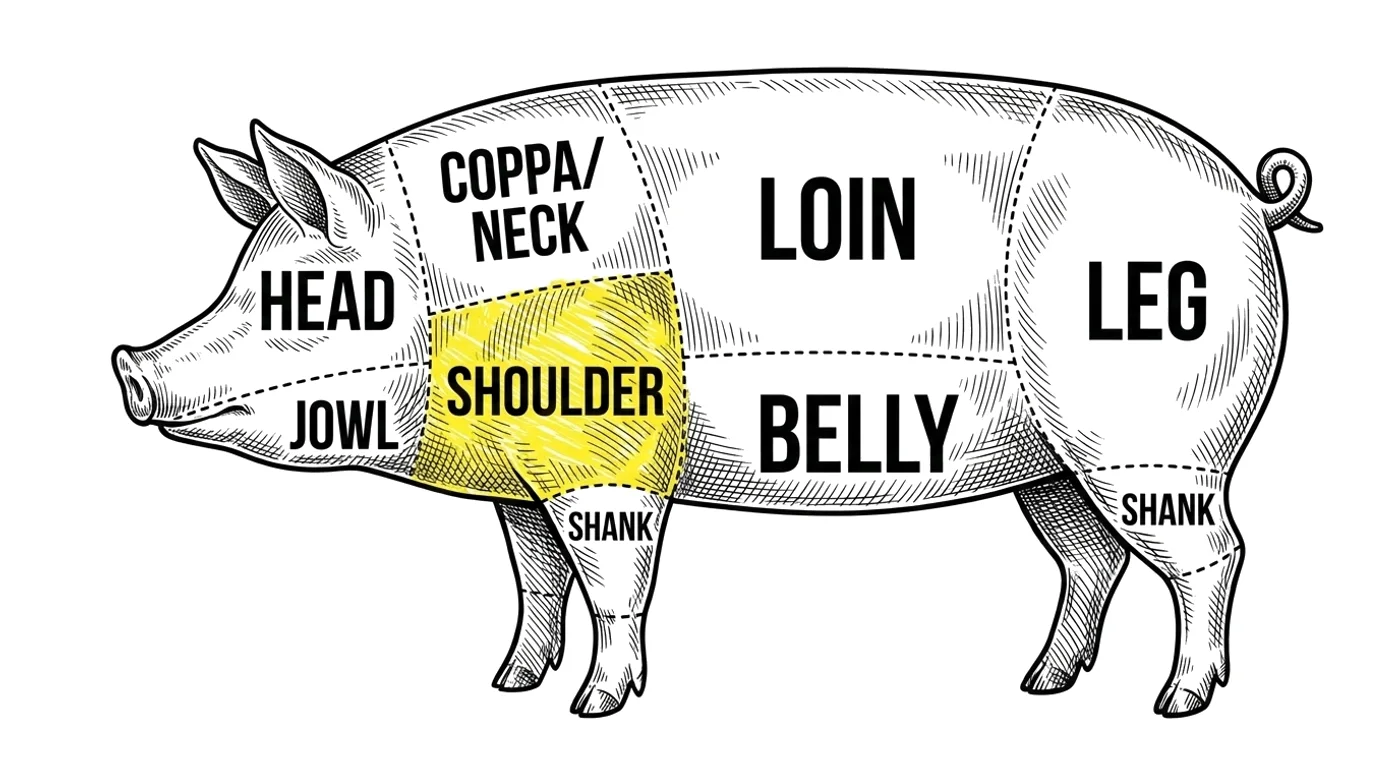
Ham and shoulder are common meat components, combined with clarified cooking liquor or prepared jelly, generous parsley, garlic and seasoning. Some formulas include wine, vinegar or aromatics. A good slice holds together while remaining tender, with clearly visible meat pieces, evenly distributed herbs and a clean gel that is neither rubbery nor watery.
Production method
Pork pieces are cured or seasoned as required by the selected branch, cooked until the centre reaches 71°C, trimmed and portioned. The gel is prepared separately, then combined with meat and parsley in moulds under hygienic conditions. The product is cooled rapidly until set, unmoulded or sliced cold and held under refrigeration throughout distribution and service.
History and cultural context
Jambon persillé is closely associated with Burgundy and is often linked to Easter and festive spring eating, when parsley provides its defining colour and freshness. It became a recognised charcutier product sold by weight or in moulded loaves. Modern quality schemes preserve one documented specification within a wider living regional tradition.
Culinary use and relationships
The product is served chilled in thick or thin slices with bread, mustard, cornichons, salad or a glass of regional wine. It belongs beside aspic meats and cooked ham but is not interchangeable with head cheese, pressed ham or plain ham in jelly. Label Rouge treatment should appear as a verified branch and labelling claim.
Recipe and cure
This is not a finished recipe. It is a window into how this meat is traditionally cured. Before you follow any process, run it through one of our curing calculators so the salt, cure and timings are right and safe for your own batch.
Make this — the measured Curesmith version →“Make this” opens the same cure as a measured recipe, scaled to your batch.
- Meat
- Pork shoulder
- Cut
- Pork shoulder
- Salt (%)
- 1.75
- Curing salt
- Cure #1/#2 as specified
- Fermented
- No
- Smoked
- No
- Basis
- per 1,000 g pork shoulder
- Style
- Cooked pork in parsley-rich wine jelly.
Ingredients
- Pork shoulder100% · 1000 g
- Pork hock or skin-on shank45% · 450 g
- Fine salt1.7% · 25 g
- Cure #1 containing 6.25% sodium nitrite0.25% · 3.5 g
- Dry white wine24.6% · 357 g
- Water or pork stock48.3% · 700 g
- Fresh parsley, chopped4.9% · 71.5 g
- Garlic0.49% · 7 g
- Black pepper0.2% · 3 g
- Gelatine1.5% · 21.5 g
Safety. Cook the pork to a validated cold-point endpoint, protect it from contamination during cutting and mould filling, prepare the jelly hygienically and cool the assembled product rapidly. Keep refrigerated and apply a validated shelf life; set gel does not prevent growth of refrigerated ready-to-eat pathogens.