
Jambon persillé de Bourgogne
Burgundy, Bourgogne-Franche-Comte, France
Chunks of ham set in a parsley-and-wine jelly, a Burgundian Easter dish.
Overview
Jambon persillé de Bourgogne is chunks of ham set in a parsley-and-wine jelly, a burgundian easter dish. Large pink pork pieces held in clear, green-flecked parsley jelly, with garlic, white wine and light acidity. The jelly should be clean and firm, not cloudy or rubbery. The Codex treats the product as a complete curing or cooking system, not simply a famous name. Raw material, cut or particle size, casing, smoke, fermentation, heat treatment and maturation all contribute to the result. The current legal or quality status is French national IGP recognition approved 11 June 2026 : EU registration pending. The source tradition and the Curesmith home method are kept separate.
Where it's from
Climate. Burgundy.
Altitude. Cote-d'Or and beyond
The cut
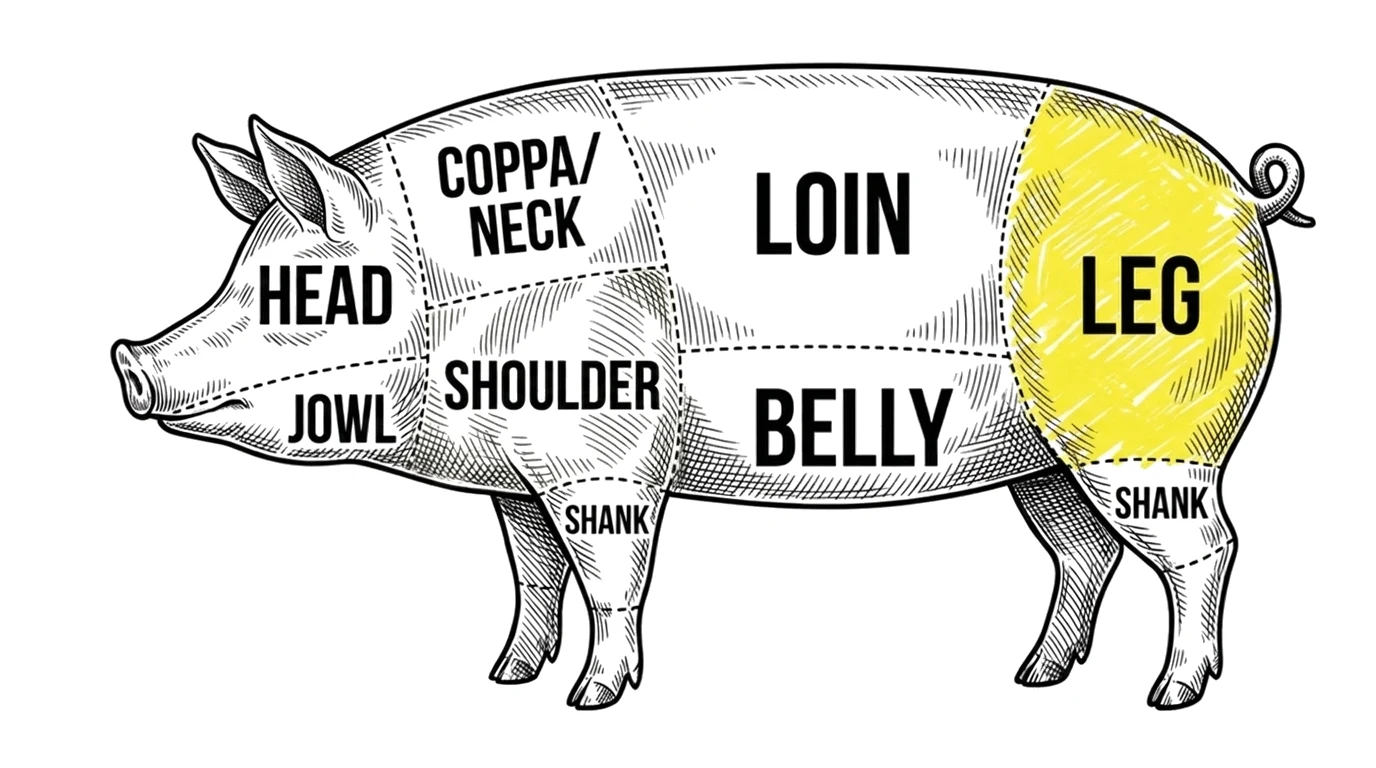
How to recognise it
Large pink pork pieces held in clear, green-flecked parsley jelly, with garlic, white wine and light acidity. The jelly should be clean and firm, not cloudy or rubbery. A raw or grey centre, split filling, sourness, greasy purge or broken refrigeration is unacceptable.
- Shape and size
- Sliced terrine, pink in green-flecked jelly
- Lean colour
- Pink ham chunks
- Fat and marbling
- Set in aspic
- Casing
- Mould
- Surface bloom
- None
Origins and history
A Burgundian Easter speciality, jambon persille, made by cooking ham until tender, breaking it into chunks and setting it in a jelly flavoured with white wine, parsley and garlic. Sliced, it shows pink ham suspended in green-flecked aspic. Traditionally eaten at Easter, it is a cool, fresh, festive charcuterie. The product is associated with Burgundian Easter tables, when cured or fresh pork was slowly cooked, broken into pieces and set in a bright parsley jelly. Wine and vinegar lighten the richness and create the recognisable green-and-pink slice. Legends and commercial origin stories are identified as such rather than used as proof of the current specification. On 11 June 2026, the French national committee voted in favour of recognising the name as an IGP. The decision confirms its Burgundian reputation and characteristic moulding with white wine, parsley and binder, but the European registration process was not yet complete.
Name. Jambon persille, 'parsleyed ham'; Bourgogne, Burgundy.
- Production today
- Producers across Burgundy.
- Protection
- Not EU-protected as a general name.
- Tradition vs modern
- A traditional Easter dish.
- Seasonality
- Especially at Easter.
Compare with. Coppa di testa
Serving and cultural significance
Sliced cold with bread and a Burgundy wine. Update the status to the June 2026 French national approval, while keeping EU registration explicitly pending. The product is cooked, not dry cured. it shows how place, material and process create identity. The reader can compare authenticity, legal status and practical home safety without confusing them. Serve cool in substantial slices with mustard, cornichons, bread and white Burgundy so the parsley, wine and gelatin remain distinct.
Recipe and cure
This is not a finished recipe. It is a window into how this meat is traditionally cured. Before you follow any process, please run it through one of our curing calculators, so the salt, cure and timings are right and safe for your own batch.
Curesmith home adaptation — not designation-compliant
Make this — the measured Curesmith version →The cure below is the traditional reference. “Make this” opens the measured Curesmith home recipe, scaled to your batch.
Traditional or protected production
Jambon persillé de Bourgogne is a cooked charcuterie of pork or ham pieces set in a strongly parsley-flecked jelly, commonly with white wine, garlic, vinegar and aromatics. The French national committee approved its recognition as an IGP on 11 June 2026, but it should not be presented as fully EU-registered until the European process is complete.
- Meat
- pork
- Salt (%)
- 1.8
- Curing salt
- None; a cooked ham set in jelly
- Fermented
- No
- Smoked
- No
- Target aW or weight loss
- cooked, not dried
- Temperature (°C)
- cooked through to a safe core temperature
- Humidity (%)
- n/a
- Maturation
- cooked; then eaten
- Basis
- per 1000 g green meat
- Style
- Traditional, cooked
Ingredients
- cooked ham (base)100% · 1000 g/kg
- dry white wine15% · 150 g/kg
- parsley2% · 20 g/kg
- garlic0.5% · 5 g/kg
- sea salt1% · 10 g/kg
Method
- Cook the ham until tender and break into chunks.
- Make a jelly from the stock with white wine, parsley and garlic.
- Layer ham and jelly in a mould.
- Chill until set; slice cold.
Notes
- The official protected specification controls the named product. Any Curesmith EQ, starter-culture, curing-salt or home-scale adaptation is a separate method and must not be presented as designation-compliant.
- This is a cooked product. It must be cooked through before eating. Where a cure is used it is Cure #1 (nitrite), suited to the shorter, cooked process rather than long drying.
In the Codex
What this product teaches, and where to read more.
Temple. Pillar, Meat Quality