
Jambon sec des Ardennes
Ardennes, Grand Est, France
Mellow and savoury, a northern dry ham shaped by a cool, damp climate.
Overview
Jambon sec des Ardennes is the unsmoked French ham of the Ardennes, legally distinct from Belgium's smoked Jambon d'Ardenne. The PGI also covers noix cuts from the ham. Long maturation, modest seasoning and a clean dry texture define the French product.
Where it's from
Climate. The cool, damp forested Ardennes of north-eastern France.
Altitude. Ardennes uplands
The cut
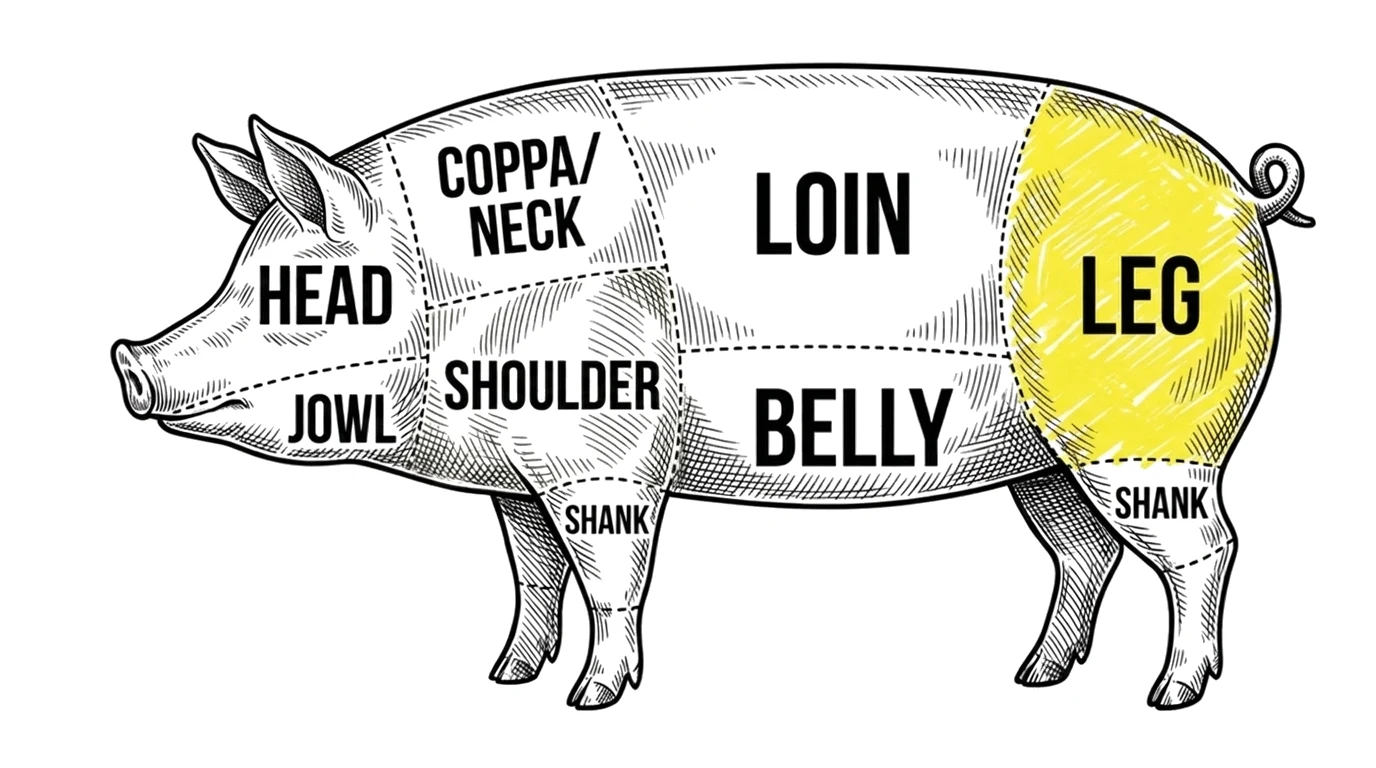
How to recognise it
The whole ham or boneless noix has a dry brown exterior and a red, compact slice with white fat. Aroma is clean and cured, without the smoke expected in the Belgian product. A harsh smoky note, rancidity, grey wet centre or severe outer hardness is inconsistent with the French style.
- Shape and size
- Whole leg
- Lean colour
- Red
- Fat and marbling
- White
- Casing
- None
- Surface bloom
- Possible
Origins and history
The wooded French Ardennes supported pigs, small farms and winter preservation, while trade crossed a border that later divided similar regional names between France and Belgium. French households dry salted legs and noix cuts without making smoke the defining flavour. The name acquired commercial value in local markets, but confusion grew because Belgian Jambon d'Ardenne developed a protected smoked identity of its own. French producers therefore had to protect both geography and method. The PGI specifies unusually clear minimum maturation periods: 360 days for a whole ham, 120 days for a large noix and 45 days for the smaller noix. Those distinctions show that the protected family is organised by muscle size as well as place.
Name. Jambon sec, dry ham; Ardennes the region.
- Production today
- Producers in the Ardennes.
- Protection
- IGP.
- Tradition vs modern
- Cool, damp-climate curing.
- Seasonality
- Year-round.
Compare with. Jambon d'Auvergne
Serving and cultural significance
Slice the whole ham thinly, while noix can be cut slightly thicker. Serve with bread, mustard, pickles, local beer or light red wine. Its clean cure also works in salads and warm potato dishes. The unsmoked character makes it especially suitable for dishes where a stronger smoked ham would dominate the vegetables or cheese.
Recipe and cure
This is not a finished recipe. It is a window into how this meat is traditionally cured. Before you follow any process, please run it through one of our curing calculators, so the salt, cure and timings are right and safe for your own batch.
Curesmith home adaptation — not designation-compliant
Make this — the measured Curesmith version →The cure below is the traditional reference. “Make this” opens the measured Curesmith home recipe, scaled to your batch.
Traditional or protected production
The PGI protects Jambon sec des Ardennes and the specified noix forms in the French Ardennes. Production is unsmoked, and the minimum maturation is 360, 120 or 45 days according to the protected form.
Sea salt, sometimes with a little juniper; salt-box method; no fixed percentage.
- Meat
- pork
- Salt (%)
- traditional, no fixed %
- Curing salt
- Sea salt only
- Fermented
- No
- Starter or mould
- Natural cellar mould possible
- Smoked
- No
- Target aW or weight loss
- ~ weight loss
- Temperature (°C)
- cold salting, then 10 to 15
- Humidity (%)
- 70 to 80
- Maturation
- 7 to 12 months
- Basis
- percentage of green meat weight
- Style
- Traditional dry salting (salt-box)
Method
- Salt and season the cut by the traditional method and rest cold so the salt draws through.
- Wash or brush off surface salt and begin the slow dry.
- Case or hang as the style requires.
- Age to the target loss, judging by weight.
Notes
- The official protected specification controls the named product. Any Curesmith EQ, starter-culture, curing-salt or home-scale adaptation is a separate method and must not be presented as designation-compliant.
- A more efficient way of curing this product is using the EQ Method. No more than 2.5% salt to meat weight is required. To follow the EQ method, please use our whole-muscle EQ curing calculator to work out proper ratios and curing times.
In the Codex
What this product teaches, and where to read more.
Temple. Roof, Microclimate