
Jaternice / Jitrnice
Also known as Jaternice-Czech, Jitrnice, Czech jaternice
Czech Republic
Overview
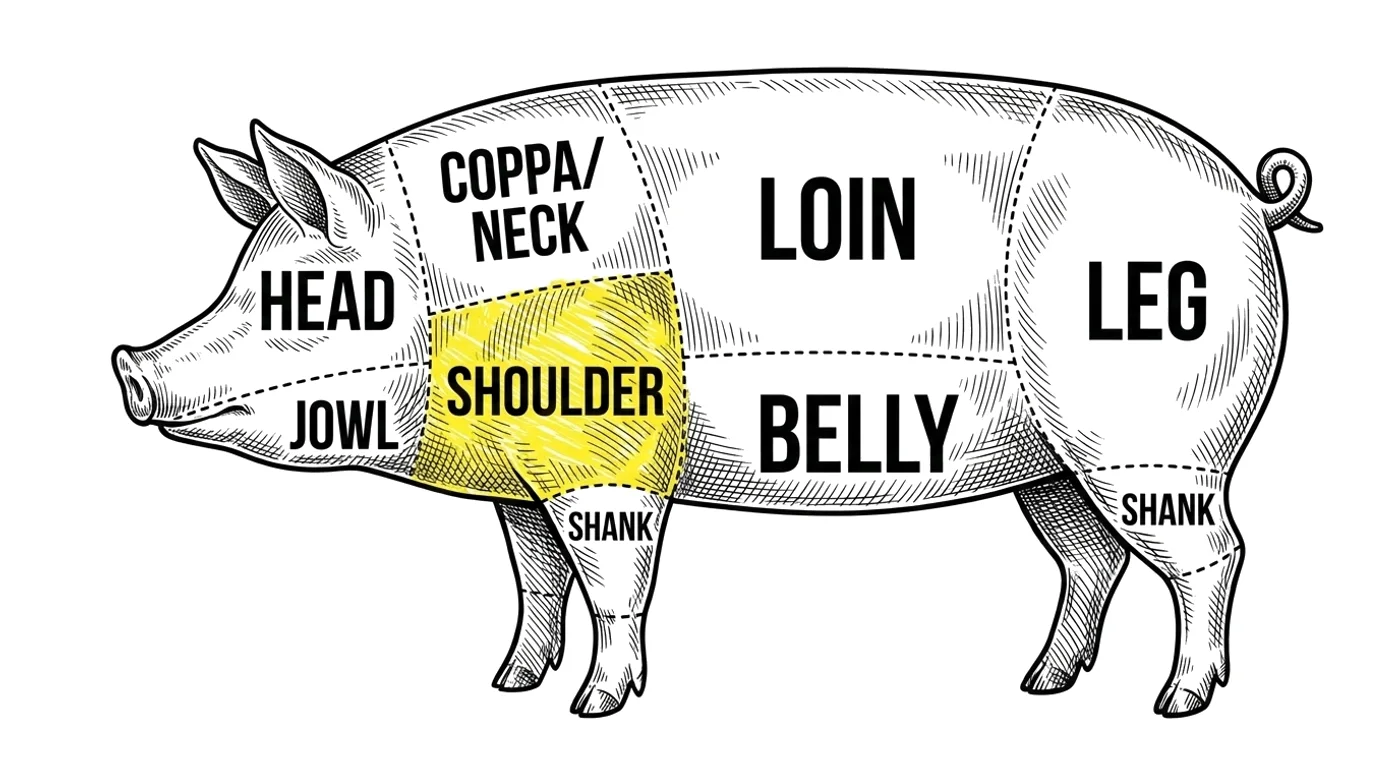
Jaternice, also written jitrnice, is a Czech heat-treated sausage of pork, edible offal and bread roll filled into natural casing. It is pale grey rather than cured pink, with a soft, visibly grainy filling that firms when cold and loosens on reheating. The Curesmith branch uses pork shoulder, head meat, liver, skin, heart and bread. That model is kept separate from the indexed source's barley-rich variation.
Where it's from
The cut
Identity and terminology
The paired names jaternice and jitrnice are both recognised in current Czech meat-product rules. The definition identifies a product for direct consumption in natural intestine and names pork skeletal muscle, pork offal and bread roll as basic materials. A gluten-free version may use an alternative binder, but ordinary bread-based product requires a wheat declaration. The name is a national product identity, not a registered geographical indication.
Composition and characteristics
Cooked head and shoulder meat provide body, liver supplies its characteristic mineral flavour, and finely minced skin sets the filling as it cools. Diced bread absorbs measured stock while keeping a loose crumb-like cut rather than an emulsion. Onion, garlic, marjoram, pepper and allspice give a restrained slaughter-season profile. A sound link is dry on the surface, firm when chilled and tender and granular when warmed.
Production and process
The pork meats and skin are simmered until tender and deboned; liver is poached separately to avoid excessive hardening. All cooked components and stock are chilled promptly before grinding. Moistened bread and seasoning are folded through the cold mince, which is stuffed loosely and poached again to a measured 74°C cold point. This second cook and controlled chilling are essential because the filling combines cooked offal, bread and stock.
History and regional forms
Jaternice belongs to the Czech zabijačka, the winter pig-slaughter tradition in which quickly perishable parts are transformed and shared. Public programmes at the Czech National Agriculture Museum still demonstrate the craft alongside other slaughter products. Household versions vary in offal balance and seasoning. Similar Slovak and Central European sausages exist, but their names and cereal choices should not be collapsed into one universal recipe.
Use, storage and related products
Serve jaternice warmed gently, baked or pan-browned with bread, potatoes, sauerkraut, mustard or pickles. Avoid hard frying that splits the fragile casing and expels the filling. Refrigerate at 0–4°C and use promptly or freeze. It differs from blood sausage because blood is not defining, and from smooth liverwurst because the Czech product retains a clearly grainy pork, offal and bread structure.
Recipe and cure
This is not a finished recipe. It is a window into how this meat is traditionally cured. Before you follow any process, run it through one of our curing calculators so the salt, cure and timings are right and safe for your own batch.
Make this — the measured Curesmith version →“Make this” opens the same cure as a measured recipe, scaled to your batch.
- Meat
- Pork shoulder
- Cut
- Pork shoulder
- Salt (%)
- 1.6
- Curing salt
- None
- Fermented
- No
- Starter or mould
- None; this product is not fermented
- Smoked
- No
- Maturation
- Refrigerate at 0–4°C; use within 3 days or freeze promptly
- Basis
- per 1,000 g pork shoulder
- Style
- uncured, twice-cooked Czech pork-and-offal sausage
Ingredients
- Pork shoulder100% · 1000 g
- Deboned pork head and cheek meat55% · 550 g
- Pork liver35% · 350 g
- Cleaned pork skin20% · 200 g
- Pork heart10% · 100 g
- Day-old white bread roll, diced12.1% · 266.5 g
- Defatted cooking stock12.1% · 266.5 g
- Softened onion5.1% · 111 g
- Fresh garlic1% · 22 g
- Fine salt1.6% · 35.5 g
- Black pepper0.2% · 4.5 g
- Dried marjoram0.15% · 3.5 g
- Ground allspice0.05% · 1 g
Method
- Clean the head meat, skin, heart and liver carefully. Simmer the pork meats and skin until tender; poach the liver separately only until cooked.
- Drain the cooked parts, reserve defatted stock and chill everything promptly to 5°C or below.
- Moisten the diced bread roll with the measured stock and soften the onion.
- Grind each chilled fraction as specified, then fold it with bread, onion, garlic and seasoning to a visibly grainy mass.
- Fill the hog casings loosely and form short links.
- Poach at 78–82°C until the cold point reaches 74°C.
Safety. Use inspected edible offal, debone meticulously, cool cooked components promptly, reach 74°C after stuffing and declare wheat and gluten.