
Jauersche
Also known as Jauersche Wurst, Jauersche Brühwurst
Germany
Overview
Jauersche is a narrow cured German Brühwurst made from finely comminuted beef and pork with bacon or pork fat. It is smoked, cooked and sold as a reddish link with a close-textured slice. Current German meat guidelines place it with Vienna-style and related scalded sausages while allowing Jauersche to remain somewhat coarser. The batch branch preserves that slight grain instead of turning the filling into a completely smooth frankfurter emulsion.
Where it's from
The cut
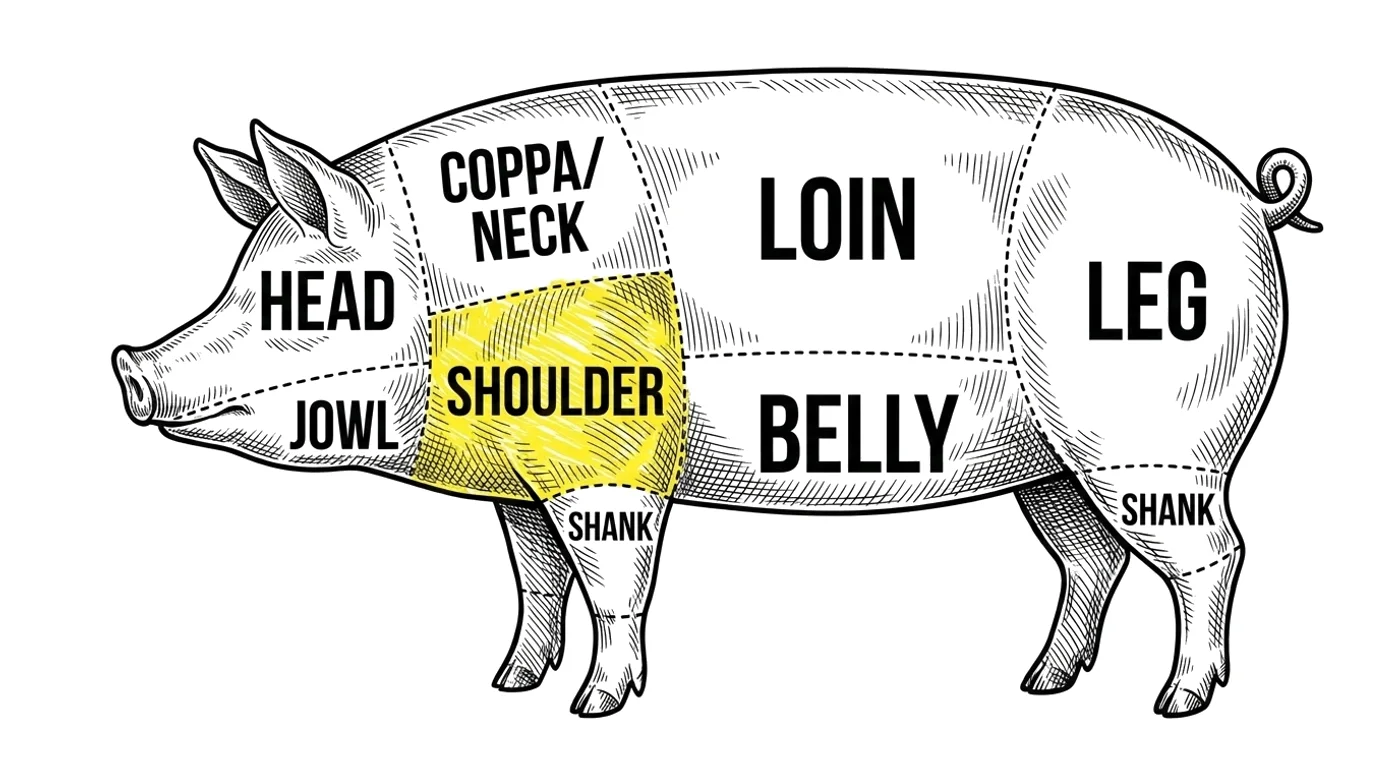
Identity and terminology
The official guideline name establishes a German product identity but does not establish a protected geographical origin. Explanations connecting the sausage to Jauer, now Jawor in Lower Silesia, circulate widely, yet the available primary product rule does not prove that etymology. The name is well attested. The town-origin story behind it is not. Jauersche also remains distinct from Jagdwurst, which uses a broader casing and visible coarse inclusions.
Composition and characteristics
Lean pork supplies most of the matrix, pork belly and back fat add succulence, and a small beef fraction strengthens the bind. Cure produces the red cut and characteristic cured aroma. Pepper, mace, coriander, cardamom and ginger create a warm but delicate seasoning. The link is typically narrower than a ring Fleischwurst, with a taut smoked casing and fine slice that may show a little more particle definition than Wiener Würstchen.
Production and process
Well-chilled meat and fat are ground finely, then mixed or bowl-cut with salt, Cure #1 and crushed ice while the batter remains below 10°C. The mass is filled into sheep casing, cured under refrigeration, surface-dried and smoked at moderate temperature. Poaching to a measured 71°C cold point completes lethality. Rapid cooling fixes the texture and prevents the post-cook temperature window from becoming a bacterial-growth stage.
History and regional forms
Jauersche belongs to the German family of cured scalded sausages developed for a resilient, ready-to-eat link rather than long dry storage. Its naming history is less secure than its technical identity, so regional assertions require cautious attribution. Modern guideline classification is the controlling evidence used here. The product's narrow calibre and cured-smoked profile explain why it is often served in ways similar to Wiener or Bockwurst despite retaining its own name.
Use, storage and related products
Eat Jauersche cold, warm it gently in water below a boil, or serve it with bread, mustard, potato salad or sauerkraut. Keep it refrigerated because smoking and curing do not make this home branch shelf stable. The sausage differs from uncured fresh bratwurst, from the coarser Jagdwurst family and from dry Landjäger. A measured cook and cold chain remain required after smoking.
Recipe and cure
This is not a finished recipe. It is a window into how this meat is traditionally cured. Before you follow any process, run it through one of our curing calculators so the salt, cure and timings are right and safe for your own batch.
Make this — the measured Curesmith version →“Make this” opens the same cure as a measured recipe, scaled to your batch.
- Meat
- Pork shoulder
- Cut
- Pork shoulder
- Salt (%)
- 1.8
- Curing salt
- Cure #1 as specified in the recipe
- Fermented
- No
- Starter or mould
- None; this product is not fermented
- Smoked
- Yes
- Maturation
- Refrigerate at 0–4°C; use within 4 days or freeze promptly
- Basis
- per 1,000 g pork shoulder
- Style
- cured, smoked and cooked German narrow-calibre scalded sausage
Ingredients
- Pork shoulder100% · 1000 g
- Pork belly40% · 400 g
- Beef chuck20% · 200 g
- Pork back fat20% · 200 g
- Crushed ice10.1% · 182 g
- Fine salt1.8% · 32.5 g
- Cure #1, 6.25% sodium nitrite0.25% · 4.5 g
- White pepper0.2% · 3.5 g
- Ground mace0.05% · 0.9 g
- Ground coriander0.05% · 0.9 g
- Ground cardamom0.1% · 0.5 g
- Ground ginger0.03% · 0.5 g
Method
- Chill meat, fat, ice and equipment to 0–2°C.
- Grind the beef, pork, belly and back fat through 3 mm.
- Dissolve Cure #1 in part of the ice, mix it with meat and salt until tacky, then add spices, remaining ice and fat while fine-cutting.
- Fill the sheep casings, remove air and form 20–25 cm links, then refrigerate 8–12 hours.
- Dry the casing surface and smoke at 50–60°C for 45–75 minutes.
- Poach at 75–78°C until the cold point reaches 71°C.
Safety. Distribute Cure #1 through the complete animal block, keep the batter cold, reach 71°C and cool rapidly before refrigerated storage.