
Overview
Jerky is ready-to-eat dried meat made as strips or pieces, most commonly from sliced whole muscle but also from formed or comminuted meat. Drying is central to its texture and keeping quality, yet safe jerky depends on a validated combination of lethality, moisture control, final water activity, packaging and storage.
Where it's from
The cut
Identity and terminology
The word describes a broad international product family rather than one species or seasoning. Beef jerky is the dominant commercial form, with venison, poultry and other lawful species as children. Sliced whole-muscle jerky is the canonical branch here; ground-and-formed sticks or sheets must be identified because their structure and process behaviour differ.
Composition and characteristics
Whole-muscle jerky shows visible meat fibres and an irregular strip shape. Formed jerky is more uniform and may have a finer grain. Finished pieces range from pliable to firm but should not be wet, greasy or brittle from uncontrolled drying. Colour and flavour vary with species, marinade, smoke and heat treatment.
Production branches
Meat is trimmed, sliced or comminuted, seasoned and subjected to a validated heating and drying sequence. Some processes heat before drying; others combine controlled heat and humidity during drying. Poultry, game and formed products require route-specific validation. Final release depends on measured water activity and packaging rather than a visual dryness judgement.
History and cultural context
Drying strips of meat is an ancient preservation practice found across the Americas, Africa and Asia. The English name is linked to Andean charqui traditions, while modern jerky developed into a major packaged snack category. Industrial controls transformed a traditional dried food into a regulated ready-to-eat product with defined hazard controls.
Culinary use and relationships
Jerky is eaten as a portable snack, trail food or concentrated protein ingredient and may be chopped into travel meals. Related products include biltong, charqui, pemmican and meat sticks, but they differ in cut, acidification, fat, smoke, heat treatment or cultural identity. Beef, venison, turkey and the other single-species jerkies all sit within this family.
Recipe and cure
This is not a finished recipe. It is a window into how this meat is traditionally cured. Before you follow any process, run it through one of our curing calculators so the salt, cure and timings are right and safe for your own batch.
Make this — the measured Curesmith version →“Make this” opens the same cure as a measured recipe, scaled to your batch.
- Meat
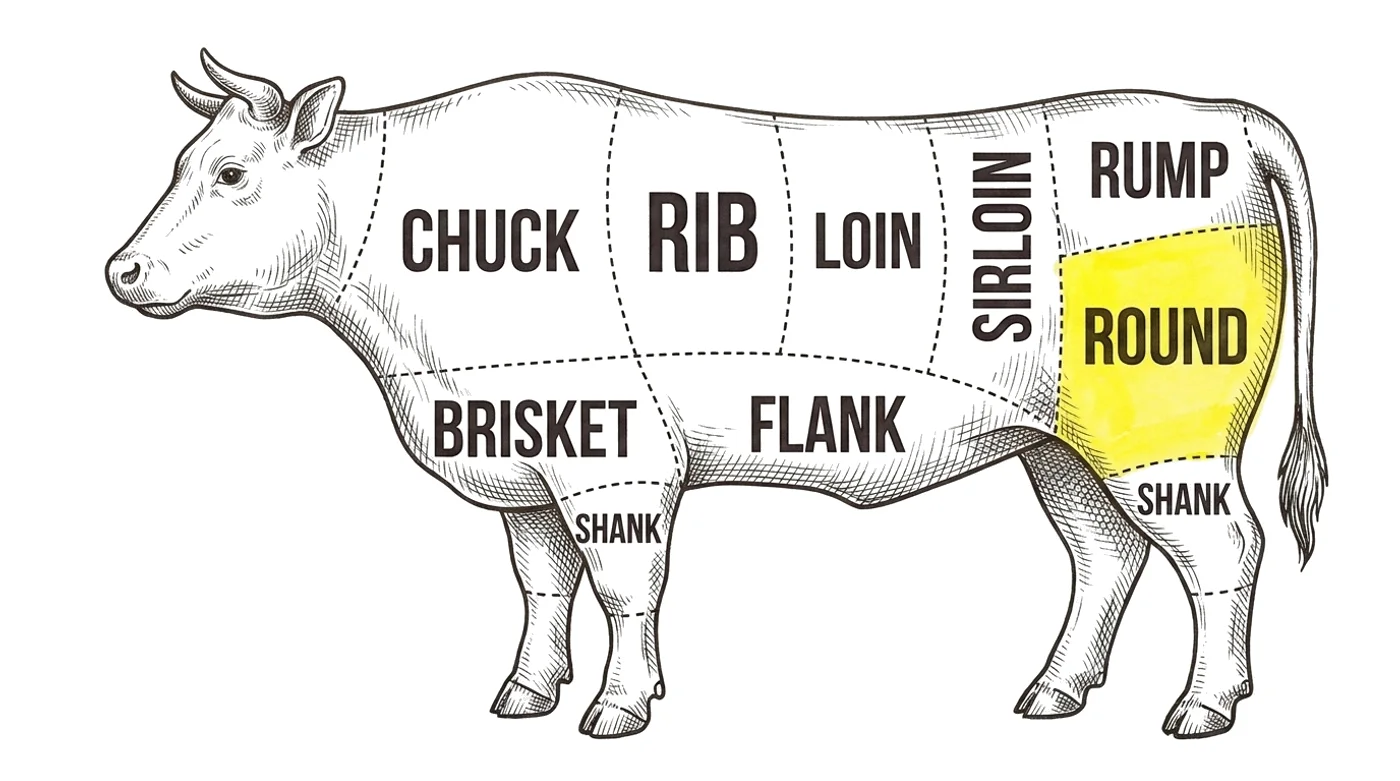
- Lean beef eye round, sliced 5 mm
- Cut
- Lean beef eye round, sliced 5 mm
- Salt (%)
- 1.8
- Curing salt
- Cure #1/#2 as specified
- Fermented
- No
- Smoked
- Yes
- Basis
- per 1,000 g lean beef eye round, sliced 5 mm
- Style
- Heat-treated and dried sliced beef jerky.
Ingredients
- Lean beef eye round, sliced 5 mm100% · 1000 g
- Fine salt1.8% · 18 g
- Cure #1 containing 6.25% sodium nitrite0.25% · 2.5 g
- Brown sugar1.5% · 15 g
- Black pepper0.3% · 3 g
- Garlic powder0.2% · 2 g
- Onion powder0.2% · 2 g
- Smoked paprika0.2% · 2 g
- Water5% · 50 g
Safety. Drying raw meat without an effective lethality step is unsafe. The process must control pathogens before or during moisture removal and avoid surface drying that protects organisms. Measure final water activity, validate thickest pieces, prevent post-process contamination, and use packaging and storage conditions supported by the validated process. Poultry and wild game need species-specific controls.