
Overview
Kabanosy are long, thin Polish sausage sticks with a cured red colour, smoky aroma and dry, firm texture. Their small diameter produces a characteristic snap and allows relatively rapid heating and drying. They are commonly eaten without further cooking when made through a validated ready-to-eat process.
Where it's from
The cut
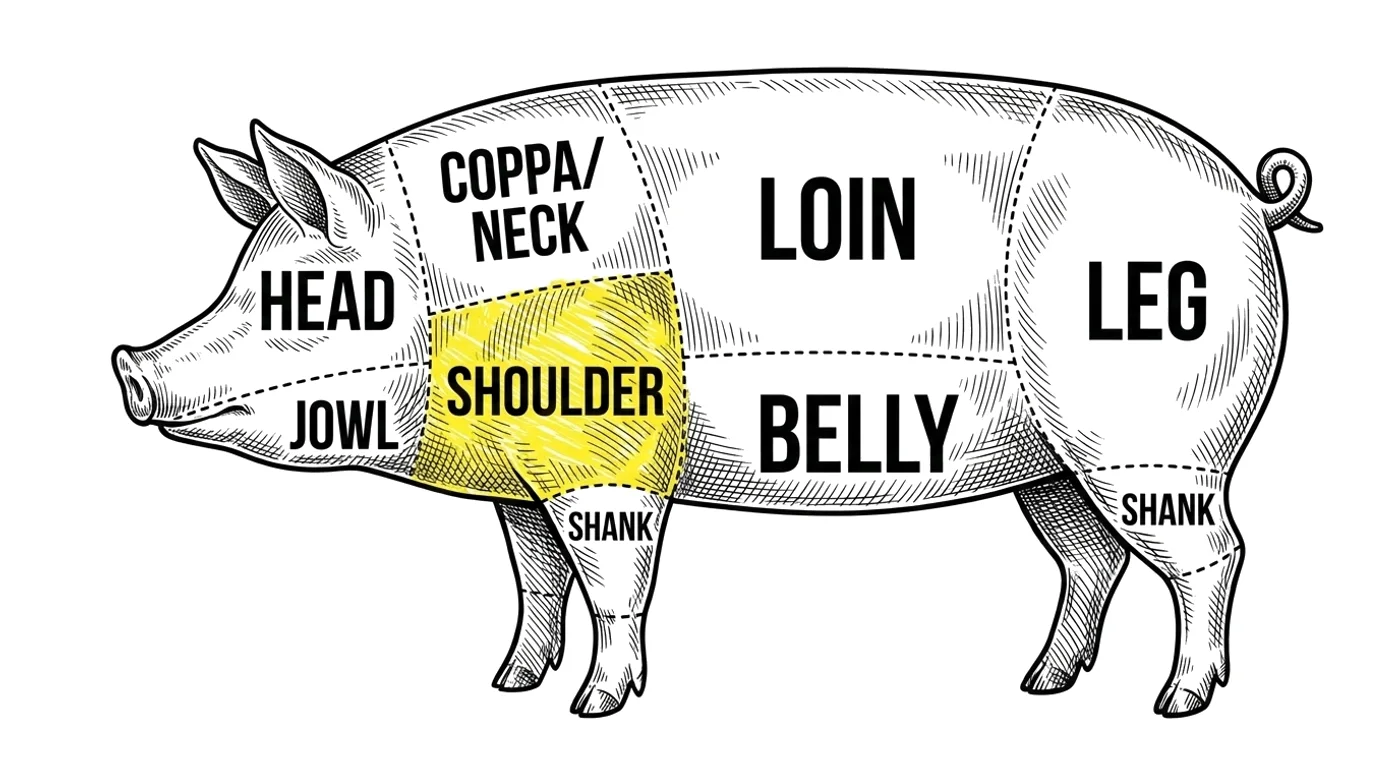
Identity and terminology
Kabanosy is the broad historical product name. The reserved TSG name is Kabanosy staropolskie, which protects a specified traditional composition and method rather than a geographical area. Generic products, foreign versions and species-labelled variants may not claim the reserved name unless they comply fully with the specification.
Composition and characteristics
Traditional forms are pork-based, finely to moderately ground and seasoned with pepper and other restrained spices. The sticks are narrow and evenly dried, with a clean smoked aroma and a brittle or crisp snap rather than a soft cooked-sausage bite. Fat should remain distinct rather than smeared. A good stick is narrow, evenly filled and dry without being hollow or brittle throughout. The surface should be clean and the interior should show a cohesive meat matrix with distinct fat. Severe wrinkling, wet centres or excessive hardness indicate process imbalance.
Production and process
The TSG method includes traditional dry curing, resting, stuffing into narrow casings, hot smoking and baking or heating to a specified internal temperature, followed by controlled drying to the required yield and texture. Generic Kabanosy may follow different routes, so cure, lethality, drying and release criteria must be stated rather than inferred from shape.
History and regional forms
Thin dry sausages were practical travel and storage foods in Poland. Kabanosy became one of the country's best-known sausage forms and later a major industrial export. The TSG registration preserves the staropolska method while leaving the generic product name available for non-TSG forms. The product's portability helped make it popular beyond Poland. Export and mass production broadened the generic family, which is why the distinction between ordinary kabanosy and the reserved Kabanosy staropolskie name is important.
Use, storage and related products
Kabanosy are eaten as portable snacks, served with bread, cheese and pickles or cut into cold platters. Storage depends on the verified water activity, packaging and process. Related forms include Landjäger and Salami Sticks, but each has its own identity and manufacturing route.
Recipe and cure
This is not a finished recipe. It is a window into how this meat is traditionally cured. Before you follow any process, run it through one of our curing calculators so the salt, cure and timings are right and safe for your own batch.
Make this — the measured Curesmith version →“Make this” opens the same cure as a measured recipe, scaled to your batch.
- Meat
- Pork shoulder
- Cut
- Pork shoulder
- Salt (%)
- 1.8
- Curing salt
- Cure #1/#2 as specified
- Fermented
- No
- Smoked
- Yes
- Basis
- per 1,000 g pork shoulder
- Style
- Generic cooked and lightly dried Kabanosy branch; not Kabanosy staropolskie TSG.
Ingredients
- Lean pork65% · 650 g
- Pork shoulder100% · 1000 g
- Fine salt1.8% · 30 g
- Cure #1 containing 6.25% sodium nitrite0.24% · 4 g
- Black pepper0.2% · 3.5 g
- Ground nutmeg0.1% · 1.5 g
- Sugar0.1% · 1.5 g
- Caraway0.1% · 1.5 g
Safety. The generic name does not establish a validated process. The reserved TSG child uses a defined dry-curing, smoking, heating and drying sequence. Any home or non-protected method requires correct cure calculation, validated lethality where used, controlled drying and a measured release endpoint such as water activity. Thin calibre does not guarantee safety.