
Kabanosy Staropolskie
Also known as Kabanosy, Kabanos, Old Polish kabanosy
Poland
Overview
Kabanosy staropolskie are thin Polish pork sticks protected as a Traditional Speciality Guaranteed. They are cured, seasoned, smoked, cooked and dried to a dark red, evenly wrinkled exterior and a firm, characteristically brittle bite. Their narrow sheep casing, paired-stick form and three-class pork structure make the identity more precise than the broad international use of kabanos for any slender smoked snack sausage.
Where it's from
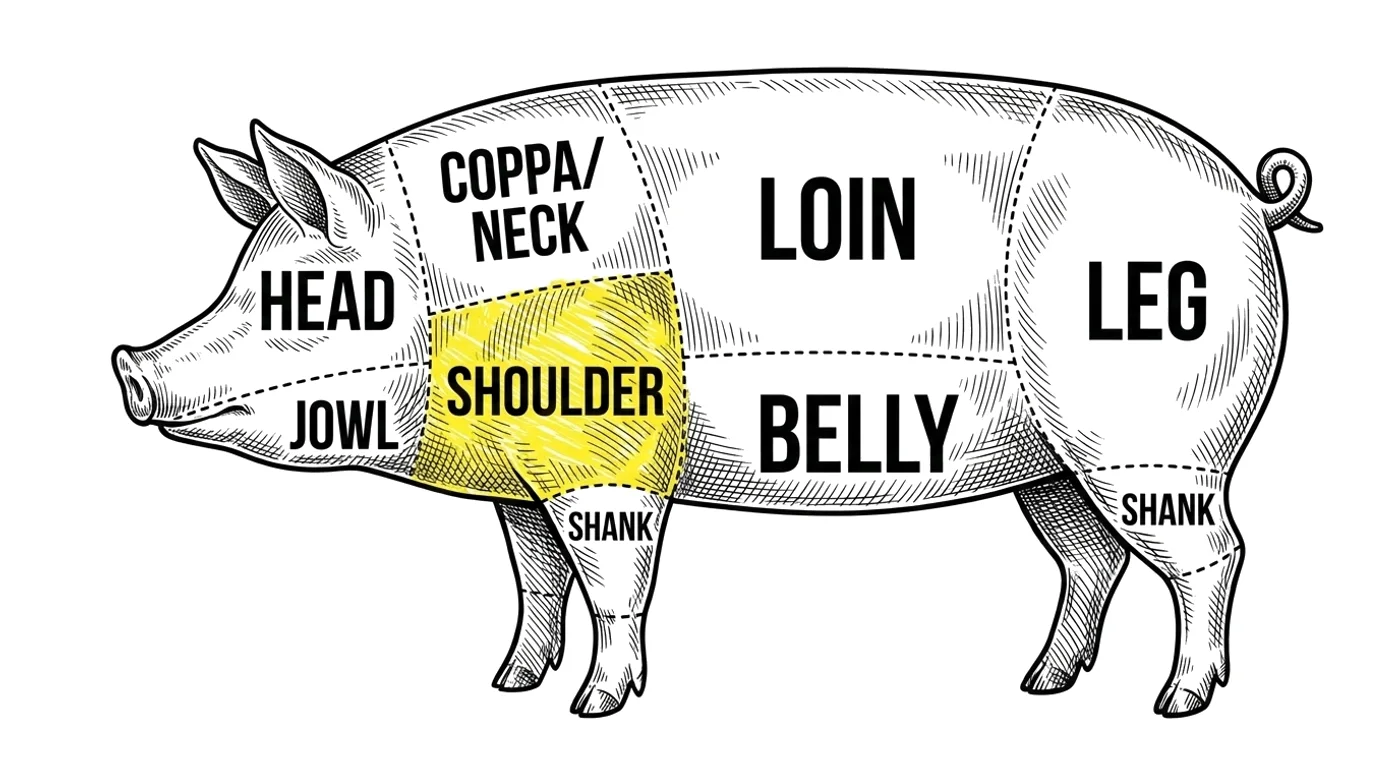
The cut
Identity and terminology
Kabanosy entered the EU register as a TSG in 2011, and Polish certification records use the reserved traditional name Kabanosy staropolskie. A Polish amendment application was published in 2026; this batch treats it as pending, not as an already effective EU specification. TSG protection concerns the traditional recipe and method, not exclusive production in one Polish region. Home production cannot claim certified status.
Composition and characteristics
The specification separates class I lean pork, class IIA medium-fat pork and class IIB fat pork, creating an irregular cut with red lean pieces and paler fat. Pepper, nutmeg, caraway and a small amount of sugar provide the characteristic warm, lightly sweet spice profile. The natural sheep casing is slender, commonly around 20–22 mm. Finished sticks are short, paired at the twist and noticeably drier than cooked Kabana.
Production and process
Each pork class is chilled and ground to retain its intended particle size, then mixed with salt, nitrite cure and seasoning. The filling is stuffed into sheep casing, dried, smoked and cooked before final drying. The Curesmith branch uses a 71°C cold-point endpoint, at least 32% recorded weight loss and a measured water-activity condition for any ambient-release assessment. No starter culture is added because this is not an intentionally fermented sausage.
History and regional forms
The thin stick developed as a portable, concentrated pork product whose smoke and dry texture distinguished it from larger cooked sausages. Its modern TSG status formalises composition and method while allowing production beyond a single locality. International products called cabanossi, cabana or meat sticks may be inspired by kabanosy, but different meat mixtures, diameters, fermentation claims and moist cooked textures keep those branches separate.
Use, storage and related products
Eat Kabanosy staropolskie as a dry snack, slice them onto a cold board, or pair them with bread, cheese, mustard and pickles. The home adaptation remains refrigerated unless the whole process receives a validated ambient release. It differs from Australian Kabana and Austrian Cabanossi, which may be moister cooked-smoked sausages, and from Kiełbasa jałowcowa staropolska, which is a larger juniper ring.
Recipe and cure
This is not a finished recipe. It is a window into how this meat is traditionally cured. Before you follow any process, run it through one of our curing calculators so the salt, cure and timings are right and safe for your own batch.
Make this — the measured Curesmith version →“Make this” opens the same cure as a measured recipe, scaled to your batch.
- Meat
- Pork shoulder
- Cut
- Pork shoulder
- Salt (%)
- 1.8
- Curing salt
- Cure #1 as specified in the recipe
- Fermented
- No
- Starter or mould
- None; this product is not fermented
- Smoked
- Yes
- Maturation
- Refrigerate at 0–4°C unless a competent process authority validates an ambient release
- Basis
- per 1,000 g pork shoulder
- Style
- cured, smoked, cooked and dried Polish thin pork sticks
Ingredients
- Pork ham75% · 750 g
- Pork shoulder100% · 1000 g
- Pork belly75% · 750 g
- Ice water8% · 200 g
- Fine salt1.8% · 45 g
- Cure #1, 6.25% sodium nitrite0.24% · 6 g
- Black pepper0.2% · 5 g
- Sugar0.1% · 2.5 g
- Ground nutmeg0.1% · 2.5 g
- Crushed caraway0.1% · 2.5 g
Method
- Separate the pork into ham, shoulder and belly and chill to 0–2°C.
- Dissolve Cure #1 in the ice water, distribute it with salt across the full animal block and refrigerate for 24–48 hours.
- Grind each cut as specified and mix with pepper, sugar, nutmeg and caraway until cohesive.
- Fill sheep casings, form paired thin sticks and remove visible air.
- Dry the surface, apply warm smoke, then raise the chamber gradually until the cold point reaches 71°C.
- Cool under control, then dry at 10–12°C and 75–80% relative humidity with gentle exchange until the lot loses at least 32% of stuffed weight.
Safety. Use accurate Cure #1, reach 71°C, dry under controlled conditions, record at least 32% weight loss and require aw evidence before ambient release.