
Kalbsbratwurst
Also known as Veal bratwurst, Kalbs-Bratwurst
Germany
Overview
Kalbsbratwurst is a pale German bratwurst made as a short-keeping, non-reddened sausage for scalding, reheating or frying. Its defining features are a light interior, fine or medium-fine texture and restrained warm seasoning rather than smoke, fermentation or dry curing. The source recipe uses veal alone, but that is one legitimate branch within a broader German identity rather than the universal definition.
Where it's from
The cut
Identity and terminology
The name literally means calf-meat bratwurst, yet current German meat guidelines do not require an all-veal formula. They place Kalbsbratwurst with Weißwurst and allow young beef or veal together with fatty pork and bacon. That legal composition matters because consumers should not infer one hundred per cent veal merely from an English translation. The name has no EU geographical protection and is not confined to one town.
Composition and characteristics
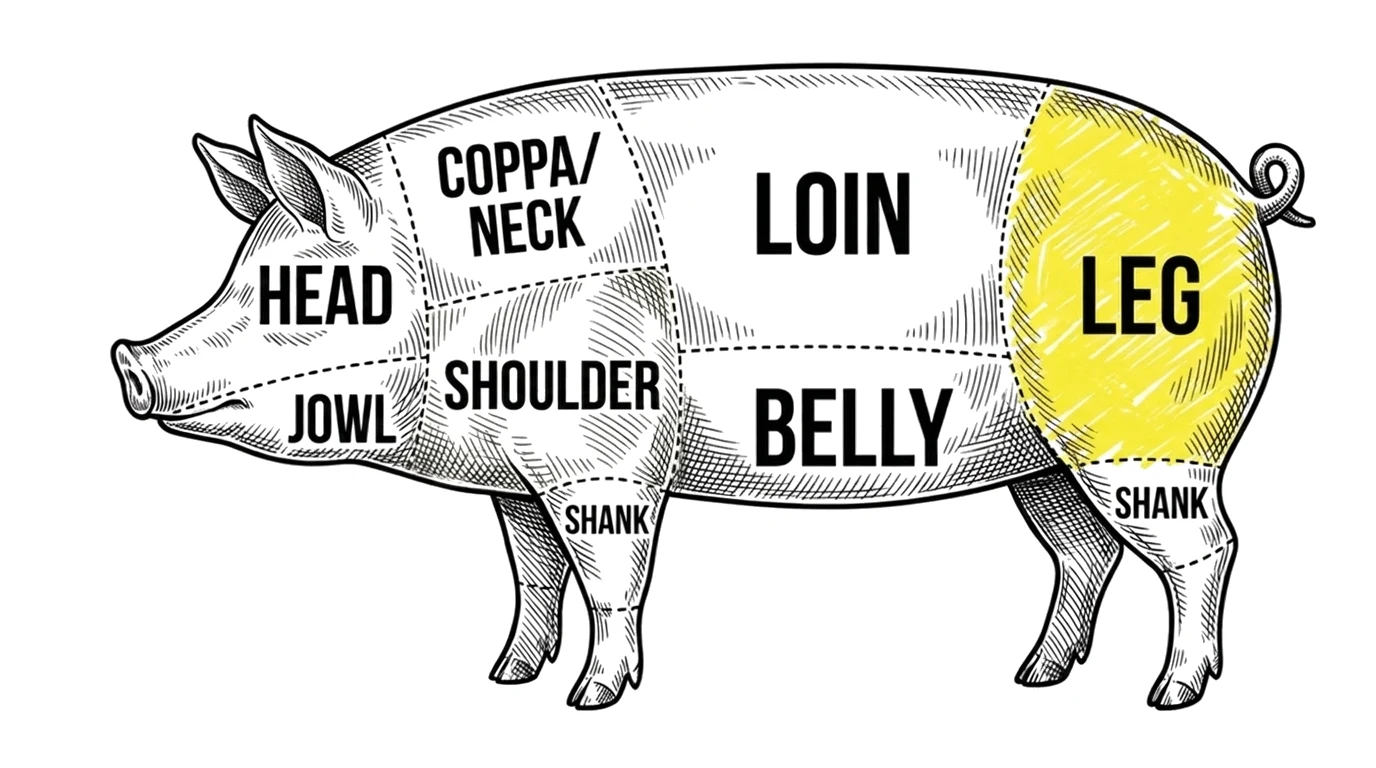
An all-veal version combines lean leg or shoulder with fatty breast and trimming meat. Mixed versions obtain additional fat and moisture from pork and bacon. The sausage is normally uncured, so the cooked slice stays ivory to light grey rather than cured pink. White pepper, mace and allspice support the delicate meat flavour. A narrow hog or sheep casing and a cohesive but not rubbery bind complete the characteristic profile.
Production and process
The meat and fat are kept close to freezing, ground finely or medium-finely and mixed with salt, spices and a small amount of ice water. Stuffed links are scalded rather than smoked. The executable all-veal branch uses a measured cold-point endpoint instead of a fixed cooking time, then applies rapid chilling. Because no nitrite cure or preservation step is used, process control depends on hygiene, full cooking and an uninterrupted cold chain.
History and regional forms
Kalbsbratwurst belongs to the wide German bratwurst tradition, but it should not be collapsed into Münchner Weißwurst. Weißwurst has its own casing, composition and service conventions, while Kalbsbratwurst may be sold raw for immediate cooking or already scalded. Nor is it a veal frankfurter: frankfurter-style sausages are cured, smoked and more finely emulsified. The distinctions are visible in colour, texture and intended service.
Use, storage and related products
Serve a scalded Kalbsbratwurst gently reheated with bread and mustard, or brown it briefly without drying the filling. Raw links must be cooked immediately; cooked links remain refrigerated and should be used quickly. An all-veal label should describe the actual formula, while a guideline-compliant mixed version should disclose pork and bacon clearly. The product's quality is expressed through freshness, pale colour and a clean, delicate bite.
Recipe and cure
This is not a finished recipe. It is a window into how this meat is traditionally cured. Before you follow any process, run it through one of our curing calculators so the salt, cure and timings are right and safe for your own batch.
Make this — the measured Curesmith version →“Make this” opens the same cure as a measured recipe, scaled to your batch.
- Meat
- Veal leg and shoulder
- Cut
- Veal leg and shoulder
- Salt (%)
- 1.8
- Curing salt
- None
- Fermented
- No
- Starter or mould
- None; this product is not fermented
- Smoked
- No
- Maturation
- Refrigerate at 0–4°C; use within 3 days or freeze promptly
- Basis
- per 1,000 g veal leg and shoulder
- Style
- uncured pale all-veal German scalded bratwurst
Ingredients
- Veal leg and shoulder100% · 1000 g
- Veal breast and fatty veal100% · 1000 g
- Ice water3% · 60 g
- Fine salt1.8% · 36 g
- White pepper0.2% · 4 g
- Ground mace0.1% · 2 g
- Ground allspice0.05% · 1 g
Method
- Trim the veal, weigh the fatty fraction and chill meat, water and equipment to 0–2°C.
- Grind lean and fatty veal together through 5 mm.
- Mix the ground veal with salt, spices and ice water until cohesive and tacky.
- Fill the casing without air pockets and form 15–20 cm links.
- Poach in 78–80°C water until the cold point reaches 71°C.
- Shower briefly and complete controlled chilling.
Safety. Keep the mixture cold, cook raw or scalded links to a verified 71°C cold point, cool rapidly and maintain refrigeration.