
Kiełbasa Czosnkowa
Also known as Garlic sausage, Polish garlic sausage, Czosnkowa
Poland
Overview
Kiełbasa czosnkowa is a Polish garlic-forward cooked sausage rather than one single protected regional formula. The source branch combines coarse pork and fat with a fine beef brät, cures the mixture, forms a large ring, hot-smokes it and poaches it. Fresh garlic is deliberately dominant, supported by pepper, marjoram, paprika and coriander. The finished sausage has a brown-red casing, cured pink interior and visibly mixed grain rather than the uniform surface of a frankfurter.
Where it's from
The cut
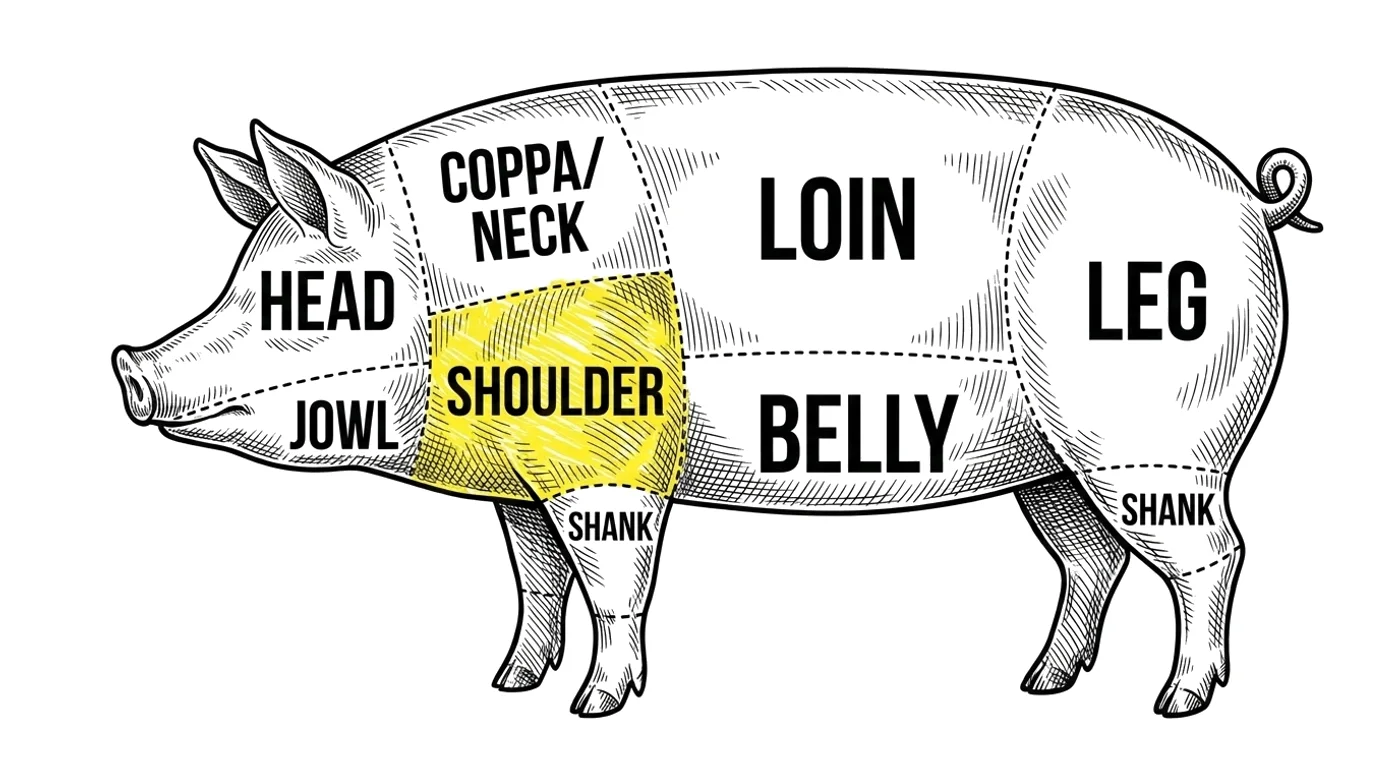
Identity and terminology
Czosnkowa is the feminine adjectival form of czosnek, garlic, agreeing with kiełbasa, sausage. The name therefore means garlic sausage and describes flavour rather than a specific town. Many Polish sausages contain garlic, but a product called czosnkowa makes it the organising spice. Regional sausages with their own registered names may also taste strongly of garlic; they should not be collapsed into this generic family. Likewise, American garlic sausage or garlic bologna belongs to a separate national usage.
Composition and characteristics
The formula uses lean pork ham for large visible pieces, somewhat fattier shoulder for body, beef for a fine binding brät and firm back fat for pale inclusions. Garlic at a clearly noticeable dose leads the aroma. Marjoram supplies the familiar Polish herbal note, while paprika and coriander add warmth without turning the sausage into chorizo. A beef round or smoke-permeable casing forms a broad ring whose cut face shows coarse pork held in a finer cured matrix.
Production and process
Meat and fat are cured cold with measured Cure #1, then ground separately to preserve contrasting particle sizes. The beef portion is fine-processed with ice water and seasoning until tacky, after which coarse pork and fat are folded through. The ring is stuffed, dried under controlled conditions, hot-smoked and poached to 71°C at the cold point. A cold shower begins cooling, followed by refrigeration to 5°C or below within the two-stage limit. The product is not fermented or shelf stable.
History and regional forms
Garlic has long been central to Polish household and butcher-shop kielbasa, especially in smoked sausages made around pig slaughter and preserved for winter meals. The generic czosnkowa label belongs to this wider practice, but it does not carry a single documented origin date comparable to a protected regional sausage. Poland's Traditional Products List records numerous named local meat products, many with garlic profiles, which demonstrates regional diversity rather than ownership of the broad descriptive name.
Use, storage and related products
Kiełbasa czosnkowa is sliced cold with rye bread, mustard, horseradish and pickles, warmed with cabbage or potatoes, or added to bigos, beans and soups. Garlic aroma is strongest soon after production and softens during storage. The coarse-and-fine structure distinguishes it from emulsified garlic bologna, while its cooked status separates it from raw fermented garlic salami. Store the ring at 0–4°C, keep sliced surfaces covered and freeze portions if they will not be used promptly.
Recipe and cure
This is not a finished recipe. It is a window into how this meat is traditionally cured. Before you follow any process, run it through one of our curing calculators so the salt, cure and timings are right and safe for your own batch.
Make this — the measured Curesmith version →“Make this” opens the same cure as a measured recipe, scaled to your batch.
- Meat
- Lean pork ham
- Cut
- Lean pork ham
- Salt (%)
- 1.8
- Curing salt
- Cure #1 as specified in the recipe
- Fermented
- No
- Starter or mould
- None; this product is not fermented
- Smoked
- Yes
- Maturation
- Refrigerate at 0–4°C; use within 4 days after opening or freeze promptly
- Basis
- per 1,000 g lean pork ham
- Style
- coarse cured, smoked and cooked Polish garlic sausage
Ingredients
- Lean pork ham100% · 1000 g
- Pork shoulder with approximately 25% fat55% · 550 g
- Lean beef chuck70% · 700 g
- Pork back fat55% · 550 g
- Ice water12.8% · 357 g
- Fine salt1.8% · 51.5 g
- Cure #1, 6.25% sodium nitrite0.25% · 7 g
- Fresh garlic, crushed0.61% · 17 g
- Black pepper0.2% · 5.5 g
- Dried marjoram0.15% · 4.5 g
- Sweet paprika0.1% · 3 g
- Ground coriander seed0.05% · 1.5 g
Method
- Dice the meats, distribute salt and Cure #1 through the complete meat-and-fat block, cover and cure at 3–5°C for 24–48 hours.
- Grind pork ham coarsely, shoulder and fat to 8–10 mm, and beef through 3 mm.
- Fine-process beef with ice water and seasonings, keeping the brät below 10°C.
- Fold the coarse pork and fat into the beef brät until evenly distributed and tacky.
- Stuff 40–45 mm casing firmly, form rings and remove air pockets.
- Dry under controlled conditions, then hot-smoke at 55–60°C until the casing is brown with a red tint.
Safety. Distribute Cure #1 across the full meat block, control the cold brät, cook to 71°C and refrigerate after rapid cooling.