
Kiełbasa Dębowiecka
Also known as Debowiecka sausage, Kiełbasa debowiecka
Podkarpackie, Poland
Overview
Kiełbasa Dębowiecka is an uncured smoked pork sausage from Dębowiec in Jasło County, south-eastern Poland. It was entered on Poland's List of Traditional Products in 2013 for Podkarpackie. The official description records long ring-shaped links, a brown-cherry surface and a brittle, relatively loose interior.
Where it's from
The cut
Identity and terminology
Dębowiecka is the adjectival form of Dębowiec and identifies the sausage with the village rather than with oak smoke, despite dąb meaning oak in Polish. The ministry record is a national traditional-product listing that documents cultural history; it is not an EU PDO, PGI or TSG and does not create the same certification system.
Composition and characteristics
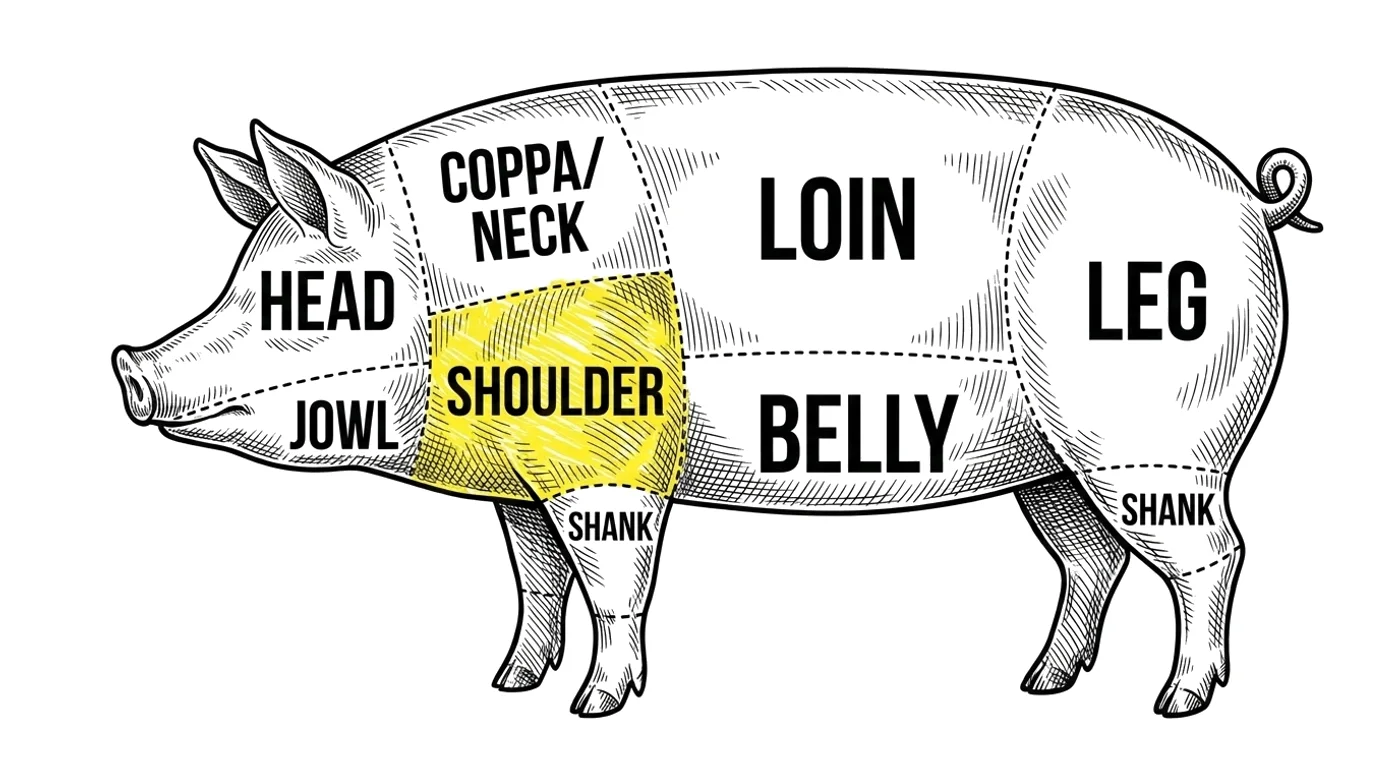
Traditional production uses pork from the ham and shoulder with some back fat, seasoned principally with salt, black pepper and garlic. The ministry description explicitly characterises the meat as unpeklowane, uncured. A cut link may show a grey or green-grey eye rather than the uniform pink expected from nitrite-cured sausage.
Production and process
The meat is ground and worked for an unusually long time until the mass binds and pulls cleanly from the hand. It is stuffed into cleaned natural casings, formed into rings and smoked slowly over fruitwood, especially apple or plum. Modern production needs a measured cooking step and refrigerated storage because smoke and surface drying alone do not establish shelf stability.
History and regional forms
The ministry's oral-history account describes Dębowiec butchers guarding family recipes and producing slightly different textures while preserving the uncured pork, garlic and smoke character. The sausage was made both for ordinary use and festivals. Claims that well-smoked links kept for months belong to historical practice, not an automatic modern safety status.
Use, storage and related products
Kiełbasa Dębowiecka is eaten sliced or warmed, with bread, mustard or pickled accompaniments. It differs from standard pink cured Polish smoked sausages through its uncured meat colour, pronounced garlic and fruitwood smoke, and brittle texture. A cured source adaptation must be labelled as such rather than presented as the controlling traditional identity.
Recipe and cure
This is not a finished recipe. It is a window into how this meat is traditionally cured. Before you follow any process, run it through one of our curing calculators so the salt, cure and timings are right and safe for your own batch.
Make this — the measured Curesmith version →“Make this” opens the same cure as a measured recipe, scaled to your batch.
- Meat
- Lean pork ham muscles
- Cut
- Lean pork ham muscles
- Salt (%)
- 2
- Curing salt
- None
- Fermented
- No
- Starter or mould
- None; this product is not fermented
- Smoked
- Yes
- Maturation
- Refrigerate at 0–4°C; use within 4 days or freeze promptly
- Basis
- per 1,000 g lean pork ham muscles
- Style
- uncured Polish coarse pork sausage, fruitwood-smoked and cooked
Ingredients
- Lean pork ham muscles100% · 1000 g
- Pork shoulder70% · 700 g
- Pork back fat30% · 300 g
- Ice water3% · 60 g
- Fine salt2% · 40 g
- Black pepper0.2% · 4 g
- Fresh garlic, crushed to a paste0.3% · 6 g
Method
- Chill trimmed ham, shoulder and back fat to 0–2°C and chill the grinder.
- Grind ham through 12 mm and shoulder and back fat through 8 mm.
- Mix pork with salt, pepper, garlic paste and ice water until the mass is strongly tacky.
- Stuff into hog casings, form 30–35 cm rings and remove trapped air.
- Dry the surface, then smoke slowly over clean apple, plum or other suitable hardwood while raising chamber heat gradually.
- Finish in the smokehouse or a controlled oven until the cold point reaches 71°C.
Safety. The official identity is uncured. Historical keeping claims do not prove shelf stability; use a verified cooking endpoint, rapid cooling and refrigeration unless a separate validated process exists.