
Kiełbasa Głogowska
Also known as Głogowska sausage, Glogovska
Podkarpackie, Kolbuszowa Plateau, Poland
Overview
Kiełbasa Głogowska is a smoked pork sausage from Głogów Małopolski on the Kolbuszowa Plateau north of Rzeszów. Poland's Ministry of Agriculture entered it on the List of Traditional Products in 2006. The official description emphasises small, relatively uniform loops arranged spirally, a lightly wrinkled natural casing and an uneven cut face with small pieces of meat, occasional fat and pepper. Its flavour is strongly smoky, garlicky and peppery. National traditional-list recognition documents heritage but is not the same as EU PDO, PGI or TSG protection.
Where it's from
The cut
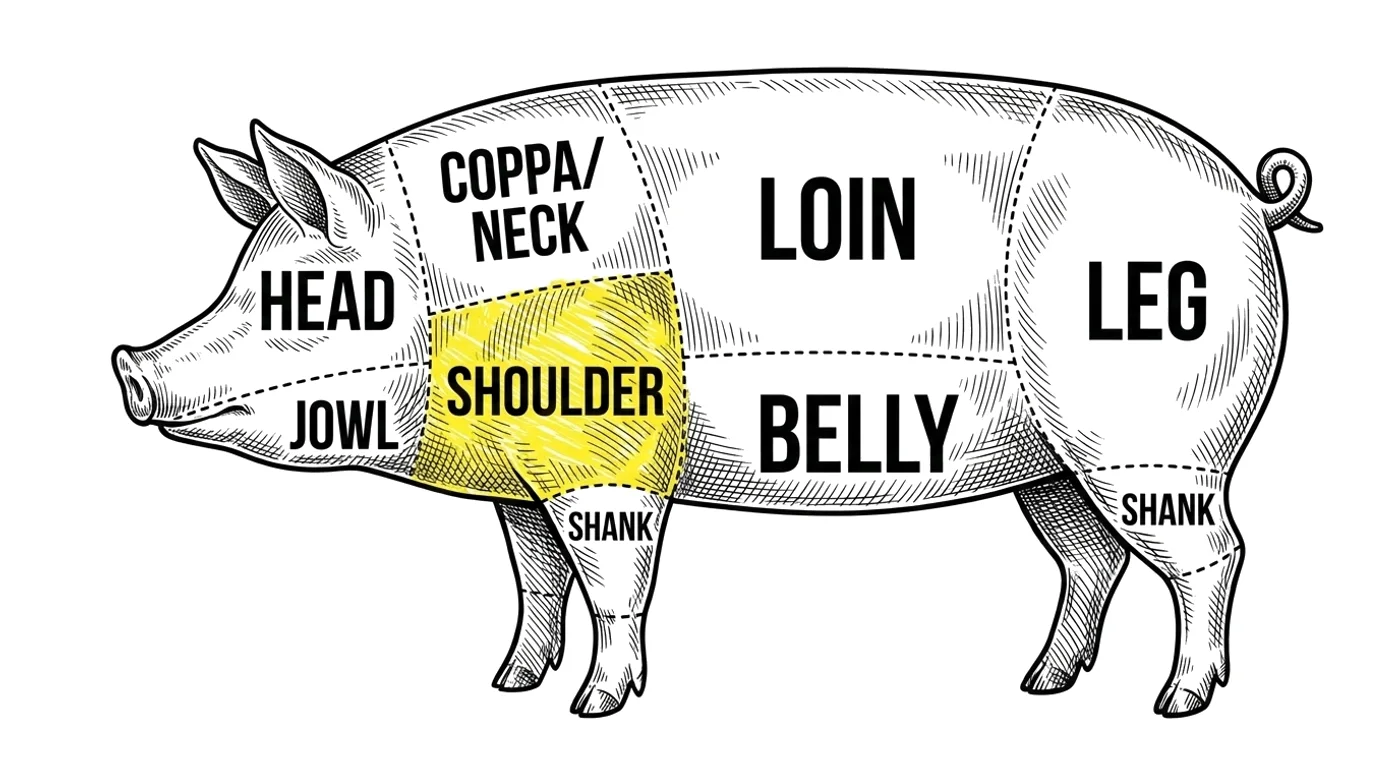
Identity and terminology
Głogowska is the feminine adjective from Głogów, agreeing with kiełbasa. Here the place is Głogów Małopolski in Podkarpackie, not the larger city of Głogów in Lower Silesia. The source's Anglicised Glogovska obscures both the Polish spelling and this regional distinction. The official record also describes a central grey oval sometimes visible within the otherwise pink cut surface, a feature associated with the traditional process rather than a licence for undercooking.
Composition and characteristics
The sausage is entirely pork-based in the Curesmith branch. Large pieces of lean ham produce the irregular visible grain, moderately fat shoulder gives succulence and a fine paste from connective trim holds the pieces together. Garlic and pepper are the defining seasonings. Natural hog casing forms small spiralled lengths no more than roughly the official maximum diameter. The exterior ranges from light to dark cherry after smoking; the interior is cohesive and medium-firm rather than crumbly, with the casing peeling cleanly when manufacture and smoking are well controlled.
Production and process
Pork fractions are classified by function, cured cold, then cut or ground separately. Ham remains in large cubes, shoulder is medium-ground and the binding portion is finely processed with water and seasoning. After mixing, the sausage is filled into natural casing and arranged in short spirals. Controlled drying precedes hot smoking and smokehouse baking until the centre reaches 71°C. Rapid cooling and refrigeration follow. The traditional appearance cannot substitute for lethality, and smoke does not make the sausage shelf stable.
History and regional forms
The Ministry's record places the sausage within the agricultural life of Głogów Małopolski, where sandy soils and surrounding forest shaped a mixed household economy. A sausage-makers' guild was active in the eighteenth century. By the late nineteenth century, Głogowska had acquired a reputation beyond Galicia, reaching Vienna and other Habsburg cities through the local garrison, travelling merchants and migrant builders. Family butchers continued small-scale production, especially around holidays, maintaining different house styles within the shared local identity.
Use, storage and related products
Kiełbasa Głogowska is served with the local liver-based barszcz and also works as a cold sliced sausage with rye bread, horseradish, mustard and pickles. It can be warmed in soups, cabbage and bean dishes without losing its garlic-smoke character. Its small spiral form, uneven cut face and association with Głogów Małopolski distinguish it from generic Polish garlic sausage and from western products sold under a similar spelling. Store cooked sausage at 0–4°C and cover cut surfaces.
Recipe and cure
This is not a finished recipe. It is a window into how this meat is traditionally cured. Before you follow any process, run it through one of our curing calculators so the salt, cure and timings are right and safe for your own batch.
Make this — the measured Curesmith version →“Make this” opens the same cure as a measured recipe, scaled to your batch.
- Meat
- Pork shoulder, moderately fat
- Cut
- Pork shoulder, moderately fat
- Salt (%)
- 1.8
- Curing salt
- Cure #1 as specified in the recipe
- Fermented
- No
- Starter or mould
- None; this product is not fermented
- Smoked
- Yes
- Maturation
- Refrigerate at 0–4°C; use within 4 days or freeze promptly
- Basis
- per 1,000 g pork shoulder, moderately fat
- Style
- cured, hot-smoked and baked Polish pork sausage
Ingredients
- Pork ham muscles, fully trimmed65% · 650 g
- Pork shoulder, moderately fat100% · 1000 g
- Pork jowl and shoulder connective trim20% · 200 g
- Ice water4.9% · 91 g
- Fine salt1.8% · 32.5 g
- Cure #1, 6.25% sodium nitrite0.24% · 4.5 g
- Black pepper, coarsely cracked0.19% · 3.5 g
- Fresh garlic, crushed0.3% · 5.5 g
Method
- Separate ham, shoulder and binding trim, then chill to 0–2°C.
- Mix all pork evenly with salt and dissolved Cure #1 and refrigerate for 8–12 hours.
- Cut ham to 20 mm, grind shoulder through 10 mm and fine-process binding trim with ice water, pepper and garlic.
- Combine the three textures until the fine paste binds the coarse pieces.
- Stuff into hog casings and arrange short lengths in small spirals for hanging.
- Dry the casing, then hot-smoke gradually until it is cherry-brown.
Safety. Apply cure uniformly, retain the official small spiral form, cook to a measured endpoint and complete rapid refrigerated cooling.