
Kiełbasa Gnieźnieńska
Also known as Gniezno Sausage, Gnieźnieńska sausage
Wielkopolskie, Poland
Overview
Kiełbasa Gnieźnieńska is a pork-and-veal smoked cooked sausage preserved in the source as a Polish technical formula. Coarse pork is held in a fine veal batter, filled into broad beef middles as long straight sticks, smoked and poached. The name associates the product with Gniezno in Wielkopolskie, but the available official registers do not establish a current protected geographical designation or a national Traditional Products List entry. The place-name carries no legal protection and no documented historical claim.
Where it's from
The cut
Identity and terminology
Gnieźnieńska is the feminine adjective from Gniezno, agreeing with kiełbasa. The spelling Gniezno Sausage is useful in English, but the Polish title better preserves the naming logic. Place-named Polish sausages can be protected, traditionally listed, historically standardised or merely commercial; the adjective alone does not decide which category applies. For this product, the documented formula and physical form are firmer evidence than a romantic origin story. It remains separate from generic pork-and-veal sausage because of its distinctive coarse-pork and fine-veal construction.
Composition and characteristics
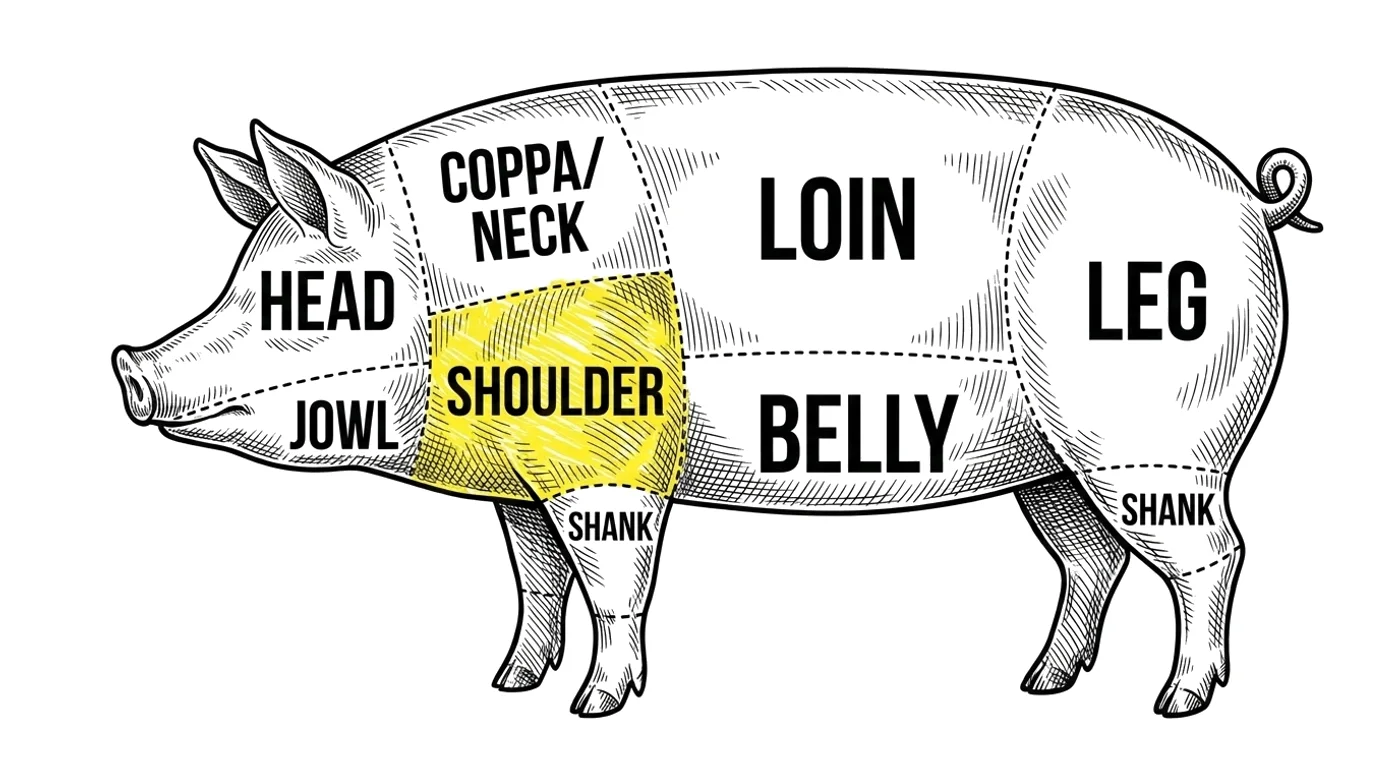
The filling combines equal quantities of moderately fat pork shoulder and veal shoulder or breast trim. Pork passes through a medium plate and remains visible, while veal is fine-processed with ice, salt, curing salt, pepper, white mustard seed and garlic to create the binding matrix. The straight casing is broad and unusually long, commonly around thirty centimetres, with a twine loop at one end. The cut face shows medium pork particles in a smooth pink base, and the smoke should be evident without overwhelming the mild veal.
Production and process
Cold pork and veal are ground separately. Veal is comminuted with ice and seasoning while kept below emulsion-breaking temperature; coarse pork is then folded through until evenly bound. The mixture is stuffed into beef middles, tied as straight sticks and cured under refrigeration. Surface drying prepares the casing for smoke, after which controlled hot smoking and gentle poaching complete the process. The source's lower endpoint and partial cooling stop are replaced by a measured 71°C cold point and full two-stage cooling.
History and regional forms
Gniezno is central to the history of the early Polish state. The city's official history records the creation of the archbishopric in 999 and the first royal coronation in 1025. Those facts explain the cultural weight carried by the place-name, but they do not date the sausage or prove a royal connection. No reliable evidence located for this batch establishes an inventor, guild, coronation tradition or protected recipe. Gnieźnieńska is a documented sausage formula whose local production history remains unresolved.
Use, storage and related products
Kiełbasa Gnieźnieńska is suited to cold slicing because the broad straight stick gives a clear mosaic of coarse pork in fine veal bind. Pepper, mustard seed and garlic allow it to accompany rye bread, pickles and mild mustard, while gentle warming suits potatoes or cabbage. It differs from frankfurter-type sausage through its visible pork grain and from coarse all-pork kielbasa through the smooth veal matrix. Keep the cooked stick refrigerated, wrap the cut end and freeze portions if they will not be used within four days.
Recipe and cure
This is not a finished recipe. It is a window into how this meat is traditionally cured. Before you follow any process, run it through one of our curing calculators so the salt, cure and timings are right and safe for your own batch.
Make this — the measured Curesmith version →“Make this” opens the same cure as a measured recipe, scaled to your batch.
- Meat
- Pork shoulder, moderately fat
- Cut
- Pork shoulder, moderately fat
- Salt (%)
- 1.8
- Curing salt
- Cure #1 as specified in the recipe
- Fermented
- No
- Starter or mould
- None; this product is not fermented
- Smoked
- Yes
- Maturation
- Refrigerate at 0–4°C; use within 4 days or freeze promptly
- Basis
- per 1,000 g pork shoulder, moderately fat
- Style
- cured, hot-smoked and poached Polish pork-and-veal sausage
Ingredients
- Pork shoulder, moderately fat100% · 1000 g
- Veal shoulder and breast trim100% · 1000 g
- Crushed ice15% · 300 g
- Fine salt1.8% · 36 g
- Cure #1, 6.25% sodium nitrite0.25% · 5 g
- Black pepper0.2% · 4 g
- White mustard seed0.1% · 2 g
- Fresh garlic, crushed0.35% · 7 g
Method
- Chill pork, veal, ice and equipment to 0–2°C, then grind separately.
- Fine-process veal with salt, Cure #1, pepper, mustard, garlic and crushed ice.
- Fold the coarse pork through the fine veal brät until evenly bound.
- Stuff straight sticks, tie securely and refrigerate for 8–12 hours.
- Dry the casing surface, then apply controlled hot smoke.
- Poach at 75–78°C until the cold point reaches 71°C.
Safety. Keep the veal brät cold, cure under refrigeration, cook the thick stick to a measured endpoint and complete rapid cooling.