
Kiełbasa Hutnicka
Also known as Hutnicka, Kiełbasa hutnicka parzona podsuszana, Steelworker's sausage
Poland
Overview
Kiełbasa hutnicka is a Polish pork-and-beef sausage whose full technical description, parzona podsuszana, states its process: it is scalded and then lightly dried. The source formula is ninety per cent semi-fat pork and ten per cent beef, seasoned simply with pepper and garlic. Its identity lies in a coarse pork body supported by a fine beef binder, a brown smoked casing and a short post-cook drying stage rather than in elaborate spicing.
Where it's from
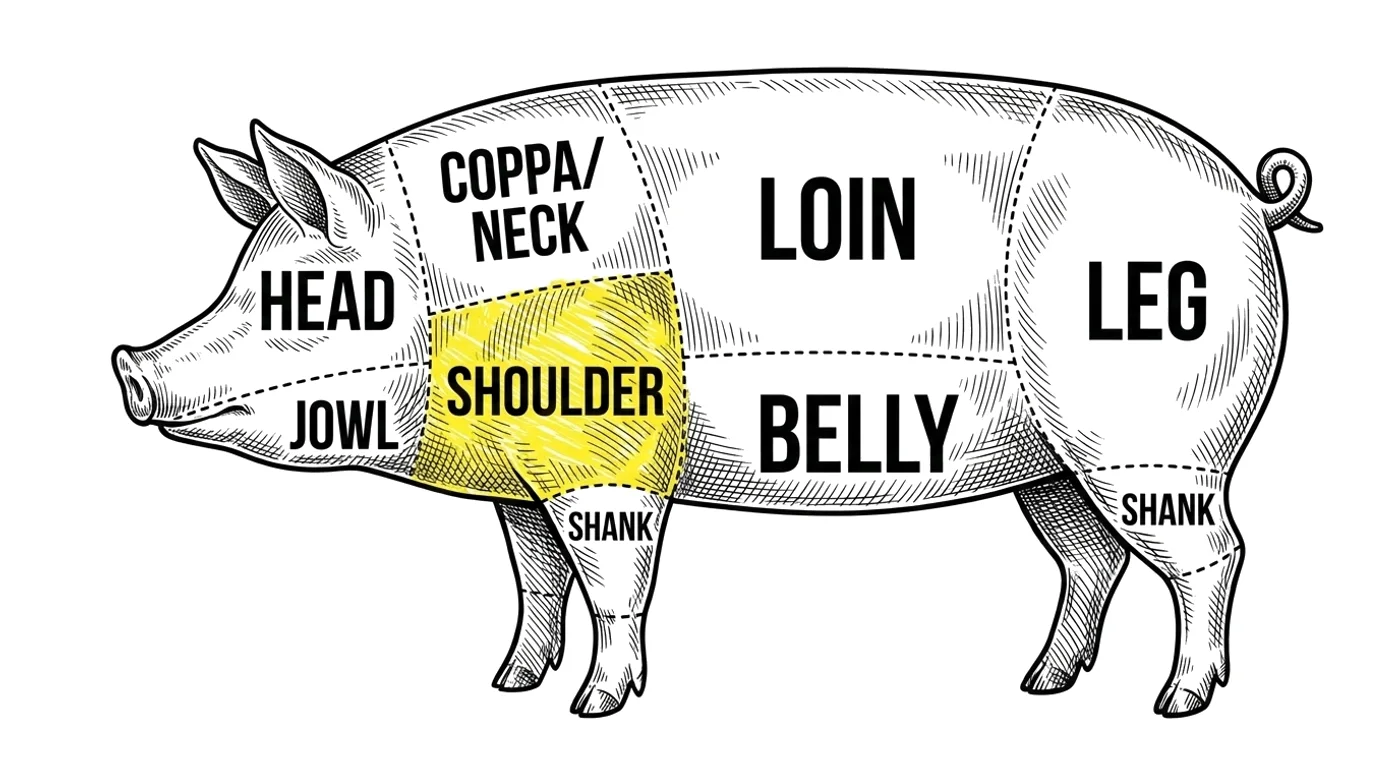
The cut
Identity and terminology
Hutnik is a worker in a foundry or steelworks, so hutnicka means steelworker's style. The occupational name sits within a larger Polish naming tradition that includes sausages linked to trades, places and intended users. The batch found no current PDO, PGI, TSG or national traditional-product status for the unqualified name. It is therefore retained as a documented technical sausage and not presented as the exclusive product of one factory town.
Composition and characteristics
The dominant pork is ground to about 8 mm, preserving a coarse, juicy bite. Beef is ground much finer and mixed with ice water, cure, pepper and garlic to make the binding phase. This two-fraction structure gives the slice visible pork particles without crumbling. A beef middle or 50 mm casing produces long, substantial pieces. Light drying firms the sausage and concentrates smoke and garlic, but it should not make the centre hard or the casing heavily wrinkled.
Production and process
Pork and fine beef binder are mixed cold and cured under refrigeration. The filled casing is dried until tacky, smoked at moderate heat and poached to 71°C. Only after full cooking and controlled chilling is it dried at 10–12°C to about ninety per cent of its cooked weight. That modest yield loss represents podsuszanie while keeping the recipe reproducible. No water-activity threshold is claimed, so the finished sausage returns to refrigeration.
History and regional forms
The formula belongs to the Polish standardised sausage tradition in which meat classes, plate sizes, casing dimensions, smoking, scalding and yield were recorded together. Those details matter more to identity than a decorative occupational story. Hutnicka's simple formula also reflects a practical canteen and slicing sausage: dependable pork flavour, enough beef bind for structure and a finish robust enough for transport while still handled as a cooked refrigerated product.
Use, storage and related products
Slice for sandwiches, cold platters or a simple meal with bread, mustard and pickles. It may also be warmed gently in water. Store at 0–4°C and use opened sausage promptly. Hutnicka is distinct from long-dried fermented sausage because its light drying follows cooking and does not depend on acidification. It also remains separate from other Polish podsuszana sausages whose meat grading, spice profile or regional name differs.
Recipe and cure
This is not a finished recipe. It is a window into how this meat is traditionally cured. Before you follow any process, run it through one of our curing calculators so the salt, cure and timings are right and safe for your own batch.
Make this — the measured Curesmith version →“Make this” opens the same cure as a measured recipe, scaled to your batch.
- Meat
- Semi-fat pork shoulder
- Cut
- Semi-fat pork shoulder
- Salt (%)
- 1.8
- Curing salt
- Cure #1 as specified in the recipe
- Fermented
- No
- Starter or mould
- None; this product is not fermented
- Smoked
- Yes
- Maturation
- Refrigerate at 0–4°C; use within 4 days or freeze promptly
- Basis
- per 1,000 g semi-fat pork shoulder
- Style
- cured, smoked, cooked and lightly dried Polish pork sausage
Ingredients
- Semi-fat pork shoulder100% · 1000 g
- Beef chuck10% · 100 g
- Ice water3% · 33.5 g
- Fine salt1.8% · 20 g
- Cure #1, 6.25% sodium nitrite0.23% · 2.5 g
- Black pepper0.2% · 2 g
- Garlic, crushed0.3% · 3.5 g
Method
- Chill pork, beef, water and equipment to 0–2°C, then grind each meat separately.
- Dissolve Cure #1 in ice water and fine-mix it with beef, pepper and garlic.
- Knead pork with salt until tacky, combine with the beef binder, then refrigerate for 8–12 hours.
- Fill casings firmly, remove air and tie in 30–40 cm lengths.
- Smoke at 55–65°C to a brown casing, then poach at 75–80°C until the cold point reaches 71°C.
- Shower briefly and complete controlled chilling.
Safety. Cure cold, cook to 71°C, chill fully before light drying and retain refrigerated storage because no shelf-stable release is established.