
Kiełbasa Jałowcowa Staropolska
Also known as Juniper Sausage, Kiełbasa jałowcowa, Old Polish juniper sausage
Poland
Overview
Kiełbasa jałowcowa staropolska is a Polish Traditional Speciality Guaranteed built around cured pork, freshly crushed juniper berries, smoking, cooking and drying. It is made as a dark brown, wrinkled ring in natural hog casing, with a coarse slice and a clear juniper aroma. The protected identity is more specific than the English source title Juniper Sausage, which could describe any link seasoned with juniper.
Where it's from
The cut
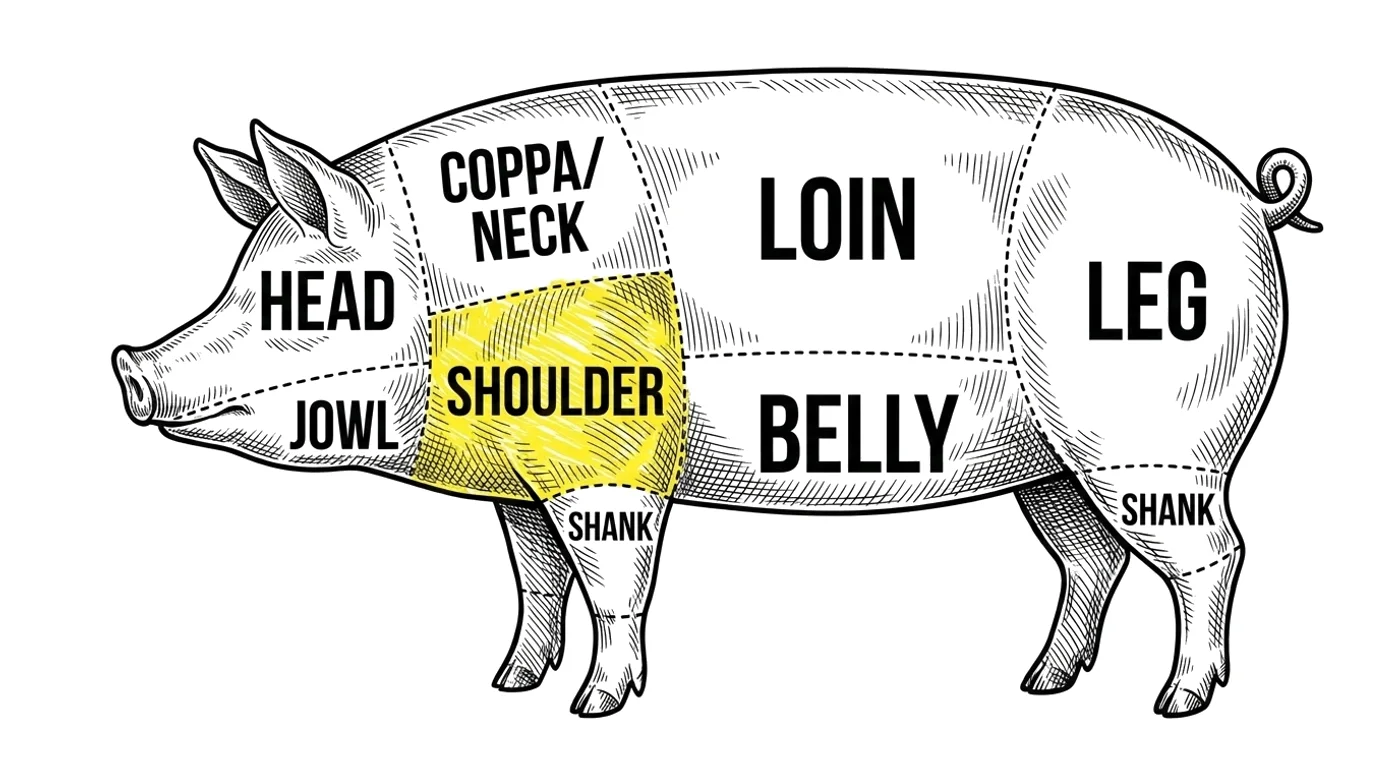
Identity and terminology
The European registration reserves the traditional name while protecting method and composition rather than a single geographical production area. Earlier Kiełbasa jałowcowa registration was transitioned to the reserved name Kiełbasa jałowcowa staropolska in 2017. Polish authorities published an amendment application in April 2026. This batch records that document as pending evidence and does not treat the proposed changes as already approved EU law.
Composition and characteristics
The traditional structure uses classified pork fractions: lean class I, medium-fat class IIA, connective class III and back fat. Coarse lean pieces remain visible against finer connective meat and white fat. Salt and nitrite cure the meat; pepper supports, rather than masks, freshly crushed juniper. Juniper twigs may contribute to the smoke aroma. A typical product is a compact ring in medium natural hog casing.
Production and process
The chilled pork classes are cured, ground through different plates and mixed without losing the coarse structure. Rings are surface-dried, smoked and cooked until the centre reaches 71°C, then cooled and dried under controlled temperature, humidity and gentle air exchange. The Curesmith branch reaches 71°C and records a 25–29% weight loss. It also requires water-activity evidence before any ambient-release decision.
History and regional forms
Juniper has a long place in Polish meat preservation and woodland cookery, but the TSG is not simply an old flavour combination. Its protected character lies in the defined ring form, pork classification, seasoning, smoke, heat treatment and drying sequence. The staropolska term marks the traditional specification. Certified commercial use requires approved production and controls that a home adaptation cannot claim.
Use, storage and related products
Slice the ring thinly for bread, pickles and cold platters, or serve it as a compact savoury snack. The home branch remains refrigerated unless a competent process validates water activity and the complete process. It differs from Kabanosy staropolskie in casing diameter, ring shape and drying target, and from generic game or hunter sausages because juniper alone does not confer the TSG identity.
Recipe and cure
This is not a finished recipe. It is a window into how this meat is traditionally cured. Before you follow any process, run it through one of our curing calculators so the salt, cure and timings are right and safe for your own batch.
Make this — the measured Curesmith version →“Make this” opens the same cure as a measured recipe, scaled to your batch.
- Meat
- Pork shoulder
- Cut
- Pork shoulder
- Salt (%)
- 2
- Curing salt
- Cure #1 as specified in the recipe
- Fermented
- No
- Starter or mould
- None; this product is not fermented
- Smoked
- Yes
- Maturation
- Refrigerate at 0–4°C unless a competent process authority validates an ambient release
- Basis
- per 1,000 g pork shoulder
- Style
- cured, smoked, cooked and dried Polish juniper sausage
Ingredients
- Pork ham40% · 400 g
- Pork shoulder100% · 1000 g
- Pork shank40% · 400 g
- Pork back fat20% · 200 g
- Fine salt2% · 40 g
- Cure #1, 6.25% sodium nitrite0.25% · 5 g
- Black pepper0.15% · 3 g
- Freshly crushed juniper berries0.1% · 2 g
- Crushed ice3% · 60 g
Method
- Trim the pork into the declared lean, medium-fat, connective and fat fractions and chill to 0–2°C.
- Dissolve Cure #1 in the crushed ice, distribute it with salt across the full 1,000 g animal block and refrigerate for 36–48 hours.
- Grind each fraction as specified, then mix with pepper and freshly crushed juniper until cohesive.
- Fill natural hog casing, form 200 g rings and remove visible air.
- Dry the surface, apply warm smoke with optional clean juniper twigs, then cook until the cold point reaches 71°C.
- Cool under control, then dry at 10–12°C and 75–80% relative humidity with gentle air exchange to 25–29% weight loss.
Safety. Apply Cure #1 accurately, cook to 71°C, control chamber airflow and humidity, record weight loss and require aw evidence before any ambient release.