
Kiełbasa Kminkowa
Also known as Caraway Sausage, Kminkowa
Poland
Where it's from
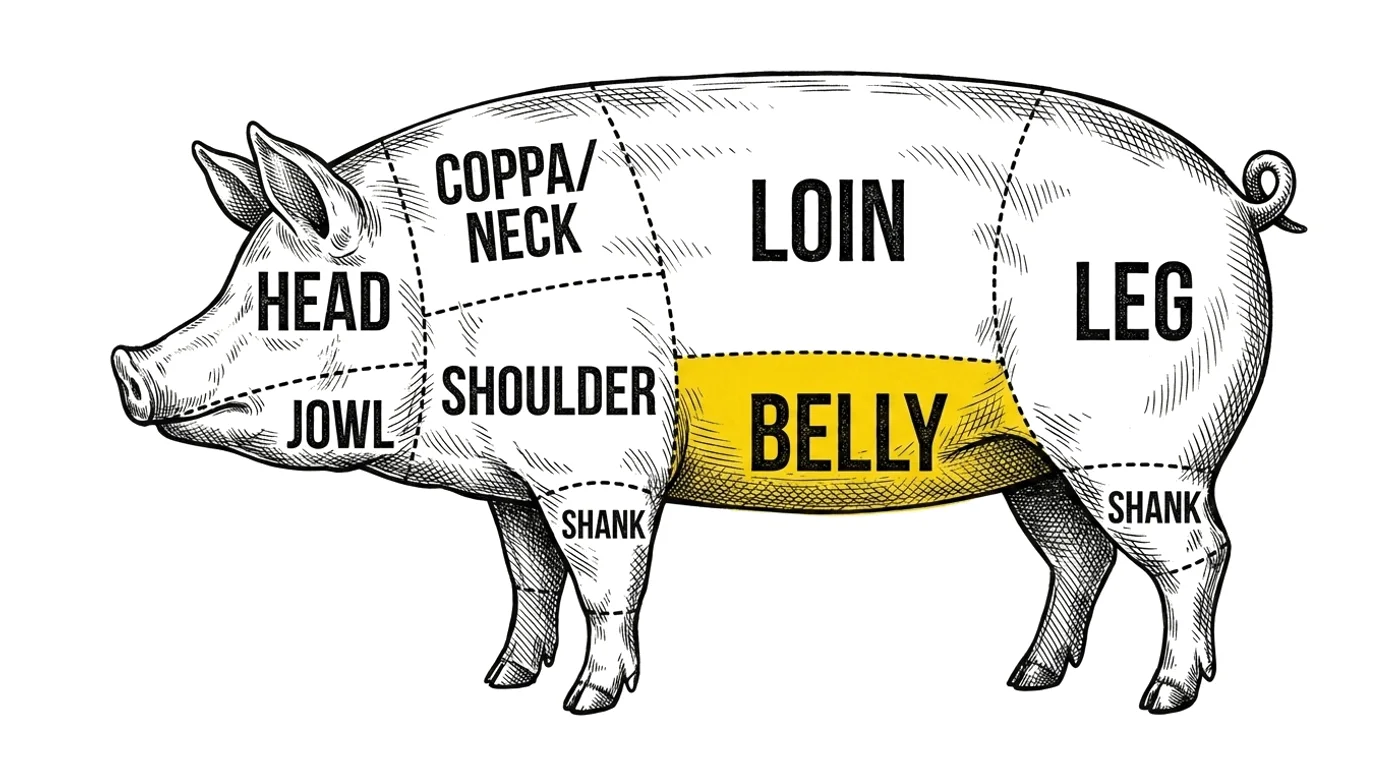
The cut
Identity and name
Kiełbasa kminkowa means caraway sausage in Polish: kminek is caraway, the seed that supplies the product's defining aroma. It is a named seasoning identity rather than a place name. The English title Caraway Sausage is therefore a direct explanation, not a separate national product.
Documented Polish context
A 1964 Polish ministerial storage schedule lists kiełbasa kminkowa among non-durable sausages in a group that also included Bydgoska and Gnieźnieńska. That archival classification anchors the name in Poland's post-war standard system, although it does not create modern geographical protection or a single immutable recipe.
Composition and sensory profile
The meat block combines coarse lean pork, somewhat finer semi-fat pork and a small fine-processed beef portion for bind. Lightly crushed caraway should be obvious in the aroma without masking pepper and onion. The cut face is pink, moist and visibly grained, unlike a fully emulsified frankfurter.
Production method
The meats are cured under refrigeration before their separate grinds. The beef becomes a cold fine batter with a small amount of ice water, while both pork fractions retain texture. After stuffing into a broad beef middle, the sausage is dried at the surface, hot-smoked and gently poached.
Serving and culinary use
Kminkowa is suited to cold slicing with rye bread, mustard and pickles, where the caraway echoes a familiar Polish bread seasoning. It can also be warmed gently with potatoes or cabbage. Hard boiling is avoided because it can split the casing and wash out fat.
Boundaries and safety
Caraway alone does not make every sausage Kminkowa. The Polish identity also requires its cured, smoked, cooked structure and mixed coarse-and-fine grain. Accurate nitrite dosing, a verified cold-point cook, rapid cooling and refrigeration remain necessary because this is not a dry or shelf-stable sausage.
Recipe and cure
This is not a finished recipe. It is a window into how this meat is traditionally cured. Before you follow any process, run it through one of our curing calculators so the salt, cure and timings are right and safe for your own batch.
Make this — the measured Curesmith version →“Make this” opens the same cure as a measured recipe, scaled to your batch.
- Meat
- Semi-fat pork shoulder and belly
- Cut
- Semi-fat pork shoulder and belly
- Salt (%)
- 2.3
- Curing salt
- Cure #1 as specified in the recipe
- Fermented
- No
- Starter or mould
- None; this cooked sausage is not fermented
- Smoked
- Yes
- Maturation
- Refrigerate at 0–4°C; use within 4 days or freeze
- Basis
- per 1,000 g semi-fat pork shoulder and belly
- Style
- Polish cured, hot-smoked and cooked coarse pork-beef sausage
Ingredients
- Lean pork shoulder80% · 800 g
- Semi-fat pork shoulder and belly100% · 1000 g
- Lean beef chuck20% · 200 g
- Ice water2.5% · 50 g
- Fine salt2.3% · 45 g
- Cure #1, 6.25% sodium nitrite0.25% · 5 g
- Black pepper0.15% · 3 g
- Onion powder0.1% · 2 g
- Caraway seed, lightly crushed0.15% · 3 g
Method
- Mix the diced meats evenly with salt and Cure #1 and refrigerate for 24–48 hours.
- Trim, dice and chill all meat and fat to 0–2°C; chill grinder parts.
- Grind lean pork through 16 mm, semi-fat pork through 10 mm, and beef through 3 mm.
- Fine-process beef with ice water, pepper, onion and caraway; mix into the pork to a firm bind.
- Stuff into beef middle, approximately 45–55 mm; remove air pockets and form the specified links.
- Rest the filled casings for 8–12 hours.
Safety. Dose Cure #1 against the meat block, cook to 71°C at the cold point, cool rapidly and refrigerate.