
Kiełbasa Knyszyńska
Also known as Knyszynska, Kielbasa knyszynska, Knyszyn sausage
Podlaskie, Poland
Overview
Kiełbasa knyszyńska is a Polish cured sausage built from four textural fractions: coarse lean pork, medium semi-fat pork, finely comminuted lean beef and connective beef used for bind. Smoke, baking and a juniper-garlic seasoning place it among regional Polish hot-smoked sausages. The source associates the name with Knyszyn, but the available evidence does not support presenting it as a current protected geographical designation.
Where it's from
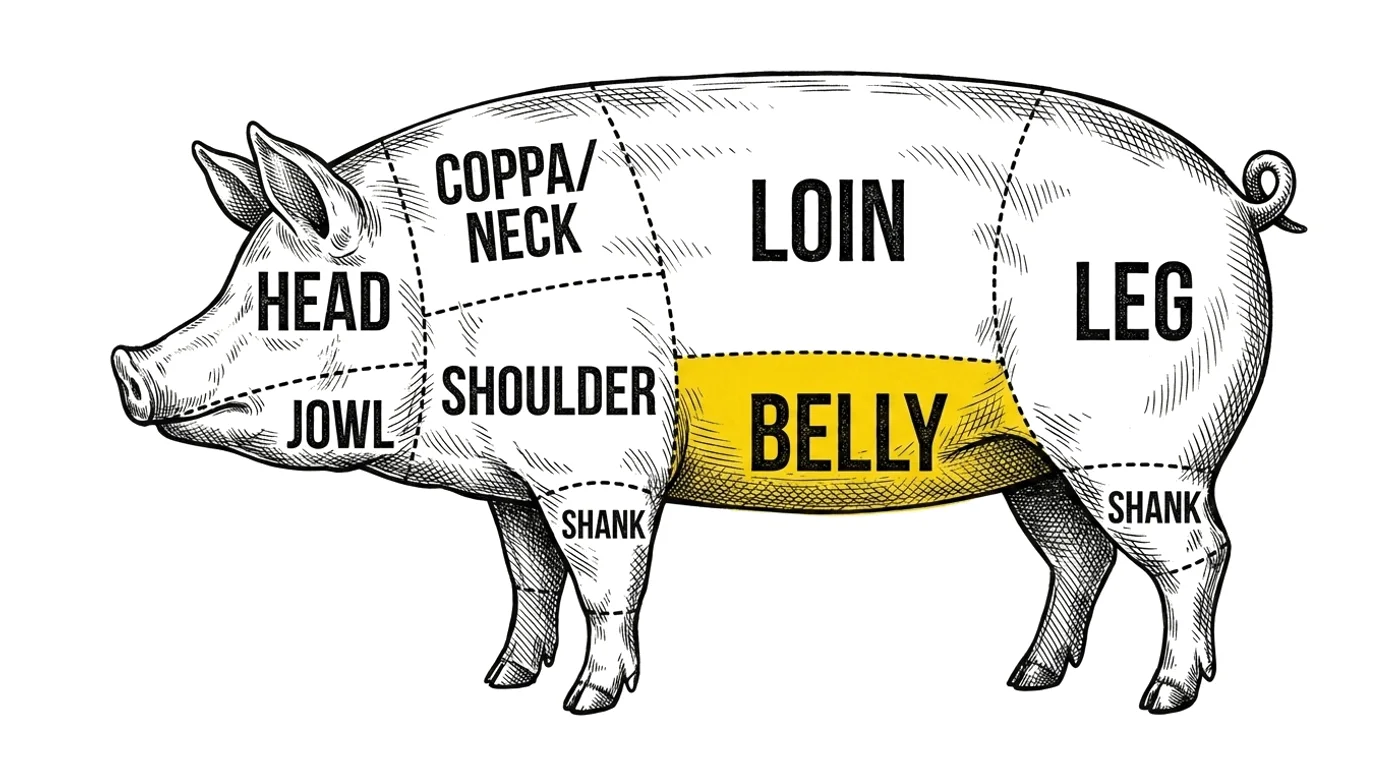
The cut
Identity and terminology
The adjectival name means a sausage connected with Knyszyn. It appears in the historical technical corpus of Polish sausage formulas and in modern secondary lists derived from that material. No EU protected designation or current entry on Poland’s List of Traditional Products was established during this review. It is a historically documented technical style, not a legally exclusive recipe and not a certified local product.
Composition and characteristics
Lean pork remains in conspicuous large pieces, semi-fat pork creates the main matrix and beef supplies a fine sticky bind. The result is more visibly coarse than a frankfurter but more cohesive than a loose fresh sausage. Black pepper, crushed juniper and garlic define the aroma, with a small sugar addition rounding the cure. The broad hog casing and paired links support smoking and oven finishing.
Production and process
Each meat class is ground separately so its role survives mixing. Beef is fine-cut with cure, ice and seasoning to create an adhesive paste. Pork is mixed with salt until tacky, then folded with the beef bind without destroying the coarse lean pieces. The linked coil cures under refrigeration, dries, receives warm smoke and is baked in controlled stages to a measured centre temperature. Rapid chilling replaces slow air-cooling to a merely cool surface.
History and regional forms
Knyszyn lies in north-eastern Poland, a region with strong pork, game, smoke and juniper traditions. The sausage fits that sensory landscape, yet a place-derived name alone is not proof of continuous local production or legal protection. It should be distinguished from Kiełbasa jałowcowa, whose juniper identity has EU Traditional Speciality Guaranteed status, and from Kiełbasa myśliwska, another protected dried Polish sausage.
Use, storage and related products
Serve Kiełbasa knyszyńska cold in substantial slices, gently warmed or browned after reheating. The cut face should show large lean pork pieces held in a finer cured beef-and-pork matrix. Juniper should be evident but not resinous, and garlic should remain secondary to smoke and meat. The cooked sausage requires refrigeration; neither smoke nor brief post-baking drying makes it shelf stable.
Recipe and cure
This is not a finished recipe. It is a window into how this meat is traditionally cured. Before you follow any process, run it through one of our curing calculators so the salt, cure and timings are right and safe for your own batch.
Make this — the measured Curesmith version →“Make this” opens the same cure as a measured recipe, scaled to your batch.
- Meat
- Semi-fat pork shoulder and belly
- Cut
- Semi-fat pork shoulder and belly
- Salt (%)
- 2
- Curing salt
- Cure #1 as specified in the recipe
- Fermented
- No
- Starter or mould
- None; this product is not fermented
- Smoked
- Yes
- Maturation
- Refrigerate at 0–4°C; use within 4 days or freeze promptly
- Basis
- per 1,000 g semi-fat pork shoulder and belly
- Style
- cured smoked and baked Polish coarse sausage
Ingredients
- Pork ham and shoulder40% · 400 g
- Semi-fat pork shoulder and belly100% · 1000 g
- Beef chuck40% · 400 g
- Beef shank with controlled connective tissue20% · 200 g
- Crushed ice and water3% · 60 g
- Fine salt2% · 40 g
- Cure #1, 6.25% sodium nitrite0.25% · 5 g
- Black pepper0.15% · 3 g
- Crushed juniper berries0.1% · 2 g
- Sugar0.1% · 2 g
- Fresh garlic0.15% · 3 g
Method
- Trim, classify and chill pork, beef, water and equipment to 0–2°C.
- Grind each meat fraction through its specified plate.
- Dissolve Cure #1 in the measured ice water and fine-cut it with both beef fractions, pepper, juniper, sugar and garlic.
- Mix pork with salt until tacky, fold in the beef bind, then fill hog casings and form paired links.
- Refrigerate the linked coil for 8–12 hours.
- Dry the casing, smoke at 50–60°C, then bake in stages until the cold point reaches 71°C.
Safety. Keep four grind fractions cold and distinct, calculate Cure #1 on the whole meat block, bake to 71°C and chill rapidly.