
Kiełbasa Kolska
Also known as Kolska, Kolska sausage
Wielkopolskie, Poland
Overview
Kiełbasa kolska is a Polish smoked pork sausage built around conspicuous lean cubes held by a finer connective-meat bind. Its broad chub, paprika-red seasoning and garlic distinguish it from uniform fine sausages. The geographical adjective points to Koło and the surrounding Wielkopolska context, but this review found no current EU protected designation for the name.
Where it's from
The cut
Identity and terminology
Kolska is the feminine adjectival form connected with Koło. Historical Polish technical material records named sausages through their graded meat classes and processing instructions, which is the evidence basis used here. A modern trade mark using the name does not by itself convert the recipe into a public geographical indication or prove that every product sold as kolska shares one statutory composition.
Composition and characteristics
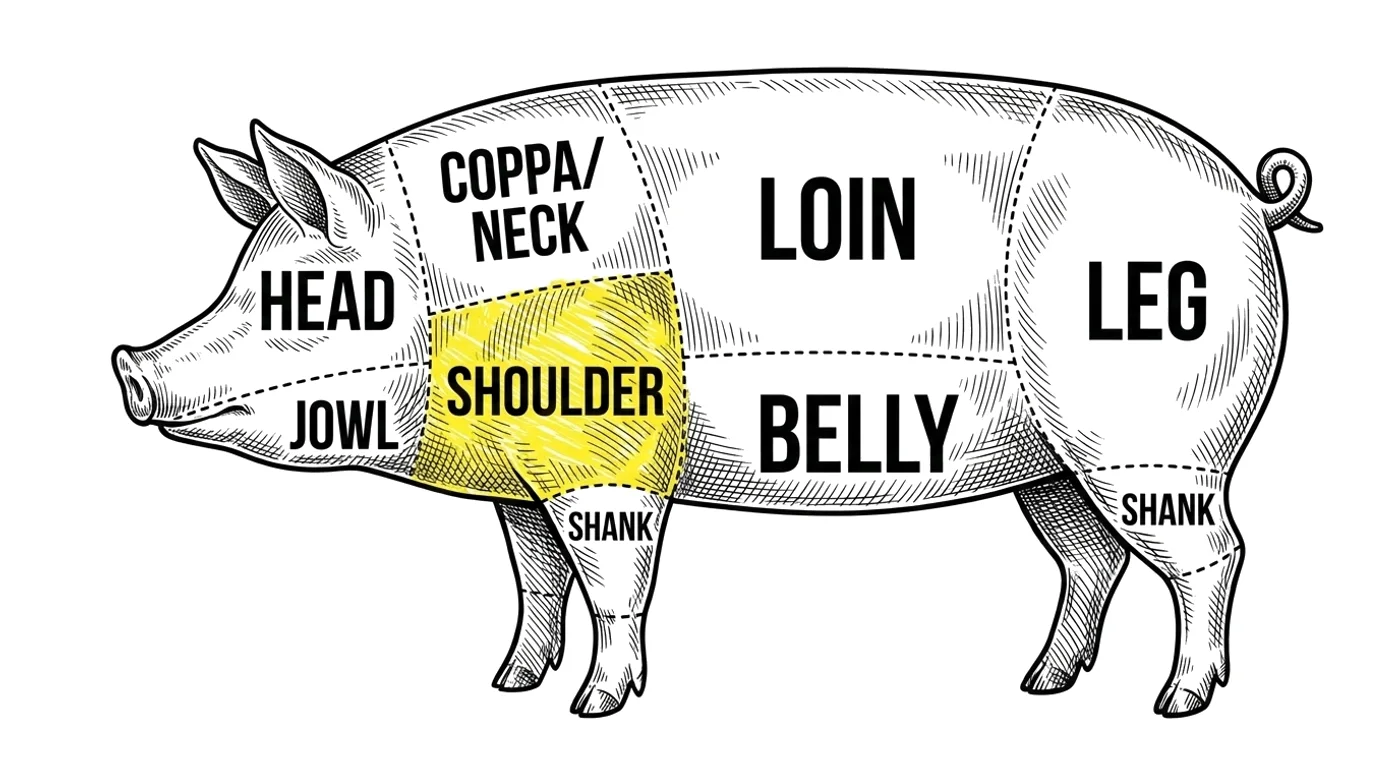
Lean pork remains in large pieces, semi-fat pork supplies a medium grain, and connective shoulder trimmings are fine-cut with water to make the adhesive phase. Sweet paprika contributes colour and gentle fruitiness rather than chilli heat. Black pepper and fresh garlic complete a restrained profile. The cut face should show an organised mosaic rather than a homogenous emulsion.
Production and process
The meat classes are cured separately under refrigeration so nitrite reaches each fraction accurately. After grinding, the connective portion is fine-cut into bind, the semi-fat pork remains coarse and the lean meat stays cubed. The mixture is filled into a wide casing, dried, hot-smoked, poached until the cold point reaches 71°C, then chilled quickly. The method preserves visual structure while delivering a ready-to-eat refrigerated product.
History and regional forms
Koło lies in central-western Poland on long transport and agricultural routes through Wielkopolska. The sausage's technical design fits the Polish practice of identifying quality through meat class, particle size and smoke treatment. Evidence supports the named style and its association, but not an exclusive protected recipe. Historical identity, commercial branding and legal protection are three separate things here.
Use, storage and related products
Kiełbasa kolska is suited to substantial cold slices, sandwiches and gently warmed service with bread, mustard or pickles. It should be distinguished from fine parówki, from dried Krakowska forms and from paprika-forward Hungarian sausages. Curing and smoke do not make this moist cooked chub shelf stable; intact and cut storage both require refrigeration.
Recipe and cure
This is not a finished recipe. It is a window into how this meat is traditionally cured. Before you follow any process, run it through one of our curing calculators so the salt, cure and timings are right and safe for your own batch.
Make this — the measured Curesmith version →“Make this” opens the same cure as a measured recipe, scaled to your batch.
- Meat
- Pork ham and shoulder
- Cut
- Pork ham and shoulder
- Salt (%)
- 1.8
- Curing salt
- Cure #1 as specified in the recipe
- Fermented
- No
- Starter or mould
- None; this product is not fermented
- Smoked
- Yes
- Maturation
- Refrigerate at 0–4°C; use within 4 days or freeze promptly
- Basis
- per 1,000 g pork ham and shoulder
- Style
- cured hot-smoked and cooked Polish coarse pork sausage
Ingredients
- Pork ham and shoulder100% · 1000 g
- Semi-fat pork shoulder and belly30% · 300 g
- Pork shoulder25% · 250 g
- Ice water6% · 92.5 g
- Fine salt1.8% · 27.5 g
- Cure #1, 6.25% sodium nitrite0.25% · 4 g
- Black pepper0.2% · 3 g
- Sweet paprika0.25% · 4 g
- Fresh garlic0.3% · 4.5 g
Method
- Separate the three pork classes, distribute salt and Cure #1 by weight, pack tightly and cure 48–72 hours at 3–5°C.
- Keep lean pork as cubes, grind semi-fat pork through 12 mm and connective pork through 3 mm.
- Fine-cut the connective fraction with ice water, pepper, paprika and garlic until adhesive.
- Work the lean cubes and semi-fat pork until tacky, then fold in the binding mass without destroying the mosaic.
- Fill the broad casing firmly, remove air and tie securely.
- Dry the casing and apply clean hot smoke at 45–60°C until evenly brown.
Safety. Distribute cure by the weight of each meat class, cook to 71°C and cool the large casing under the two-stage rule.