
Kiełbasa Krakowska Krajana
Also known as Krakowska, Krakowska Sausage, Kiełbasa krakowska krajana
Lesser Poland, Poland
Overview
Kiełbasa krakowska krajana is a Polish large-calibre sausage whose defining feature is manually cut cured pork held by a small amount of fine jowl bind. Krajana means cut or sliced, describing the visible meat architecture. The chub is smoked and baked or poached, then chilled, giving a moist cooked form distinct from long-dried Krakowska products.
Where it's from
The cut
Identity and terminology
Krakowska means associated with Kraków, while krajana identifies the cutting method. The full legal distinction is important: the EU-registered TSG name is Kiełbasa krakowska sucha staropolska, literally old-Polish dry Krakowska sausage. A cooked krajana formula may belong to the wider Krakowska family, but it cannot borrow the registered dry designation without meeting that specification.
Composition and characteristics
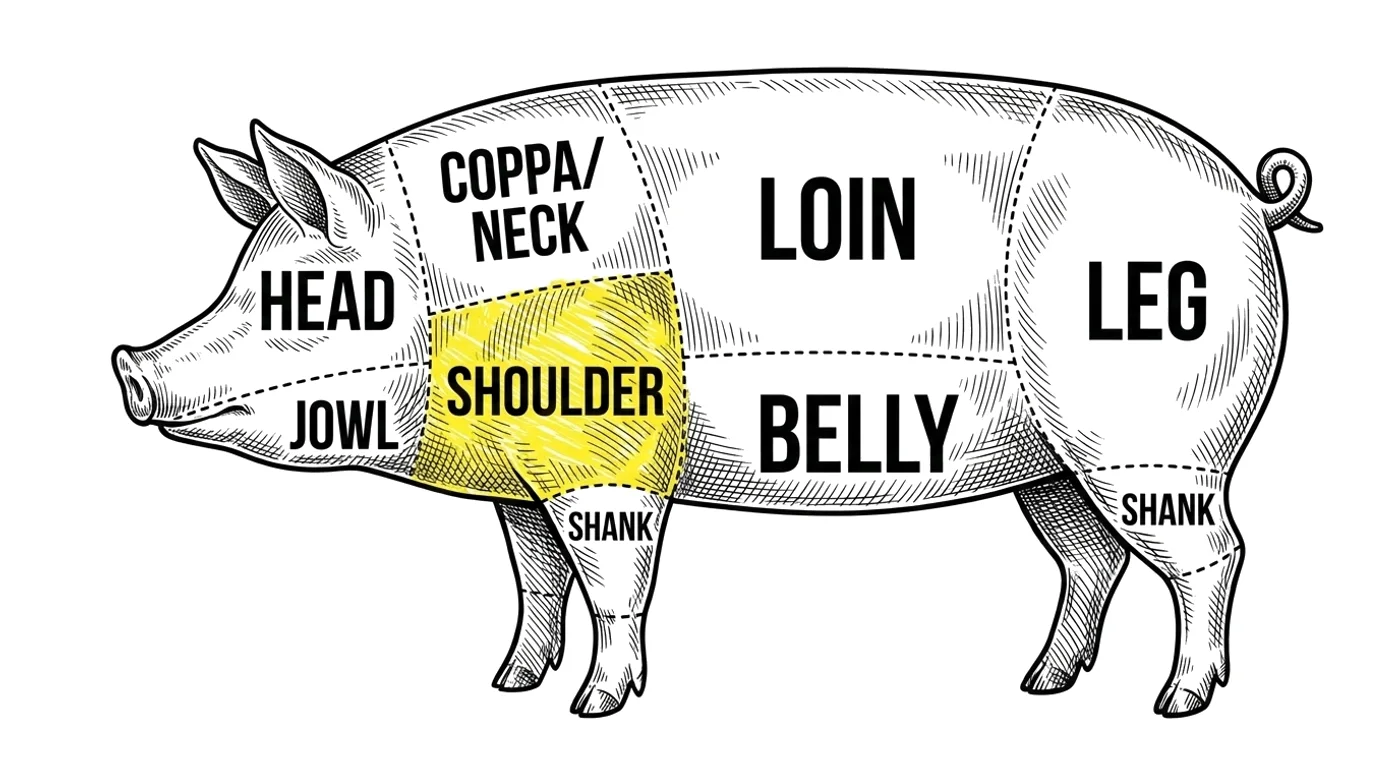
Lean ham and shoulder dominate the formula and remain in pieces large enough to read clearly across the slice. A small jowl fraction is ground and fine-cut with water to bind those pieces. Pepper, nutmeg and a trace of sugar support cured pork rather than creating a heavily spiced sausage. The finished cross-section is mostly dark pink lean meat with a narrow paler matrix.
Production and process
Lean pieces and the fatty binding fraction are cured separately for two days so their different surfaces receive an accurate dose. The jowl is fine-cut into adhesive paste; the large pork pieces are mixed until their surfaces become tacky, then combined without grinding. After broad-casing stuffing, the sausage is surface-dried, smoked, baked until the centre reaches 71°C and chilled rapidly.
History and regional forms
Kraków's long reputation for high-grade meat products carried its name into Polish, Austrian and German sausage vocabularies. The Polish technical tradition developed several Krakowska forms: cooked, baked, semi-dry and dry, with different meat-class patterns. The krajana qualifier preserves one particular craft signal, the conspicuous hand-cut meat, rather than pretending that every Krakowska label denotes an identical recipe.
Use, storage and related products
Slice the fully chilled chub thick enough to show the cut pork, serve it with rye bread, mustard, pickles or cold-table accompaniments, or warm slices briefly. It is not the same as fine German Krakauer, although the names are related, and it is not the dry TSG product. This moist cooked branch must remain refrigerated before and after opening.
Recipe and cure
This is not a finished recipe. It is a window into how this meat is traditionally cured. Before you follow any process, run it through one of our curing calculators so the salt, cure and timings are right and safe for your own batch.
Make this — the measured Curesmith version →“Make this” opens the same cure as a measured recipe, scaled to your batch.
- Meat
- Pork ham and shoulder
- Cut
- Pork ham and shoulder
- Salt (%)
- 1.8
- Curing salt
- Cure #1 as specified in the recipe
- Fermented
- No
- Starter or mould
- None; this product is not fermented
- Smoked
- Yes
- Maturation
- Refrigerate at 0–4°C; use within 4 days or freeze promptly
- Basis
- per 1,000 g pork ham and shoulder
- Style
- cured hot-smoked and cooked Polish cut-meat sausage
Ingredients
- Pork ham and shoulder100% · 1000 g
- Pork jowl, glands removed10% · 100 g
- Ice water3% · 33.5 g
- Fine salt1.8% · 20 g
- Cure #1, 6.25% sodium nitrite0.23% · 2.5 g
- Black pepper0.2% · 2 g
- Sugar0.25% · 3 g
- Ground nutmeg0.1% · 1 g
Method
- Cure hand-cut lean pork and finely ground jowl separately for 48 hours at 3–5°C, splitting salt and Cure #1 exactly by weight.
- Fine-cut the cured jowl with ice water, pepper, sugar and nutmeg until adhesive.
- Mix the cured lean pieces until their surfaces become tacky.
- Fold in the jowl bind, fill the broad casing firmly and remove air.
- Dry the surface, apply warm smoke at 45–55°C, then build a deep brown casing with clean smoke.
- Raise the chamber gradually and bake until the cold point reaches 71°C.
Safety. Split cure accurately between meat classes, retain the cut-meat structure, bake to 71°C and chill the broad chub quickly.