
Kiełbasa Krakowska Trwała
Also known as Krakowska-Dry, Krakowska trwała, Dry Krakowska
Lesser Poland, Poland
Overview
Kiełbasa krakowska trwała is a durable Polish Krakowska made from conspicuous lean pork pieces, smaller semi-fat pork and fat particles, and a fine beef-and-connective-tissue bind. It is cured, smoked, cooked, smoked again and dried. The result is firmer and more concentrated than moist cooked Krakowska, yet its safety architecture begins with a full heat treatment rather than fermentation.
Where it's from
The cut
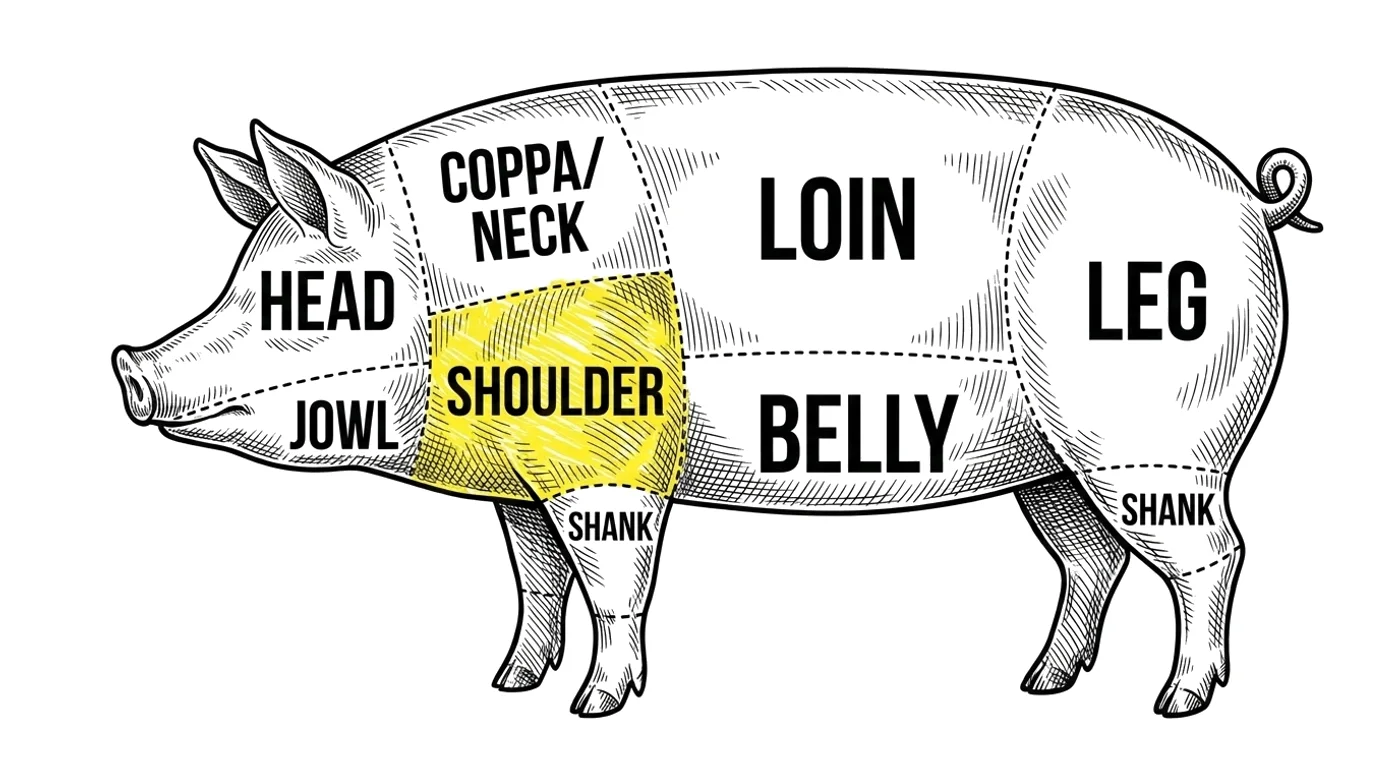
Identity and terminology
Krakowska means associated with Kraków; trwała means durable or keeping. Those words describe a historical product type, not the protected legal name. The EU Traditional Speciality Guaranteed is Kiełbasa krakowska sucha staropolska. A trwała sausage cannot use that complete reserved designation unless every registered compositional and process condition is met.
Composition and characteristics
Lean ham and shoulder dominate the cross-section. Smaller semi-fat pieces and firm back fat interrupt the dark cured mosaic, while finely comminuted beef and connective pork supply adhesion. White pepper, nutmeg and garlic are restrained. This architecture differs from fine German Krakauer and from a generic salami: the cut pork is visible, and the sausage is cooked before extended drying.
Production and process
The meat classes are cut separately and cured accurately, the binding fraction is fine-cut with a small amount of ice water, and the mass is stuffed into a broad casing. Hot smoke develops colour before poaching or baking. After rapid cooling, controlled secondary smoke and drying lower yield and water activity; neither weight loss nor firmness alone is an adequate release measurement.
History and regional forms
Kraków's name became a mark of quality across central European sausage markets, but Polish technical literature preserved several distinct Krakowska forms: cooked, baked, semi-dry and dry. Trwała reflects the branch designed to keep longer through additional smoke and moisture removal. It should therefore be recorded beside, not collapsed into, Krajana or the registered old-Polish dry speciality.
Use, storage and related products
Serve in firm slices with rye bread, mustard, horseradish or pickled vegetables. The broad slice should show large lean pieces rather than a fine emulsion. Home production should remain refrigerated unless a validated process proves ambient stability, even when the target weight and water activity have been reached. The exact TSG name and logo are outside this generic technical branch.
Recipe and cure
This is not a finished recipe. It is a window into how this meat is traditionally cured. Before you follow any process, run it through one of our curing calculators so the salt, cure and timings are right and safe for your own batch.
Make this — the measured Curesmith version →“Make this” opens the same cure as a measured recipe, scaled to your batch.
- Meat
- Pork ham and shoulder
- Cut
- Pork ham and shoulder
- Salt (%)
- 2.1
- Curing salt
- Cure #1 as specified in the recipe
- Fermented
- No
- Starter or mould
- None; this product is not fermented
- Smoked
- Yes
- Maturation
- Refrigerate at 0–4°C after drying; ambient storage requires process validation
- Basis
- per 1,000 g pork ham and shoulder
- Style
- cured smoked cooked and controlled-dried Polish Krakowska chub
Ingredients
- Pork ham and shoulder100% · 1000 g
- Semi-fat pork shoulder25% · 250 g
- Pork shoulder10% · 100 g
- Semi-fat beef chuck10% · 100 g
- Pork back fat15% · 150 g
- Ice water2.9% · 46 g
- Fine salt2% · 32.5 g
- Cure #1, 6.25% sodium nitrite0.24% · 4 g
- Ground white pepper0.19% · 3 g
- Ground nutmeg0.05% · 0.8 g
- Fresh garlic0.14% · 2.5 g
Method
- Cut and grind the chilled fractions, distribute salt and Cure #1 accurately, pack and cure 24–48 hours at 3–5°C.
- Fine-cut connective pork and beef with ice water, pepper, nutmeg and garlic until adhesive.
- Mix lean and semi-fat pork until tacky, then fold in fat and the fine bind.
- Fill the broad casing tightly, remove air and record stuffed reference weights.
- Dry the casing, hot-smoke at 45–55°C, then poach at 78–80°C until the cold point reaches 71°C.
- Shower briefly and complete controlled chilling before secondary smoking.
Safety. Cook before secondary drying, verify both yield and aw, keep chilled at home, and do not borrow the registered TSG name.