
Overview
Kiełbasa Kresowa is a coarse Polish matured-sausage family associated with the culinary memory of the Kresy, Poland's former eastern borderlands. A registered traditional form, Kiełbasa kresowa dojrzewająca, is linked to Kresowiacy communities resettled in Lubuskie.
Where it's from
The cut
Identity and terminology
Kresowa means borderlands-style. The name carries cultural and historical meaning rather than a single national standard. The Polish traditional-products register documents one specific matured form, but this status is not an EU geographical indication and should not be extended to every product sold under the name.
Composition and characteristics
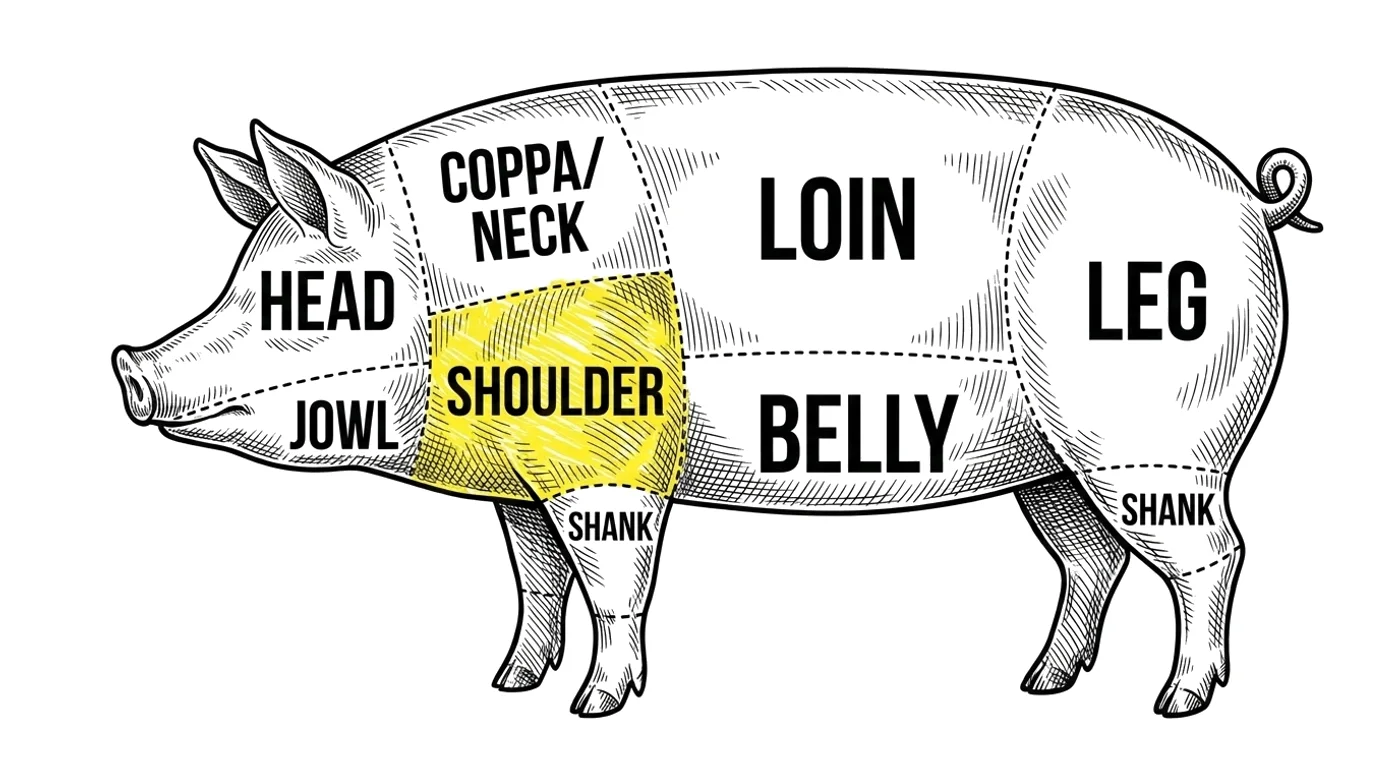
The registered form uses pork shoulder, ham, belly and jowl in a coarse structure. Its seasoning includes green pepper soaked in alcohol, paprika, garlic and sugar. The finished sausage is hard, dry and deeply coloured, with a pronounced matured aroma. Other commercial forms may use different spices or drying periods.
The balance of shoulder, ham, belly and jowl gives both firm lean structure and enough fat for long maturation. Alcohol-soaked green pepper is a distinctive registered feature, but it should remain tied to that specific traditional-product description rather than imposed on every Kresowa sausage.
Production and process
Meat and fat are cured, coarsely prepared, seasoned and stuffed into casing. The registered form records approximately one month of maturation. That historical description must be translated into controlled temperature, humidity, airflow and final water-activity criteria for any modern technical method.
History and regional forms
The product is connected with people displaced from the eastern borderlands after the Second World War who carried food traditions into western Poland. The Lubuskie registration preserves this community history. The family should therefore be described with attribution rather than reduced to a generic 'grassland sausage' mistranslation.
Cultural attribution matters because the sausage represents memory carried by displaced communities. A useful family article should therefore explain who preserved the product and where it was re-established, not only list ingredients.
Use, storage and related products
Kiełbasa Kresowa is sliced for bread, cold platters and festive service. Storage depends on the validated maturity and packaging of the actual product. The registered regional forms and ordinary commercial Kresowa sausages are related but not identical.
Recipe and cure
This is not a finished recipe. It is a window into how this meat is traditionally cured. Before you follow any process, run it through one of our curing calculators so the salt, cure and timings are right and safe for your own batch.
Make this — the measured Curesmith version →“Make this” opens the same cure as a measured recipe, scaled to your batch.
- Meat
- Pork shoulder
- Cut
- Pork shoulder
- Salt (%)
- 2.5
- Curing salt
- Cure #1/#2 as specified
- Fermented
- Yes
- Target pH
- 5.3 or lower
- Smoked
- Yes
- Basis
- per 1,000 g pork shoulder
- Style
- Fermented and dried Borderlands-style sausage; not a protected designation.
Ingredients
- Pork shoulder100% · 1000 g
- Lean beef40% · 400 g
- Pork back fat25% · 250 g
- Fine salt2.5% · 41.5 g
- Cure #2 containing 6.25% sodium nitrite0.24% · 4 g
- Dextrose0.41% · 6.5 g
- Black pepper0.3% · 5 g
- Garlic0.41% · 6.5 g
- Crushed juniper berries0.1% · 1.5 g
- Sweet paprika0.1% · 1.5 g
- Flora Italia LC or equivalent starter culture0.02% · 0.4 g
Safety. A one-month maturation description is not a universal safety process. Each formulation requires verified cure, fermentation or acidification control where used, drying conditions and a measured release endpoint. Traditional-product registration does not make every Kresowa sausage protected or shelf-stable.