
Kiełbasa Królewiecka Parzona
Also known as Krolewiecka, Królewiecka sausage
Poland
Overview
Kiełbasa królewiecka parzona is a Polish smoked and poached sausage combining a coarse semi-fat pork fraction with a fine matrix of beef, pork head meat, skin and lean trimmings. Whole mustard seed, pepper and garlic distinguish its seasoning. The broad casing and mixed particle structure produce a substantial slice rather than a fine frankfurter texture.
Where it's from
The cut
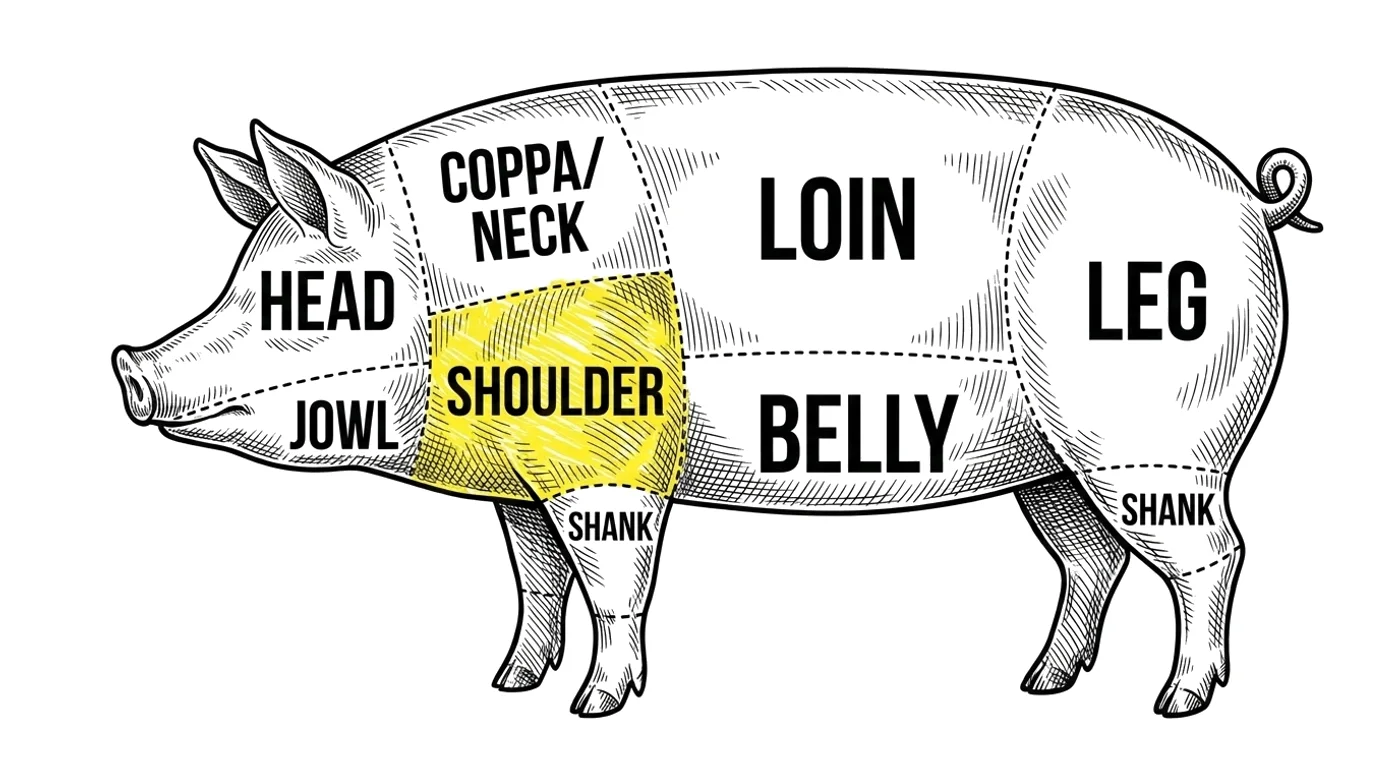
Identity and terminology
Królewiecka is an adjectival Polish name associated with królewski, royal, and historical place-name usage. The technical recipe corpus establishes the sausage form more securely than a single origin story, so the Atlas does not assign a protected town or invent a geographical designation. Parzona means scalded or poached and identifies the decisive heat-treatment branch.
Composition and characteristics
Semi-fat shoulder gives the visible meat and fat pieces. Beef and head meat strengthen flavour and protein bind, while softened pork skin contributes collagen and a resilient slice. Mustard seeds remain visible as small yellow points. This deliberate use of head and skin places the product within resourceful cooked-sausage practice without turning it into head cheese.
Production and process
The skin is tenderised, drained and chilled before fine grinding. Beef, head meat, skin and trimmings are fine-cut with water, cure and spices into an adhesive base, then coarse pork is folded through it. The chub is refrigerated, surface-dried, hot-smoked, poached until the centre reaches 74°C, then cooled quickly.
History and regional forms
Polish state and trade standards recorded a wide range of named sausages whose identities depended on meat class, comminution and heat treatment. Królewiecka belongs to that technical inheritance. Its identity is preserved through the particular coarse-and-fine construction and mustard seasoning, not through an unsupported claim that every modern sausage using a royal-sounding name follows one formula.
Use, storage and related products
Serve chilled in slices with bread, mustard, beetroot or pickled cucumber, or warm gently without boiling. Mustard is an allergen and must be declared. The product remains moist and cooked, so smoke and cure do not make it shelf stable. Keep at refrigerator temperature and distinguish it from liver sausage, head cheese and fine emulsified parówki.
Recipe and cure
This is not a finished recipe. It is a window into how this meat is traditionally cured. Before you follow any process, run it through one of our curing calculators so the salt, cure and timings are right and safe for your own batch.
Make this — the measured Curesmith version →“Make this” opens the same cure as a measured recipe, scaled to your batch.
- Meat
- Semi-fat pork shoulder
- Cut
- Semi-fat pork shoulder
- Salt (%)
- 1.8
- Curing salt
- Cure #1 as specified in the recipe
- Fermented
- No
- Starter or mould
- None; this product is not fermented
- Smoked
- Yes
- Maturation
- Refrigerate at 0–4°C; use within 4 days or freeze promptly
- Basis
- per 1,000 g semi-fat pork shoulder
- Style
- cured smoked and cooked Polish coarse-and-fine sausage
Ingredients
- Semi-fat pork shoulder100% · 1000 g
- Beef chuck50% · 500 g
- Trimmed pork head meat50% · 500 g
- Cooked drained pork skin25% · 250 g
- Pork25% · 250 g
- Ice water12% · 300 g
- Fine salt1.8% · 45 g
- Cure #1, 6.25% sodium nitrite0.24% · 6 g
- Ground black pepper0.1% · 2.5 g
- Whole yellow mustard seed0.15% · 4 g
- Fresh garlic0.15% · 4 g
Method
- Poach cleaned pork skin until tender, drain thoroughly, chill and weigh the cooked amount.
- Chill all remaining meats, grind semi-fat pork through 12 mm and the fine fractions through 3 mm.
- Fine-cut beef, head meat, skin and trimmings with ice water, salt, Cure #1, pepper, mustard and garlic until cohesive.
- Fold the 12 mm pork into the fine matrix without losing the coarse pieces.
- Fill the broad casing tightly and refrigerate 8–12 hours.
- Dry the casing and hot-smoke near 55°C until evenly brown.
Safety. Tenderise and weigh skin accurately, declare mustard, cook the cold point to 71°C and refrigerate.