
Kiełbasa Limanowska
Also known as Limanowska, Limanowa sausage
Lesser Poland, Poland
Overview
Kiełbasa limanowska is an archival Polish sausage associated with Limanowa in the mountain country of southern Lesser Poland. Its defining feature is a very high proportion of lean veal, supported by a smaller semi-fat veal fraction, a little pork connective meat for bind and a small quantity of firm pork fat. Smoking and baking create a pale, delicate but firmly sliceable chub.
Where it's from
The cut
Identity and terminology
Limanowska is the feminine adjective derived from Limanowa. The name establishes regional association in Polish technical literature but is not treated here as proof of a current geographical indication. The controlled title stays with the documented veal-dominant construction; it should not be applied loosely to any sausage made or sold near Limanowa.
Composition and characteristics
Large lean-veal pieces dominate the cross-section, while medium-ground semi-fat veal and fat interrupt the pale mosaic. A finely worked connective-pork fraction supplies adhesion with very little added water. Pepper and coriander are deliberately restrained. Compared with pork-heavy Krakowska, the colour is lighter, the flavour gentler and the fat pattern more limited.
Production and process
Each meat class is chilled and reduced separately. Connective pork becomes a fine adhesive matrix with water, cure and seasoning, while the veal retains a recognisable coarse structure. After tight stuffing and refrigerated curing, the broad casing is dried, hot-smoked and baked until the cold point reaches 71°C before controlled chilling.
History and regional forms
The sausage reflects an era when Polish standards described products through exact meat classes and processing sequences. Veal was not a token label ingredient but the principal raw material. That composition distinguishes Limanowska from modern mixed sausages that borrow regional-sounding names while relying mostly on pork, poultry or fine emulsion.
Use, storage and related products
Serve in thin or medium slices with bread, mild mustard, horseradish or pickled vegetables. The mild veal and coriander profile suits a cold table without aggressive accompaniments. The cooked sausage remains perishable and refrigerated. Optional brief drying can firm the texture, but it does not establish room-temperature stability without a validated release system.
Recipe and cure
This is not a finished recipe. It is a window into how this meat is traditionally cured. Before you follow any process, run it through one of our curing calculators so the salt, cure and timings are right and safe for your own batch.
Make this — the measured Curesmith version →“Make this” opens the same cure as a measured recipe, scaled to your batch.
- Meat
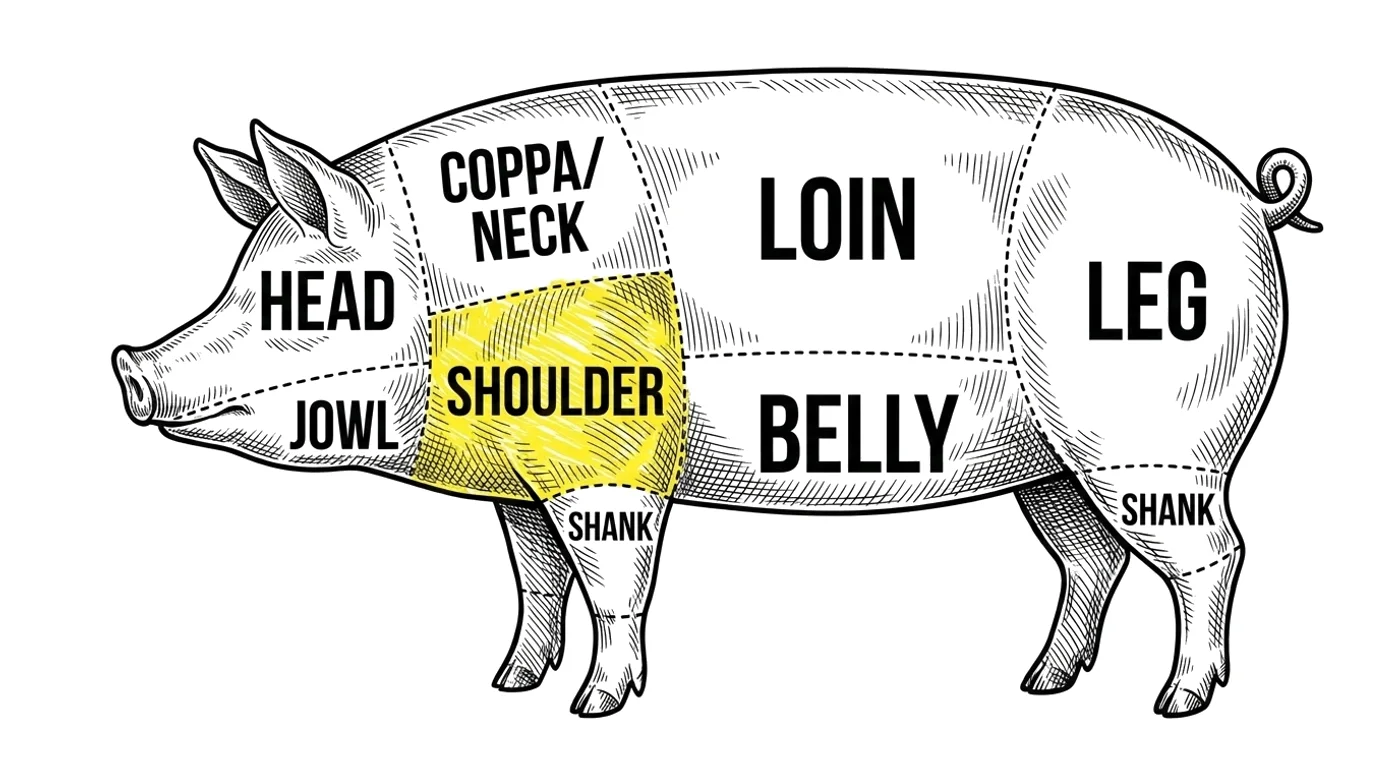
- Veal leg and shoulder
- Cut
- Veal leg and shoulder
- Salt (%)
- 2
- Curing salt
- Cure #1 as specified in the recipe
- Fermented
- No
- Starter or mould
- None; this product is not fermented
- Smoked
- Yes
- Maturation
- Refrigerate at 0–4°C; use within 4 days or freeze promptly
- Basis
- per 1,000 g veal leg and shoulder
- Style
- cured smoked and baked Polish veal-dominant sausage
Ingredients
- Veal leg and shoulder100% · 1000 g
- Semi-fat veal shoulder15% · 150 g
- Pork shoulder5% · 50 g
- Pork back fat5% · 50 g
- Ice water1.5% · 19 g
- Fine salt2% · 25 g
- Cure #1, 6.25% sodium nitrite0.25% · 3 g
- Ground black pepper0.2% · 2.5 g
- Ground coriander0.05% · 0.6 g
Method
- Separate the four animal fractions and chill to 0–2°C.
- Retain large lean-veal pieces, grind semi-fat veal and fat through 8 mm, and connective pork through 3 mm.
- Fine-cut connective pork with ice water, salt, cure, pepper and coriander until adhesive.
- Work the lean and semi-fat veal until tacky, then fold in fat and fine bind.
- Fill the broad casing tightly, remove air and refrigerate 8–12 hours.
- Dry the casing and hot-smoke until a light brown surface develops.
Safety. Preserve the veal-dominant composition, keep the fine bind cold, cook to 71°C and refrigerate; make no unsupported protection claim.