
Kiełbasa Lisiecka
Also known as Lisiecka, Liszki sausage
Lesser Poland, Poland
Overview
Kiełbasa lisiecka is Poland's protected coarse pork sausage from the neighbouring municipalities of Liszki and Czernichów near Kraków. It is made overwhelmingly from high-quality ham meat, with only small supporting semi-fat and connective fractions. The sausage is formed as a broad ring, closed with a wooden pick, smoked and cooked in the smoking chamber.
Where it's from
The cut
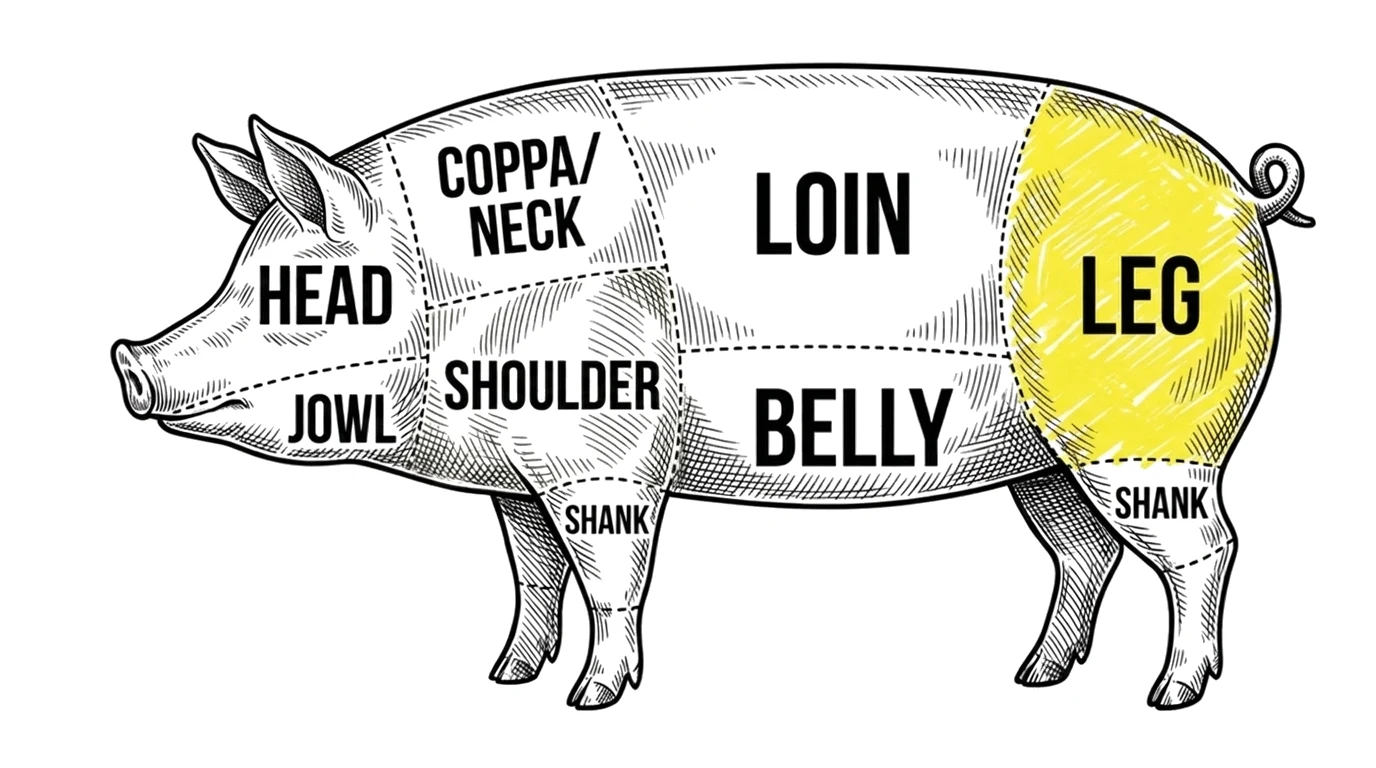
Identity and terminology
The name links the product to Liszki and the surrounding production tradition. European PGI protection reserves Kiełbasa lisiecka for compliant, controlled production in the defined geographical area. A home formula can explain and imitate the published composition, cut and shape, but it cannot carry certification or imply that geographical origin has been verified.
Composition and characteristics
Large cured ham pieces create the characteristic cut face and firm bite. Smaller semi-fat pork supplies succulence, while a very small fine connective fraction binds the mosaic. White pepper and garlic are the principal seasonings. The surface becomes dark brown through direct wood-fired smoking, and the interior remains visibly lean rather than finely emulsified.
Production and process
Production depends on accurate classification and separate handling of the pork fractions. The ham is left in large pieces, the semi-fat portion is moderately ground, and the connective portion is reduced finely with garlic. After cold curing and mixing, the mass is stuffed into a broad casing, made into a ring, pinned, dried, smoked and baked before chilling.
History and regional forms
The Liszki area developed a reputation for butcher craft and supply to Kraków. The official specification treats that local knowledge, the selected ham-rich raw material and the traditional smokehouse process as connected elements of reputation. The PGI therefore protects more than a recipe name: it protects the relationship between place, producers, raw-material discipline and recognised product character.
Use, storage and related products
Cut into substantial slices and serve with rye bread, mustard, horseradish or pickled cucumber. A genuine slice should show large lean pork pieces rather than a homogeneous paste. Keep home production refrigerated. Reserve the protected name and PGI logo for authorised product, and distinguish it from Krakowska, whose shape, meat structure and legal identity are different.
Recipe and cure
This is not a finished recipe. It is a window into how this meat is traditionally cured. Before you follow any process, run it through one of our curing calculators so the salt, cure and timings are right and safe for your own batch.
- Meat
- Pork ham from leg
- Cut
- Pork ham from leg
- Salt (%)
- 1.5
- Curing salt
- Cure #1 as specified in the recipe
- Fermented
- No
- Starter or mould
- None; this product is not fermented
- Smoked
- Yes
- Maturation
- Refrigerate at 0–4°C; use within 4 days or freeze promptly
- Basis
- per 1,000 g pork ham from leg
- Style
- Polish PGI-style cured smoked and baked coarse pork ring
Ingredients
- Pork ham from leg100% · 1000 g
- Semi-fat pork leg and shoulder10% · 100 g
- Pork hock and shin5% · 50 g
- Ice water4.1% · 47 g
- Fine salt1.5% · 17.5 g
- Cure #1, 6.25% sodium nitrite0.22% · 2.5 g
- Ground white pepper0.3% · 3.5 g
- Fresh garlic0.41% · 4.5 g
Method
- Use pork only and preserve the high lean-ham proportion, large particles and ring form described by the PGI specification.
- Combine salt and Cure #1, calculate each meat class's share by weight, and record the allocation.
- Pack each pork class separately and cure 48–72 hours at 3–5°C.
- Leave lean ham in large pieces, grind semi-fat pork through 10 mm and connective pork twice through 3 mm with garlic; mix with water and pepper until tacky.
- Fill the casing firmly, form a ring and close its ends with a wooden pick.
- Dry the surface and apply clean smoke from alder, beech or fruit wood until deep brown.
Safety. Follow the official pork-only composition and ring form, correct cure arithmetic, cook and chill measurably, and reserve the PGI claim for certified production.