
Kiełbasa Litewska
Also known as Lithuanian Sausage, Polish style, Polish Lithuanian sausage
Poland
Overview
Kiełbasa litewska is a Polish technical sausage whose name means Lithuanian sausage. The documented branch combines semi-fat pork, beef and firm pork fat with a fine binding fraction made from edible heart, tongue and head meat. It is stuffed as paired links, hot-smoked, cooked and refrigerated, with an optional historical light-drying stage.
Where it's from
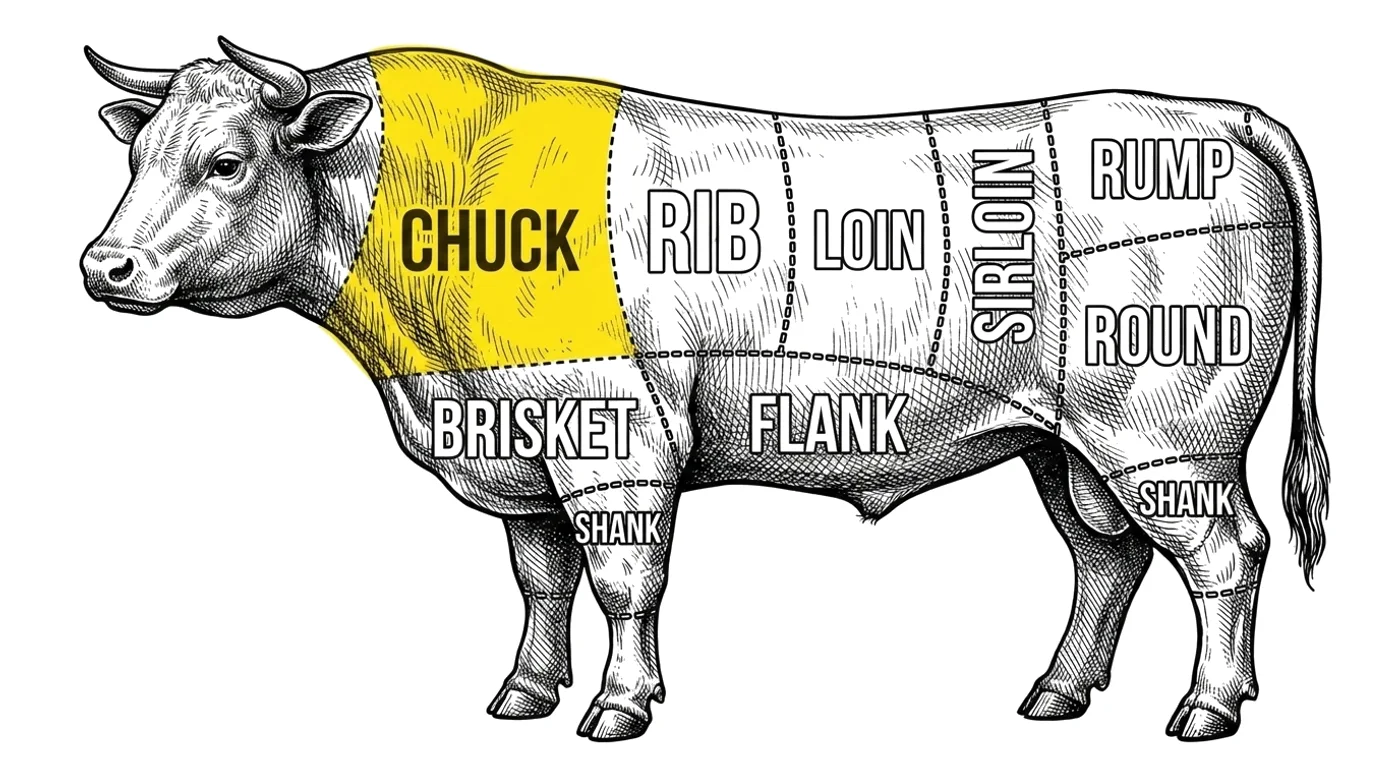
The cut
Identity and terminology
The adjective litewska means Lithuanian in Polish, but the source explicitly calls this the Polish version. That qualification matters. The Atlas does not treat the name as a translation of every Lithuanian dešra, nor merge it with the different fine-textured Lietuviška formula. It is also unrelated to the matured stomach- or bladder-stuffed speciality Lietuviškas skilandis.
Composition and characteristics
Coarse pork and firm fat remain visible within a finer beef-and-offal matrix. Heart contributes dark meat flavour, tongue adds a dense resilient bite and head meat supplies collagen-rich binding character. Pepper, paprika, allspice and garlic form the aromatic profile. The mixed structure is deliberate and should not become either a smooth frankfurter or a loose offal pudding.
Production and process
The edible offal must be inspected, trimmed and weighed as named ingredients rather than hidden under a vague trimmings category. Beef, heart, tongue and head meat are fine-cut with water, cure and spices; coarser pork and fat are folded through. Paired links are cold-cured, surface-dried, smoked, cooked until the centre reaches 74°C and chilled rapidly.
History and regional forms
Polish state standards documented Kiełbasa litewska in the mid-twentieth century, preserving a specific economical but technically controlled use of multiple meat fractions. The name also reflects long culinary contact across the Polish-Lithuanian region. That history does not justify inventing a single cross-border original; the recorded Polish formula is the safest controlling identity.
Use, storage and related products
Serve warm with potatoes or cabbage, or chilled with bread, mustard and pickles. Heart and tongue are used, and they are worth naming plainly even where local law simply groups them as edible offal. Refrigerate the cooked links. A short dry changes texture but does not make them shelf stable without validated water-activity and process controls.
Recipe and cure
This is not a finished recipe. It is a window into how this meat is traditionally cured. Before you follow any process, run it through one of our curing calculators so the salt, cure and timings are right and safe for your own batch.
Make this — the measured Curesmith version →“Make this” opens the same cure as a measured recipe, scaled to your batch.
- Meat
- Semi-fat beef chuck
- Cut
- Semi-fat beef chuck
- Salt (%)
- 2
- Curing salt
- Cure #1 as specified in the recipe
- Fermented
- No
- Starter or mould
- None; this product is not fermented
- Smoked
- Yes
- Maturation
- Refrigerate at 0–4°C; use within 4 days or freeze promptly
- Basis
- per 1,000 g semi-fat beef chuck
- Style
- cured smoked and cooked Polish coarse-and-fine sausage
Ingredients
- Semi-fat pork shoulder65% · 650 g
- Semi-fat beef chuck100% · 1000 g
- Pork back fat65% · 650 g
- Trimmed beef heart35% · 350 g
- Trimmed pork tongue35% · 350 g
- Pork head meat35% · 350 g
- Ice water11.9% · 400 g
- Fine salt2% · 66.5 g
- Cure #1, 6.25% sodium nitrite0.25% · 8.5 g
- Ground black pepper0.1% · 3.5 g
- Sweet paprika0.1% · 3.5 g
- Ground allspice0.05% · 1.5 g
- Fresh garlic0.3% · 10 g
Method
- Trim glands, vessels, gristle and external tongue skin as appropriate; weigh the clean raw heart, tongue and head-meat fractions.
- Chill every fraction to 0–2°C; grind pork and fat through 8 mm and fine fractions through 3 mm.
- Fine-cut beef, heart, tongue and head meat with ice water, salt, cure, pepper, paprika, allspice and garlic until cohesive.
- Fold coarse pork and fat into the fine matrix, fill hog casing and make paired links.
- Refrigerate the links for 8–12 hours.
- Dry the casing and hot-smoke at 55–60°C until light brown.
Safety. Use named inspected offal, keep fractions cold, cook to 71°C, chill rapidly and maintain the boundary from Lithuanian Lietuviška and skilandis.