
Kiełbasa Lubuska
Also known as Lubuska, Lubusz sausage
Lubusz, Poland
Overview
Kiełbasa lubuska is a Polish smoked and cooked sausage built from two pork classes and a finer lean-beef fraction. Medium-ground pork supplies the visible grain and fat balance, while beef contributes colour and protein bind. Garlic, marjoram and black pepper give a recognisably Polish aromatic profile. The usual form is a medium hog-casing ring or coil with a brown smoked surface and a resilient, sliceable interior.
Where it's from
The cut
Identity and terminology
Lubuska is the feminine adjective derived from Lubusz, the western Polish region centred on Zielona Góra and Gorzów Wielkopolski. The name records regional association in technical sausage literature, but the batch found no current EU protected designation for this particular product. It should therefore remain a documented regional and archival identity, not be advertised as a certified geographical indication or collapsed into every sausage made in Lubusz.
Composition and characteristics
The cut face should show an even medium pork grain held by a smaller fine beef matrix. Semi-fat pork provides succulence without creating separate hard-fat cubes. The flavour is savoury and gently smoky, with garlic and rubbed marjoram more evident than sweet spice. A well-made ring is cohesive without being emulsified, and its casing is dry and evenly coloured rather than wrinkled from uncontrolled cooling.
Production and process
Production treats the lean pork, semi-fat pork and beef as distinct fractions. The beef is ground finely and mixed first with salt and nitrite cure to develop adhesion; the pork is incorporated after medium grinding. Stuffed rings are cured under refrigeration, dried at the casing surface, hot-smoked, cooked until the centre reaches 71°C and chilled rapidly. That controlled sequence replaces warm room holds and broad, poorly defined smokehouse temperature ranges.
History and regional forms
Polish post-war meat standards described many sausages through exact raw-material classes, plate sizes, casing forms and heat treatments. Lubuska belongs to that disciplined vocabulary. Its modern value is not an invented ancient legend but a recoverable technical identity in which the regional name, mixed pork-and-beef composition and cooked-smoked ring format travel together. Related Polish sausages may share ingredients while differing in structure and legal status.
Use, storage and related products
Serve Lubuska warm with mustard, cabbage or potatoes, or cold with rye bread and pickled cucumber. Keep the cooked sausage refrigerated and protect cut surfaces from contamination. It is distinct from fresh white kiełbasa because it is cured and smoked, and from dry Krakowska because it is a moist cooked ring rather than a broad dried chub with a cut-meat mosaic.
Recipe and cure
This is not a finished recipe. It is a window into how this meat is traditionally cured. Before you follow any process, run it through one of our curing calculators so the salt, cure and timings are right and safe for your own batch.
Make this — the measured Curesmith version →“Make this” opens the same cure as a measured recipe, scaled to your batch.
- Meat
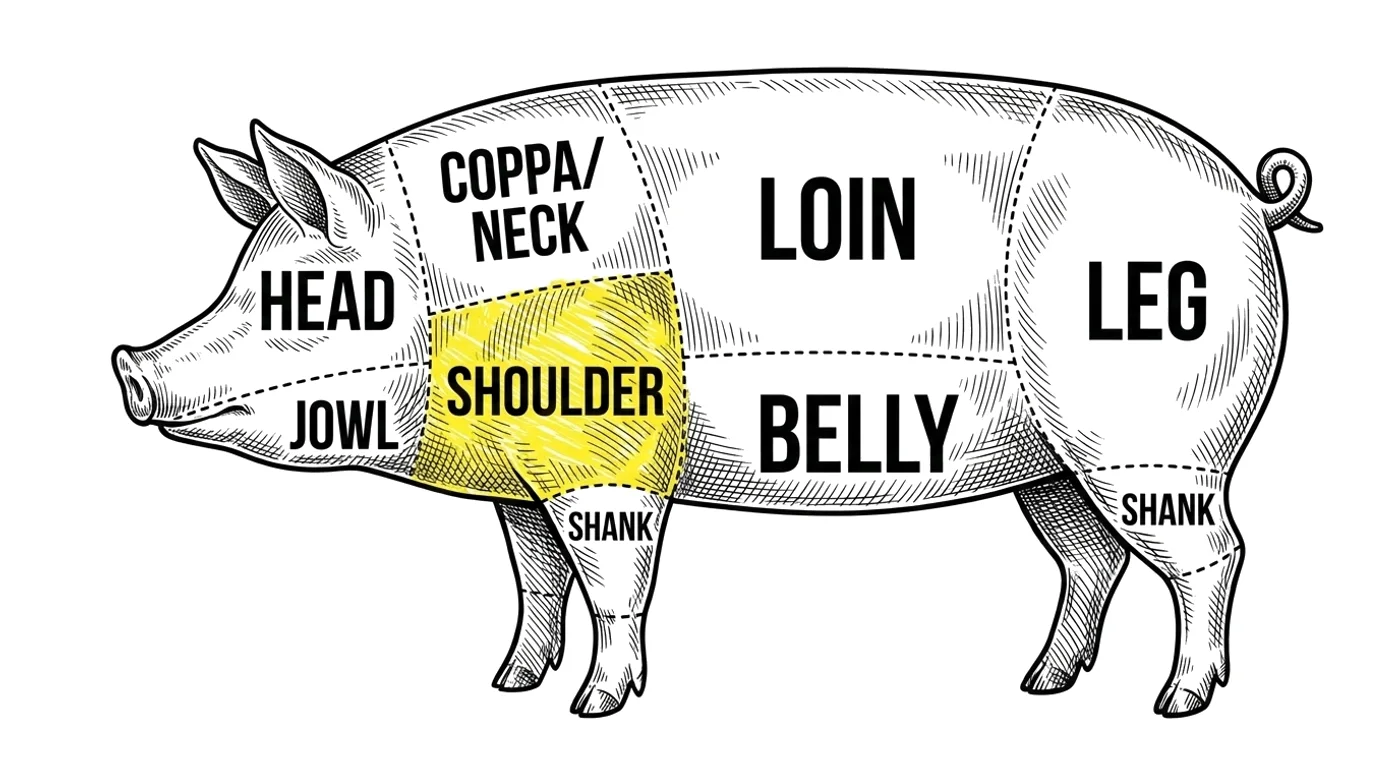
- Semi-fat pork shoulder
- Cut
- Semi-fat pork shoulder
- Salt (%)
- 1.8
- Curing salt
- Cure #1 as specified in the recipe
- Fermented
- No
- Starter or mould
- None; this product is not fermented
- Smoked
- Yes
- Maturation
- Refrigerate at 0–4°C; use within 4 days or freeze promptly
- Basis
- per 1,000 g semi-fat pork shoulder
- Style
- cured smoked and cooked Polish pork-and-beef rings
Ingredients
- Pork ham60% · 600 g
- Semi-fat pork shoulder100% · 1000 g
- Beef chuck40% · 400 g
- Fine salt1.8% · 36 g
- Cure #1, 6.25% sodium nitrite0.25% · 5 g
- Ground black pepper0.15% · 3 g
- Dried marjoram, rubbed0.05% · 1 g
- White sugar0.1% · 2 g
- Fresh garlic, finely grated0.15% · 3 g
Method
- Separate the lean pork, semi-fat pork and beef; chill all fractions and equipment to 0–2°C.
- Grind pork through 8 mm and beef through 3 mm.
- Mix beef with salt, Cure #1 and seasonings until strongly adhesive, then add both pork fractions.
- Fill hog casing firmly, remove air and form rings or a linked coil.
- Refrigerate the stuffed sausage for 8–12 hours at 3–5°C.
- Dry the casing, then hot-smoke near 55–60°C until evenly brown.
Safety. Use measured cure, maintain cold extraction, cook the cold point to 71°C, chill rapidly and make no unsupported protection claim.