
Overview
Kiełbasa Myśliwska is a Polish hunter-style sausage family characterised by a firm bite, smoked aroma and relatively portable form. It is commonly made as short links or pairs and eaten cold after manufacture. The family includes ordinary commercial and regional products as well as the reserved Kiełbasa myśliwska staropolska TSG.
Where it's from
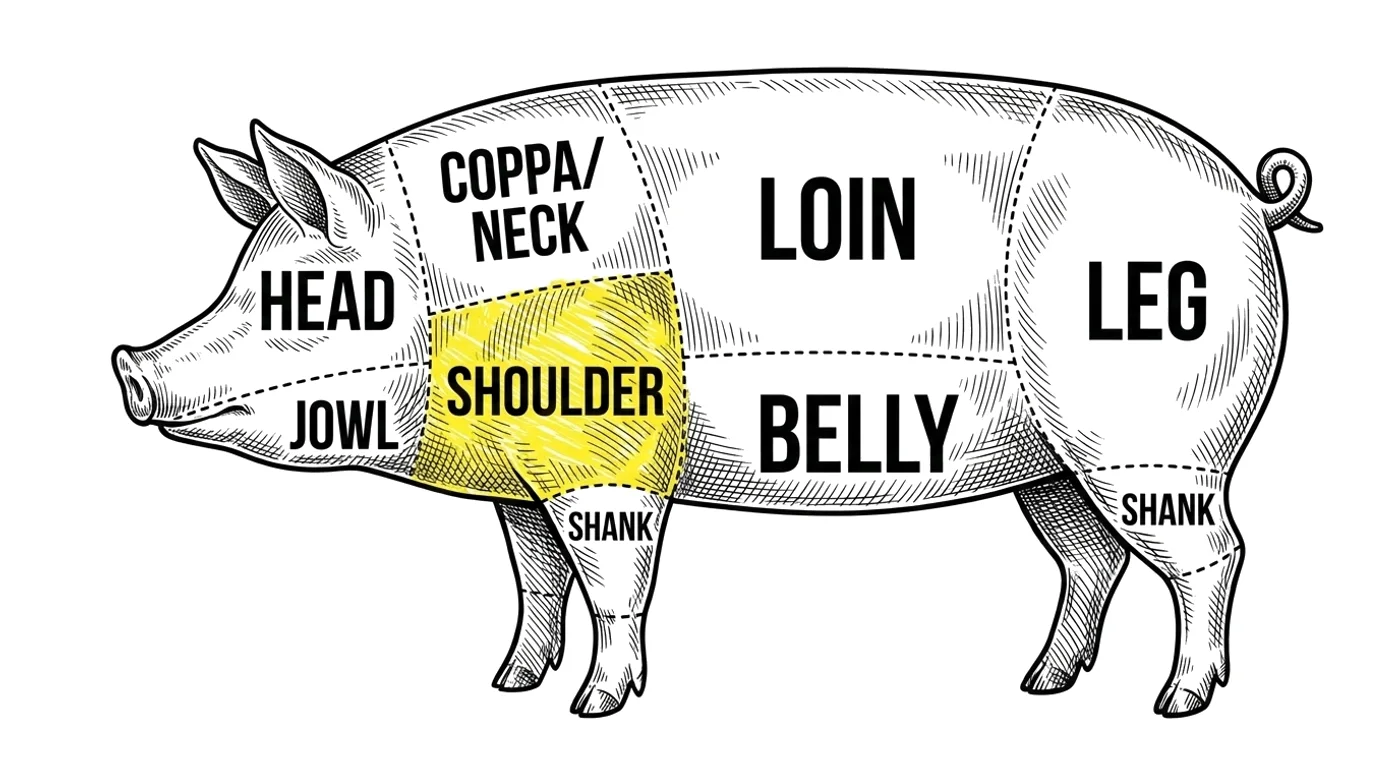
The cut
Identity and terminology
Myśliwska means hunter's sausage, but the name does not imply game meat. The reserved TSG child uses the complete name Kiełbasa myśliwska staropolska and follows a defined traditional specification. Generic myśliwska products may differ in meat quality, seasoning, drying and heat treatment and may not borrow the reserved wording or process claims.
Composition and characteristics
The sausage is usually pork-led, with coarse lean meat and visible fat. The reserved form has minimum protein and maximum moisture and fat limits that support a firm, meaty texture. Pepper, garlic and other restrained spices are common. The finished surface is smoked and dry, while the interior remains cohesive rather than brittle.
Production and process
A typical route includes curing, coarse comminution, stuffing, smoking and a heating or baking step. The TSG specification includes traditional hot smoking, an internal temperature of at least 70°C and a subsequent tenderising treatment. Generic products may use different equipment or timings, so the actual cure, lethality, cooling, conditioning and final moisture status must be stated.
History and regional forms
Portable smoked sausages suited travel, hunting and rural work. Myśliwska became a recognisable Polish style and later a major commercial category. The TSG registration protects the traditional staropolska method without converting every hunter-style sausage into the reserved product. Regional and industrial versions therefore remain legitimate but separate.
Use, storage and related products
Kiełbasa Myśliwska is sliced for snacks, sandwiches and cold platters and is often served with bread, mustard or pickles. Storage depends on the verified moisture, water activity and packaging. Related entries include Kiełbasa Jałowcowa, Kabanosy and Landjäger, but their spice, calibre and process identities differ.
Recipe and cure
This is not a finished recipe. It is a window into how this meat is traditionally cured. Before you follow any process, run it through one of our curing calculators so the salt, cure and timings are right and safe for your own batch.
Make this — the measured Curesmith version →“Make this” opens the same cure as a measured recipe, scaled to your batch.
- Meat
- Pork shoulder
- Cut
- Pork shoulder
- Salt (%)
- 1.8
- Curing salt
- Cure #1/#2 as specified
- Fermented
- No
- Smoked
- Yes
- Basis
- per 1,000 g pork shoulder
- Style
- Generic hot-smoked and cooked hunter-sausage branch; not Kiełbasa myśliwska staropolska TSG.
Ingredients
- Pork shoulder100% · 1000 g
- Lean beef30% · 300 g
- Pork back fat15% · 150 g
- Fine salt1.8% · 25.5 g
- Cure #1 containing 6.25% sodium nitrite0.25% · 3.5 g
- Black pepper0.25% · 3.5 g
- Garlic0.3% · 4.5 g
- Crushed juniper berries0.14% · 2 g
- Ground coriander0.1% · 1.5 g
- Dextrose0.2% · 3 g
- Ice-cold water7.9% · 114.5 g
Safety. The hunter-style name does not establish a validated process. Generic products require correct cure calculation, a measured lethality step where used, controlled cooling and drying, and a verified storage classification. Only specification-compliant product may use the reserved Kiełbasa myśliwska staropolska name.