
Kiełbasa Myśliwska Staropolska
Also known as Kiełbasa myśliwska, Mysliwska, Old Polish hunter sausage
Poland
Overview
Kiełbasa Myśliwska Staropolska is a short, dark-brown Polish sausage sold in curved paired links with an evenly wrinkled dry surface. Its slice shows larger dark-red pieces of lean pork and smaller lighter pieces of fattier pork held by a fine connective-meat bind. Juniper, black pepper and fresh garlic support the taste of cured, smoked and baked pork. The finished sausage is tender and crumbly rather than rubbery.
Where it's from
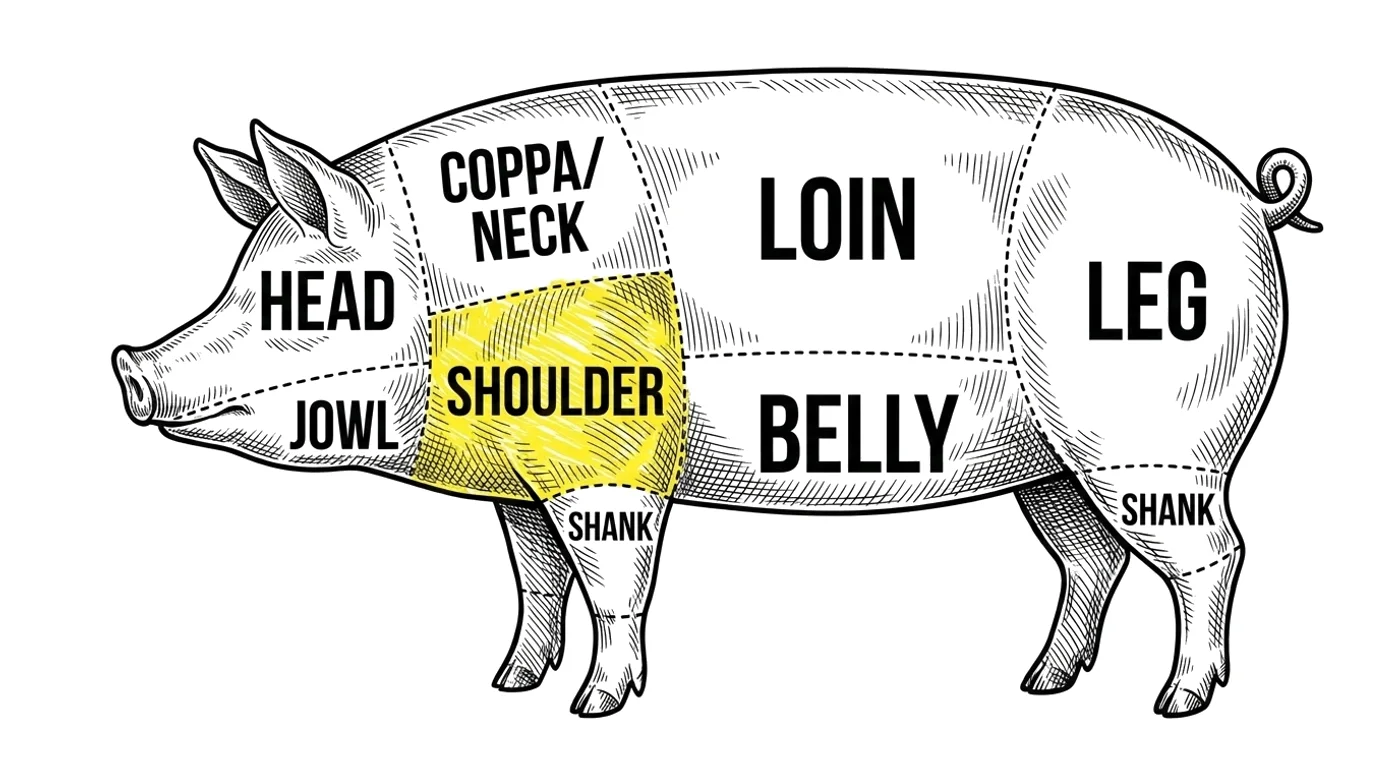
The cut
Identity and terminology
Myśliwska derives from myśliwy, hunter, and myślistwo, hunting. The official specification explains the name through the sausage's earlier role as compact dry provisions carried on hunts, journeys and longer stays away from hot food. Staropolska means Old Polish and marks the traditional character of the registered form. The exact full name is reserved as a Traditional Speciality Guaranteed, while the unqualified market term hunter sausage is much broader.
Composition and characteristics
The protected architecture uses three pork classes: lean non-sinewy meat for the largest pieces, medium-fat non-sinewy pork for the intermediate grain and more connective pork for the fine binding fraction. Part of the latter two classes may be replaced with beef within the specification. Pepper, crushed juniper, garlic and sugar are defining seasonings. Natural hog casing above ordinary breakfast-sausage calibre gives the short paired links their substantial shape.
Production and process
The classes are cured separately, ground to different sizes and recombined with a fine-cut binding fraction. A vinegar, water and vegetable-oil mixture contributes the characteristic tender bite. The links are set, surface-dried, warm-smoked, cooked and then dried for several days to a controlled yield. For home production, weight loss cannot stand alone: the cooked sausage also needs a measured water-activity gate before refrigerated release.
History and regional forms
Polish technical records document myśliwska among the country's semi-durable sausages in the 1960s. The European Union entered the reserved full name in the TSG register in 2017, based on the published traditional specification. Poland published a further specification notice in 2026 under the newer geographical-indications framework. That notice retains the hunting etymology, three-class meat structure, juniper seasoning and sequence of curing, smoking, cooking and drying.
Use, storage and related products
Eat it sliced as travel food, on a cold board, with rye bread, pickled cucumber, mustard or beer. The dense texture and juniper make small portions more appropriate than thick luncheon-meat slices. Keep a home-made version refrigerated even after drying. Do not equate the product with German Jagdwurst, Italian cacciatore salami or a generic wild-game sausage. The TSG identity concerns a defined Polish pork sausage, not whatever meat a hunter happens to carry.
Recipe and cure
This is not a finished recipe. It is a window into how this meat is traditionally cured. Before you follow any process, run it through one of our curing calculators so the salt, cure and timings are right and safe for your own batch.
Make this — the measured Curesmith version →“Make this” opens the same cure as a measured recipe, scaled to your batch.
- Meat
- Pork shoulder
- Cut
- Pork shoulder
- Salt (%)
- 1.8
- Curing salt
- Cure #1 as specified in the recipe
- Fermented
- No
- Starter or mould
- None; this product is not fermented
- Smoked
- Yes
- Maturation
- Refrigerate at 0–4°C after verified drying; use within 4 days after opening or freeze
- Basis
- per 1,000 g pork shoulder
- Style
- home-scale Polish smoked, cooked and dried hunter sausage aligned with the reserved TSG architecture
Ingredients
- Pork ham60% · 600 g
- Pork shoulder100% · 1000 g
- Pork shank40% · 400 g
- Fine salt1.7% · 35 g
- Cure #1, 6.25% sodium nitrite0.25% · 5 g
- Crushed ice2% · 40 g
- Ground black pepper0.15% · 3 g
- Crushed juniper berry0.1% · 2 g
- Fresh garlic, finely crushed0.1% · 2 g
- Sugar0.2% · 4 g
- Food vinegar, 10% acidity0.99% · 20 g
- Cold water for tenderising mixture0.99% · 20 g
- Rapeseed or sunflower oil2% · 20 g
Method
- Trim and weigh the three cuts separately; cut to pieces no larger than 5 cm.
- Mix each cut with its proportional share of salt and Cure #1 and refrigerate for at least 48 hours.
- Grind the ham to about 20 mm, the shoulder to 8 mm and the shank to 3 mm; fine-cut the shank with crushed ice.
- Whisk vinegar, water and oil, mix it through the two coarser cuts, then combine with the fine bind and seasonings.
- Fill natural hog casing above 32 mm and form paired curved links about 15 cm long.
- Set under controlled warm conditions for no longer than two hours, then dry the casing surface fully.
Safety. Follow the registered meat classes and process, measure cure, cook before drying, verify water activity, refrigerate the home branch and reserve the TSG name and logo for certified product.